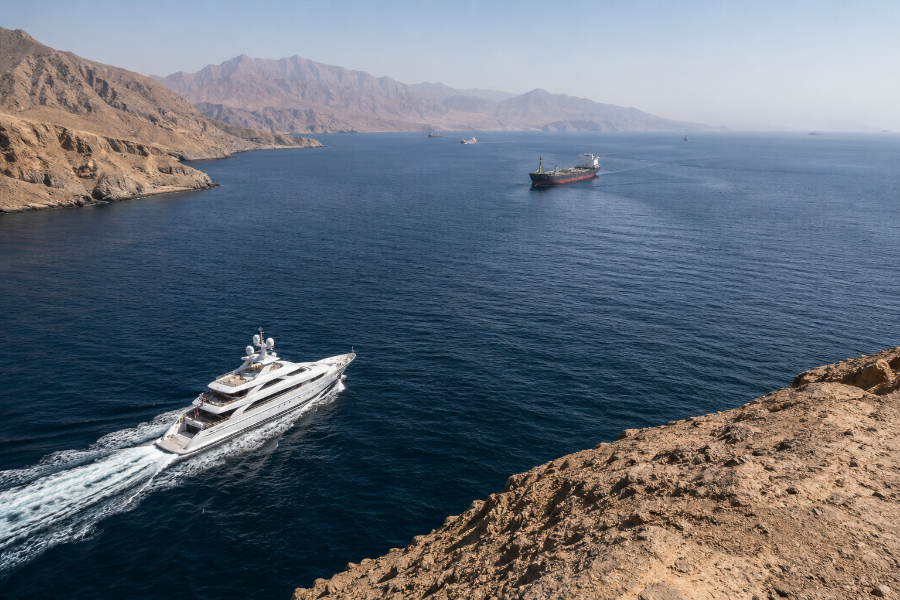
Marine insurers now play a decisive role in shaping luxury yacht routes through the Middle East. In 2026, they have significantly tightened underwriting conditions for the Strait of Hormuz Yacht Transit corridor, as they respond to heightened exposure models and reinsurance constraints.
As a result, war-risk premiums have risen across multiple underwriting markets, particularly for vessels that plan repeated Gulf transits. In some cases, insurers now require explicit pre-clearance before passage and impose strict time-window limitations for transit approval.
Consequently, several insurance-driven constraints are now shaping operations:
- War-risk insurance premiums for Gulf navigation continue to rise
- Insurers impose partial or full exclusion zones for specific maritime corridors
- Underwriting approval for high-value superyacht movements often experiences delays
- Insurers apply increased liability scrutiny on captains and owners
- Crew welfare and evacuation planning requirements have become more stringent
In addition, insurers place growing emphasis on proactive risk mitigation strategies. For example, they now require yachts to adopt dynamic routing systems and maintain continuous communication with maritime security consultants.
Therefore, insurance no longer functions as a passive cost factor. Instead, it acts as an active operational gatekeeper in Strait of Hormuz Yacht Transit decisions.
How Yacht Owners Are Changing Middle East Cruising Plans?
As risk awareness increases, yacht owners are actively rethinking Middle Eastern itineraries. In particular, they increasingly bypass the Strait of Hormuz Yacht Transit route in favor of lower-risk alternatives, even when those alternatives add time or fuel costs.
Accordingly, common strategic shifts include:
- Owners reroute voyages around the Arabian Peninsula instead of entering the Gulf directly
- They delay Gulf cruising schedules during peak tension periods
- Many substitute Mediterranean itineraries for Middle East routes
- Operators hire private maritime security consultants for voyage planning
- Owners reduce time spent in high-risk maritime zones
Meanwhile, charter operators are adapting their offerings. Some luxury yacht charter programs have revised Gulf itineraries, either limiting exposure to the Strait entirely or requiring explicit client acknowledgment of associated risks.
At the same time, crew management has become more complex. Increasingly, experienced maritime personnel request clear security protocols before they agree to Gulf-region deployments.
Limitations of Naval Escorts and Security Protection
Although naval presence in and around the Strait of Hormuz provides a stabilizing influence, it does not guarantee full protection for private yachts. Naval assets primarily safeguard commercial shipping lanes and deter large-scale disruptions, rather than escort individual luxury vessels.
However, several operational limitations remain:
- Naval forces struggle to provide vessel-specific escort coverage for yachts
- They prioritize commercial shipping over leisure craft protection
- Communication delays occur in dynamic threat environments
- Narrow maritime corridors restrict maneuverability
- Forces face limits when responding to simultaneous multi-vessel incidents
Additionally, yachts operate with different visibility and behavioral patterns compared to cargo ships. As a result, naval systems integrate them less efficiently into standardized protection frameworks.
Therefore, reliance on naval escort alone does not provide sufficient risk mitigation for Strait of Hormuz Yacht Transit planning.
Strait of Hormuz Transit vs Alternative Yacht Routes
| Route Option |
Security Risk |
Insurance Cost |
Operational Complexity |
Fuel Cost |
Owner Confidence |
| Strait of Hormuz Transit |
High |
Very High |
Medium |
Low |
Low–Moderate |
| Arabian Peninsula Circumnavigation |
Low–Medium |
Moderate |
High |
High |
High |
| Mediterranean–Red Sea Route |
Moderate |
Moderate |
Medium |
Medium |
Moderate–High |
| Gulf Internal Cruising Only |
Low |
Low |
Low |
Low |
High |
This comparison shows why many operators now prefer longer but more predictable routing options. In particular, high-value vessels often prioritize risk reduction over efficiency gains.
Impact on the Global Superyacht Industry
The implications of evolving Strait of Hormuz Yacht Transit risks extend well beyond regional navigation. Increasingly, geopolitical considerations shape global superyacht operations, including itinerary planning, charter demand, and vessel deployment strategies.
As a result, several industry-wide effects have emerged:
- Charter schedules in Gulf destinations face ongoing disruption
- Operators increasingly rely on maritime intelligence and advisory firms
- Owners hesitate more before basing vessels seasonally in the region
- Marina investment plans and tourism forecasts adjust downward
- Yacht acquisition decisions now incorporate risk forecasting
In parallel, maritime operators invest heavily in advanced tracking and monitoring systems. Moreover, AI-assisted route analysis tools have become standard among high-end yacht management companies, as they enable real-time adjustments based on changing threat conditions.
Future of Yacht Transit Security in 2026
Looking ahead, Strait of Hormuz Yacht Transit security will likely evolve through technological surveillance, insurance-driven compliance, and adaptive routing strategies. Rather than eliminating risk, the industry increasingly focuses on managing it in real time.
Emerging trends include:
- AI-enhanced maritime monitoring systems for real-time threat detection
- Expanded use of private security consultants in voyage planning
- Stricter insurance-linked routing conditions
- Satellite-based navigation verification systems
- More advanced geopolitical risk modeling in yacht ownership decisions
Ultimately, yacht ownership is also evolving. Beyond luxury and performance, superyacht mobility now demands geopolitical awareness, insurance alignment, and operational flexibility.
In this environment, the Strait of Hormuz is no longer just a passage. Instead, it has become a complex decision point where safety, cost, and global stability intersect.