Florida isn’t just a sunny tax haven anymore; it’s a launchpad for global capital. Bloomberg notes that Latin American families are moving money into Miami at record speed. Yet U.S. investors still keep about 78 percent of their stock portfolios at home—missing richer cash flows overseas, where developed-market shares yield roughly 2.9 percent versus just 1.2 percent in the States. If you want your savings to travel farther than I-95, you need an advisor who already thinks globally. Ready to look past the S&P 500? Let’s meet the Florida teams built for that mission.
How we chose the advisors
You deserve more than a popularity contest. We built a five-factor scorecard and weighed every firm the same way you might weigh a portfolio: with balance and clarity.
First, we checked how much of each firm’s business truly comes from outside U.S. borders. A Miami address alone doesn’t count. We traced Form ADV filings, reviewed press releases, and called compliance desks to confirm the share of non-U.S. assets and clients.
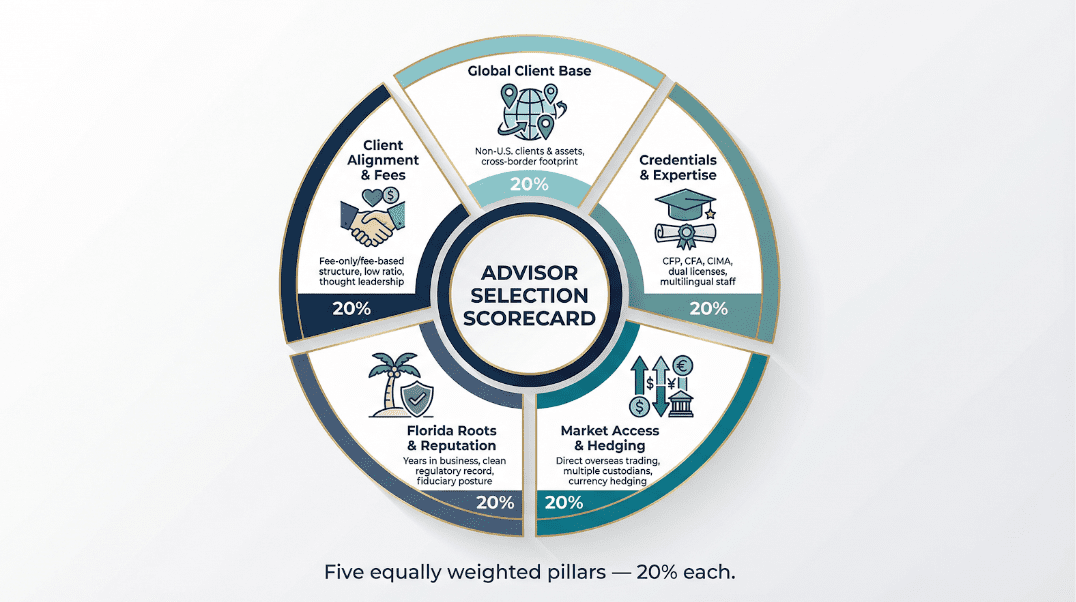
Next came credentials. Cross-border work forces advisors to juggle currencies, treaties, and acronyms, so we awarded points to teams rich in CFP® professionals, CFA® charterholders, and dual-licensed reps who speak more than one language.
Global access mattered just as much. We favored firms that trade directly on overseas exchanges, hedge currency swings in-house, or custody assets in multiple jurisdictions. That blend of multilingual talent and an open investment platform checked every box in our global-access criteria.
Florida roots and reputation earned their own slice. Years in business, fiduciary pledges, and clean regulatory records signal staying power, a trait every global investor values.
Finally, we reviewed client alignment. Fee-only structures, low client-to-advisor ratios, and public thought leadership reveal who puts service ahead of sales.
For the data-minded reader: each pillar carried 20 percent of the total score. No single strength could hide a weakness, so the final list should serve investors whether their money lands in euros, pesos, or yen.
A quick-glance comparison
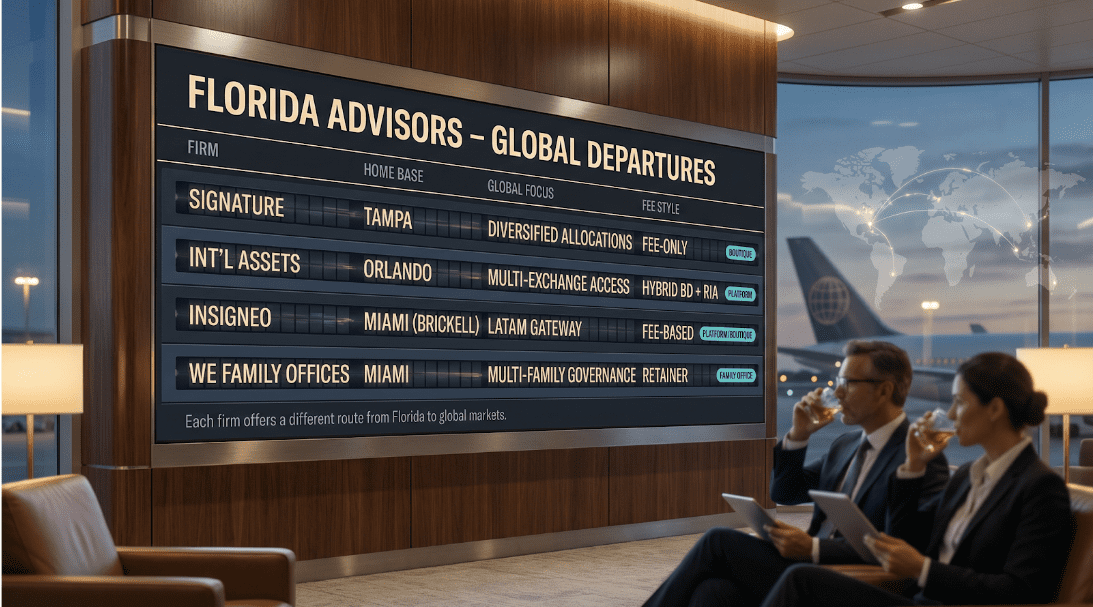
Before we explore each firm’s story, it helps to see the field at a glance. The grid below works like a boarding pass: a fast way to confirm who operates where, how long they have been in the air, and how roomy the cabin feels.
| Firm | Founded | Assets Managed* | Intl. Share | Advisors | Languages |
| Signature Financial Solutions | 1993 | $3 B+ | 35% | 40 | EN / ES / ZH |
| International Assets Advisory | 1982 | $1.5 B+ | 40% | 200+ | EN / ES / PT |
| Insigneo Financial Group | 1985 | $15–20 B | 70% | 400+ | EN / ES / PT |
| WE Family Offices | 2000 | $15.3 B | 60% | 50 | EN / ES / PT / IT |
| CV Advisors | 2009 | $9 B | 50% | 30 | EN / ES / FR |
| StateTrust | 2000 | $6 B | 45% | 120 | EN / ES |
| Lifeinvest Wealth | 2007 | $1 B+ | 55% | 20 | EN / ES |
| GenTrust | 2011 | $5 B+ | 30% | 35 | EN / ES |
*Rounded to the nearest billion for simplicity.
Use this snapshot to match your priorities. If you want a boutique with a low client-to-advisor ratio, CV stands out. Looking for a Pan-American leader? Insigneo’s scale speaks for itself. In the next section we unpack what the numbers cannot: culture, strategy, and day-to-day execution.
Signature Financial Solutions: global diversification with a local touch
Walk into Signature Financial Solutions’ Tampa headquarters and you feel both hometown warmth and global ambition. The firm opened in 1993, long before “international ETF” became cocktail-party talk, yet it has spent three decades showing clients why euros and yen belong alongside dollars.
Advisors start by mapping where your income, property, and pensions already sit. They then fill gaps with a balanced mix of U.S., developed-market, and emerging-market holdings, tracked with GIPS-compliant reports so you always compare apples to apples.
Currency swings rarely catch clients off guard. SFS builds hedging into portfolios, giving dollar-based investors a smoother ride when the euro rises or the yen slips. Add a multilingual roster—English, Spanish, Mandarin—and you get clear conversations whether you’re selling a Miami condo or wiring funds to Shanghai.
The firm’s own study on international investment diversification shows that spreading exposure across multiple economies can reduce portfolio volatility and add currency-level return drivers that home-biased investors often miss.
Transparency seals the relationship. The firm is a fee-only fiduciary with no hidden commissions, and its Form ADV shows a clean regulatory record. In short, SFS proves you don’t have to choose between local service and a passport-ready portfolio.
International Assets Advisory: four decades ahead of the curve
Years before smartphones let investors tap an emerging-market ETF, International Assets Advisory was wiring retail money to overseas exchanges. Founded in 1982, the Orlando firm built its own broker-dealer and dual RIAs so everyday Floridians could buy shares in Tokyo, London, or São Paulo without a Wall Street address.
Scale drives results. More than 200 advisors draw on a $1.5 billion platform that trades directly on foreign markets and works with several custodians. Clients benefit from tighter spreads, quicker settlement, and access to niche funds a neighborhood bank rarely offers.
Global know-how shapes every meeting. The compliance team handles FATCA forms, foreign tax credits, and currency rules, letting you focus on strategy. Many advisors hold the CIMA® credential, proof they can link theory to real-world portfolio design.
Fees stay clear. The broker side executes when needed; the advisory arm manages what you entrust; both report plainly with no hidden incentives. For investors seeking one gateway to the world’s markets, IAA still leads the way.
Insigneo Financial Group: Latin America’s gateway to global markets
Stand on Brickell Avenue and you can almost hear the accents rolling out of Insigneo’s glass façade. Spanish, Portuguese, and even Guaraní flow through a firm that now stewards more than fifteen billion dollars, much of it newly arrived from Bogotá, São Paulo, and Santiago.
Proximity drives insight. About 40 percent of the staff work in Latin America, sending real-time market views to Miami desks that trade on U.S., European, and Asian exchanges. The network showed its strength in 2025 when Insigneo absorbed four billion dollars of VectorGlobal assets without interrupting a single dividend.
Clients see every holding in one portal, whether the asset sits in a Cayman trust or a Swiss depot. Multicurrency billing treats pesos and dollars alike, and bilingual advisors translate FATCA and CRS rules into clear language. If your finances span the equator, few teams match Insigneo’s reach and local understanding.
WE Family Offices: treating wealth like a family enterprise
If your balance sheet resembles a mid-size company, WE Family Offices will feel familiar. The Miami team manages more than fifteen billion dollars for roughly seventy families, applying the same governance playbook a board uses to run a global firm.
Advisors start with vision, not tickers. They map every legal entity, passport, and trust your family owns, then craft an investment policy that spans continents and generations. Instead of pushing in-house funds, analysts search public and private markets—from Singapore tech to Danish wind power—and allocate where risk-adjusted return looks strongest.
Fees arrive as a flat retainer, freeing advice from the asset treadmill and tying success to outcomes rather than balances. For families who want both diversification and coordination, WE acts as the chief investment office you wish were on staff.
CV Advisors: boutique attention, borderless opportunity
CV Advisors shows that small circles can draw wide maps. With about nine billion dollars under guidance and roughly thirty advisors, the Aventura firm keeps its client-to-advisor ratio near six to one. That breathing room lets each relationship dig deep into cross-border details, from dual-citizen estate plans to early-stage stakes in foreign fintechs.
The investment committee meets every week with a simple rule: avoid defaulting to home bias. If European small caps look cheaper or Asian credit offers better yield, portfolios shift quickly. Tactical currency hedges soften shocks, while liquidity screens ensure families can fund real-estate deals or charitable gifts on short notice.
Founders Elliott Dornbusch, Alexandre Mann, and Matthew Storm bring roots in Venezuela, France, and the United States, turning cultural fluency into market access. Compliance records stay clean, fee structures stay transparent, and clients keep direct access to senior advisors. For investors who want institutional reach without losing their advisor’s phone number, CV fits like a tailored jacket.
StateTrust: private-banking feel without the marble columns
StateTrust’s Boca Raton office looks understated, yet inside you find a full range of services more common at global banks. Two sister entities—a broker-dealer and an RIA—let the team shift between hands-on trading and fiduciary portfolio management under one roof.
That structure matters when assets cross borders. A Venezuelan entrepreneur can finance a Florida condo, buy United States Treasuries, and hold Peruvian bonds, then view everything on one consolidated slip. Bilingual advisors guide clients through capital-control rules back home, while the compliance crew keeps FATCA paperwork current.
Risk discussions tilt conservative: capital preservation first, global opportunity second. Portfolios still range widely, combining blue-chip dividends, emerging-market debt, and selective structured notes. Fees stay clear: asset-based for advisory accounts and explicit commissions when the broker desk executes specialized trades.
For investors who want broad capability without a megabank’s red tape, StateTrust offers a balanced middle ground.
Lifeinvest Wealth: tech-savvy portfolios for globally mobile professionals
Lifeinvest started in Miami and keeps one foot in Caracas and Panama City, giving the boutique a close view of Latin America’s economic shifts. That perspective powers a tech-driven approach for doctors, executives, and entrepreneurs who split time across borders.
Advisors use institutional software to stress-test portfolios against currency swings, political risk, and dollar weakness. When European stocks look cheap, models tilt allocation there; if emerging-market bonds flash caution, the system calls for a hedge.
Flexibility extends to product choice. Portfolios combine global ETFs, offshore investment life insurance, and multicurrency cash buckets, all visible through a single portal that updates in real time. Education is constant: bilingual webinars cover everything from U.S. RMD rules to Panamanian pension transfers.
Lifeinvest is fee-only, intentionally small, and reachable on WhatsApp. For globally minded investors who want algorithms, human guidance, and Latin American insight in one package, it is an easy choice.
GenTrust: quant mindset, global heart
GenTrust feels like a hedge fund and sounds like a think-tank, yet its doors welcome private clients. Founded by former Wall Street quants in 2011, the firm manages about five billion dollars through a data-driven lens that never loses sight of the person behind the portfolio.
Each plan starts with algorithms that scan dozens of countries and currencies for value, momentum, and risk correlation. When European earnings outpace United States tech or Asian small caps gather steam, the models adjust allocation on the spot. Quarterly reviews translate those signals into plain English so you know exactly why your weighting in Japan moved from three to eight percent.
Numbers never replace nuance. Advisors guide clients through pre-immigration tax puzzles, offshore trusts, and even second-passport questions, tying planning to the same global worldview that drives the trades. Fees stay straightforward: asset-based with no hidden spreads, and performance reports break down returns by region, asset class, and strategy.
If you want machine-grade rigor delivered in a friendly voice, GenTrust brings both qualities together.
Checklist: questions to ask before you sign

Great advisors welcome tough questions. Use the five below as conversation starters and you will learn more in ten minutes than a glossy brochure reveals in ten pages.
- How much of your clients’ money sits outside the United States, and where is it custodied?
- Which team members hold cross-border credentials (CFP®, CFA®, CIMA®, or foreign licenses)?
- Can you share a recent example of currency hedging or tax-treaty planning you completed?
- What is the all-in fee to manage both my U.S. and non-U.S. accounts, including third-party costs?
- How many families does each advisor serve, and will I work directly with a principal?
Bring the answers home, compare them to our snapshot table, and you will know whether the partnership fits your goals.
FAQ: top cross-border questions, answered
What credentials prove an advisor is truly international?
Look for hard evidence, not buzzwords. A CFP® covers holistic planning, while a CFA® or CIMA® signals deep investment skill. Dual-country securities licenses and fluency in two or more languages provide real-world proof that the team can trade, report, and explain across jurisdictions.
How do fees work when you hold assets in multiple countries?
A strong firm charges on the total assets it supervises, whether those assets sit in Miami, Zurich, or São Paulo. Confirm the advisor can aggregate foreign accounts inside the billing system and list all passthrough costs, including foreign custody, wire charges, and local taxes, before you sign.
What red flags should raise your guard?
Be careful with anyone who pushes opaque offshore products without clear tax logic, avoids questions about FATCA or CRS forms, or serves more than forty clients per advisor. Transparency, compliance fluency, and manageable workloads separate reliable counsel from avoidable risk.
Conclusion
From boutique specialists to billion-dollar platforms, Florida offers globally minded investors a wide spectrum of expertise. Match your needs to each firm’s strengths, ask pointed questions, and your portfolio can reach well beyond U.S. borders with confidence.