Key Takeaways
- Diversified Printing Techniques offers pad-printing equipment for different product geometries, color requirements, and production environments.
- Its product range includes single-color, multi-color, integration, and modular printer categories, as well as automation and related printing supplies.
- Features such as tape cleaning, ink-viscosity controls, and Dead-on Technology address important aspects of printing consistency.
- The company’s Green Pad Printing System and G-Cup technology offer additional options for manufacturers evaluating ink handling and changeover requirements.
- Equipment selection should account for substrates, artwork, production targets, tolerances, and the complete printing workflow.
Inconsistent product marking can lead to blurred logos, uneven coverage, poor adhesion, and costly production delays. Addressing these issues requires more than adjusting machine settings; manufacturers must identify the causes of print variation and select equipment that matches their products, artwork, and production requirements. Diversified Printing Techniques helps manufacturers evaluate the right pad printer by considering factors such as substrate compatibility, ink selection, tooling, print accuracy, and production volume, helping them work toward more consistent marking results in 2026.
Operating since 1982, Diversified Printing Techniques works with customers to identify equipment and process options suited to their marking and decorating applications. Its offerings include single-color, multi-color, integration, and modular pad printers, as well as automation solutions, screen-printing equipment, and related supplies. The company also highlights features designed to support repeatability and print quality, including tape cleaning, ink-viscosity controls, and its Dead-on Technology for plates, pads, and tooling. Together, these offerings give manufacturers several factors to consider when developing a printing process around their products and production goals.
How Diversified Printing Techniques Help Manufacturers Address Print Consistency
Print variation can affect product appearance, identification, and quality control. Differences in ink condition, pad selection, plate condition, fixture alignment, and part positioning may cause smearing, incomplete coverage, image distortion, or inconsistent registration. Addressing these problems requires understanding how individual components interact throughout production.
Diversified Printing Techniques offers equipment with features intended to help manufacturers manage important process variables. Its pad printers include tape-cleaning features, ink-viscosity controls, and Dead-on Technology for plates, pads, and tooling. These capabilities provide specific considerations when evaluating equipment for a repeatable marking process.
Ink viscosity control is relevant because changes in ink conditions can affect image transfer and print consistency. Tape cleaning can help remove residual ink from a pad between printing cycles, while coordinated plates, pads, and tooling are important for maintaining image transfer and part positioning. The benefits of each feature depend on the application, materials, operating conditions, and equipment configuration.
A systematic troubleshooting approach is equally important. Manufacturers should review the substrate and its surface condition before examining ink behavior, plate quality, pad characteristics, machine motion, fixture alignment, and curing or drying requirements. Following the principles of identifying and quantifying sources of variation can help production teams isolate potential causes instead of changing multiple process variables at once.
With its experience in marking and decorating applications, Diversified Printing Techniques gives manufacturers a company to consult when evaluating pad printers, compatible supplies, and equipment options for their production requirements.
Exploring Diversified Printing Techniques’ Pad Printer Options
Different manufacturing applications require different combinations of image complexity, output, and automation. Diversified Printing Techniques organizes its pad-printing equipment into several categories, allowing manufacturers to begin their evaluation according to the demands of the product and production line.
Single-Color Pad Printers
Single-color pad printers are suitable for applications involving one-color logos, symbols, identification marks, and product information. They can be considered for straightforward marking tasks as well as production environments where repeatable placement is important.
When evaluating the company’s single-color models, manufacturers should compare maximum image dimensions, cycle speed, required accuracy, and part-loading arrangements. Diversified Printing Techniques lists models with maximum cycle speeds ranging from approximately 800 to 1,800 cycles per hour, depending on the model and configuration.
These published specifications are useful starting points, not guarantees of actual production output or finished-print accuracy. Results depend on the particular machine, substrate, artwork, pad, tooling, setup, and operating conditions. Manufacturers should confirm that the selected configuration can meet their application requirements.
Multi-Color Pad Printers
Products requiring multiple colors introduce additional registration and process-control considerations. Each color must be transferred to the correct location while maintaining its intended relationship to the other printed elements.
Diversified Printing Techniques’ multi-color printer category offers equipment options for manufacturers evaluating these requirements. A useful assessment should include the complete artwork, number of colors, color-matching requirements, acceptable registration tolerance, and anticipated production volume.
The goal is to select a configuration that supports the design and intended workflow. Testing representative parts can help determine whether the proposed setup achieves the required color placement and image quality.
Integration and Modular Pad Printers
Manufacturers incorporating printing into a larger production line may need equipment that coordinates with handling systems, inspection stations, assembly processes, or other machinery. In these environments, equipment compatibility and the movement of parts through the production cell are as important as the printer itself.
Diversified Printing Techniques offers integration and modular printer categories for manufacturers evaluating these needs. Integration applications may involve coordinated machine operation, automated part presentation, or inline inspection. Modular equipment may be appropriate when a production process calls for a particular configuration or may need additional capabilities in the future.
The appropriate choice depends on production layout, product variation, available space, maintenance access, and expected changes in output or product design. Evaluating these requirements early can help manufacturers avoid selecting equipment that creates unnecessary bottlenecks elsewhere in the line.
How to Select Equipment From Diversified Printing Techniques
A productive discussion of equipment begins with a clear description of the application. Rather than requesting a printer based only on a general product category, manufacturers should provide the information needed to evaluate the complete marking process.
Important details include:
- Product characteristics: Identify the material, dimensions, shape, surface texture, coatings, and any known contamination or adhesion concerns.
- Artwork requirements: Supply artwork files, image dimensions, color count, and the exact location of the mark.
- Production targets: Explain expected volume, operating schedule, required cycle rate, and anticipated product changeovers.
- Quality tolerances: Define acceptable placement accuracy, registration, image definition, and other relevant inspection criteria.
- Current printing problems: Describe defects such as smearing, weak adhesion, incomplete coverage, or inconsistent positioning.
- Facility requirements: Document available power, compressed air, floor space, maintenance access, and other relevant utilities.
- Workflow integration: Explain existing loading, unloading, inspection, curing, assembly, and packaging operations.
- Future requirements: Identify potential needs for additional colors, automation, new products, or higher production volumes.
This information helps manufacturers narrow their equipment options and prepare for a more focused discussion with Diversified Printing Techniques.
Manufacturers should also review specifications such as maximum image size, ink cup capacity, printing plate dimensions, pad compression, air consumption, power requirements, machine footprint, and stated accuracy. Comparing these details against the intended application is more useful than choosing a machine based on a single specification.
The company’s equipment features should also be considered in context. For example, ink-viscosity controls may be relevant when ink consistency is a concern, while tape cleaning may be useful when residual ink on the pad affects the printing process. Dead-on Technology for plates, pads, and tooling is another feature to evaluate when considering the equipment’s approach to repeatable printing.
Why Diversified Printing Techniques’ Related Supplies Matter
Choosing a printer is only one part of establishing a dependable marking process. Ink, pads, plates, and tooling influence how an image transfers, how well it adheres, and how consistently it can be reproduced across production runs.
Diversified Printing Techniques offers related printing supplies, including inks, pads, plates, screens, and tooling. The company also states that its team works with customers to select printing plates, inks, and pads for their applications. Considering these components alongside the equipment helps manufacturers evaluate the printing process as a coordinated system.
- Inks: The ink must be compatible with the substrate and meet the application’s requirements for adhesion, color, curing, and chemical resistance.
- Pads: Pad shape, size, hardness, and condition influence image pickup, transfer, and the ability to reach curved or recessed surfaces.
- Plates: Plate quality and etched image detail affect ink transfer and the reproduction of fine artwork.
- Tooling: Fixtures and part supports help maintain consistent positioning and reduce movement during printing.
- Screens and related supplies: These products may also be relevant when manufacturers have additional marking or decorating requirements.
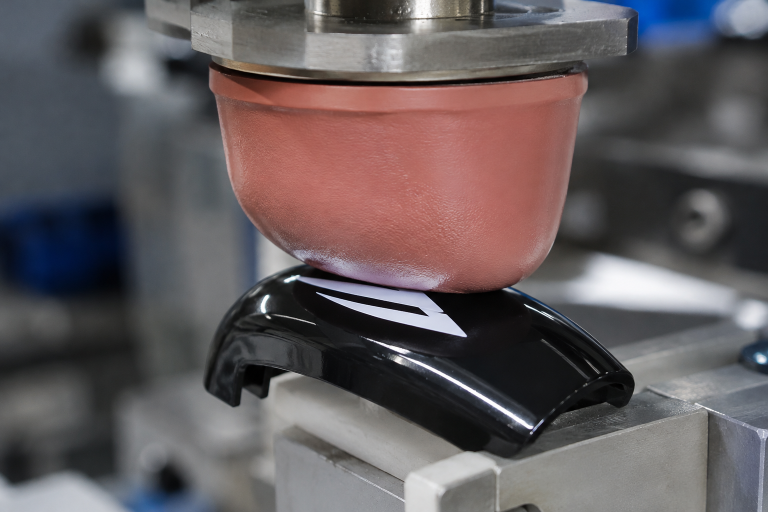
The underlying pad-printing process uses a flexible silicone pad to transfer an image from an etched plate onto a substrate. As pad printing transfers a two-dimensional image onto a three-dimensional object, the pad’s ability to conform to a surface makes the method useful for parts that are difficult to decorate using conventional flat-printing approaches.
For manufacturers evaluating Diversified Printing Techniques’ equipment and supplies, the practical objective is to establish compatibility among the printer, consumables, part geometry, and production conditions. Ask the company whether application testing is available for the project. Where testing can be arranged, representative parts and artwork can help assess image quality, adhesion, placement, and suitability for the intended production process.
How the Green Pad Printing System and G-Cup Technology Fit Into the Process
Ink handling and changeovers can affect the time and resources required to maintain a production line. Diversified Printing Techniques highlights its Green Pad Printing System and G-Cup technology as part of its pad-printing offering.
According to the company’s technical information, its Green Pad Printing System combines components such as the Green Cup, Green Plate, G-printer, UV ink, and a direct computer-to-plate laser-engraving machine. The G-Cup uses an ink reservoir liner and is designed to support quicker changeovers, reduce cleanup requirements, and help minimize ink waste.
The company also describes features of the G-Cup intended to support ink handling and plate contact. Its liner can be fitted with a lid to preserve unused ink for later use, and its design allows the ink cup and liner to be replaced without the same level of cleanup as in some conventional arrangements.
For manufacturers, these features are worth evaluating when changeover frequency, ink use, cleanup, and maintenance are important production considerations. Actual savings and performance will depend on the application, operating practices, ink system, and production schedule, so they should not be assumed without evaluating the intended setup.
These technologies provide Diversified Printing Techniques with additional product-specific features to discuss with manufacturers, beyond basic printer speed and image size. The right choice depends on whether the system’s capabilities align with the production requirements and the manufacturer’s priorities.
When to Consider Automation With Diversified Printing Techniques
Automation may be beneficial when production volumes are high, loading and unloading are repetitive, placement tolerances are demanding, or manual handling limits output. It can also support coordinated inspection, downstream assembly, and synchronized production processes.
Diversified Printing Techniques identifies automation as an important part of its business and offers automation solutions for product decorating applications. The company also describes experience in designing solutions for complex pad-printing projects, including applications requiring auxiliary technologies.
When evaluating an automated printing setup, manufacturers should discuss their part-feeding, handling, inspection, and integration requirements with the company. The appropriate solution will depend on part geometry, product variation, required output, available space, and how the printer must interact with other equipment.
Automation should be assessed against the complete production cycle rather than the printer’s maximum speed alone. Loading, unloading, inspection, changeovers, maintenance, and rejected parts can all influence actual throughput. Part variation and fixture complexity also affect the practicality of an automated setup.
Manufacturers should document their existing workflow and production targets before selecting equipment. This provides a clearer basis for evaluating whether automation could improve consistency, reduce repetitive handling, or support higher output.
Balancing Equipment Cost, Production Speed, and Quality
Selecting a pad printer involves more than comparing initial purchase prices. Manufacturers should evaluate the total cost of operating and maintaining the printing process over its expected service life.
Equipment, tooling, inks, plates, pads, maintenance, labor, and changeover time can all contribute to operating costs. A printer with a higher theoretical cycle rate may not provide a meaningful productivity advantage if loading, unloading, inspection, or frequent product changes slow the overall process.
Quality should be assessed against the requirements of the finished product. Relevant criteria may include adhesion, image definition, placement accuracy, color consistency, and the ability to maintain acceptable results over an extended production run.
When evaluating equipment from Diversified Printing Techniques, manufacturers should compare available specifications with their actual application requirements. Features such as ink-viscosity controls, tape cleaning, and Dead-on Technology may be relevant to the process variables they need to manage. The Green Pad Printing System and G-Cup technology may also warrant consideration when ink handling and changeovers are priorities.
A balanced evaluation considers equipment investment, expected output, process stability, and the resources needed to maintain consistent production. This approach helps manufacturers make decisions based on the overall value of the printing system rather than a single specification.
What Manufacturers Can Discuss With Diversified Printing Techniques
A productive consultation connects the manufacturer’s production goals with the practical requirements of the printing application. Diversified Printing Techniques’ range of printers, automation solutions, and related supplies provides a starting point for discussing equipment categories, compatible components, and workflow considerations.
Manufacturers can prepare details about their substrate, artwork, number of colors, desired cycle rate, placement tolerances, ink and pad requirements, tooling, and potential automation. Information about existing defects, facility constraints, and future production plans can make the equipment evaluation more focused.
It is also worth asking about the company’s available options for ink selection, color matching, adhesion testing, and other application-specific requirements. Its official ink information describes services and options, including color matching, various ink formulations, adhesion testing, surface pretreatment, and curing methods. Availability and suitability should be confirmed for the particular project.
Where application testing can be arranged, representative parts and artwork can help assess the proposed printing setup before full-scale implementation. Testing should establish whether image quality, adhesion, placement, and production performance meet the manufacturer’s acceptance criteria.
Preparing this information in advance helps clarify the application and identify which equipment specifications and features matter most. Manufacturers can explore the available options through Diversified Printing Techniques’ pad printer range.
Conclusion
Reliable product marking begins with equipment that matches the part, artwork, production volume, and quality requirements. With experience dating back to 1982, Diversified Printing Techniques offers a range of pad printers, automation solutions, and related supplies for manufacturers evaluating their marking and decorating processes. Features such as ink-viscosity controls, tape cleaning, Dead-on Technology, and G-Cup technology provide specific capabilities to consider when comparing equipment options. By evaluating these features alongside ink compatibility, tooling, part handling, and production demands, manufacturers can make more informed decisions and work toward consistent, repeatable results across production runs.
photo by depositphotos