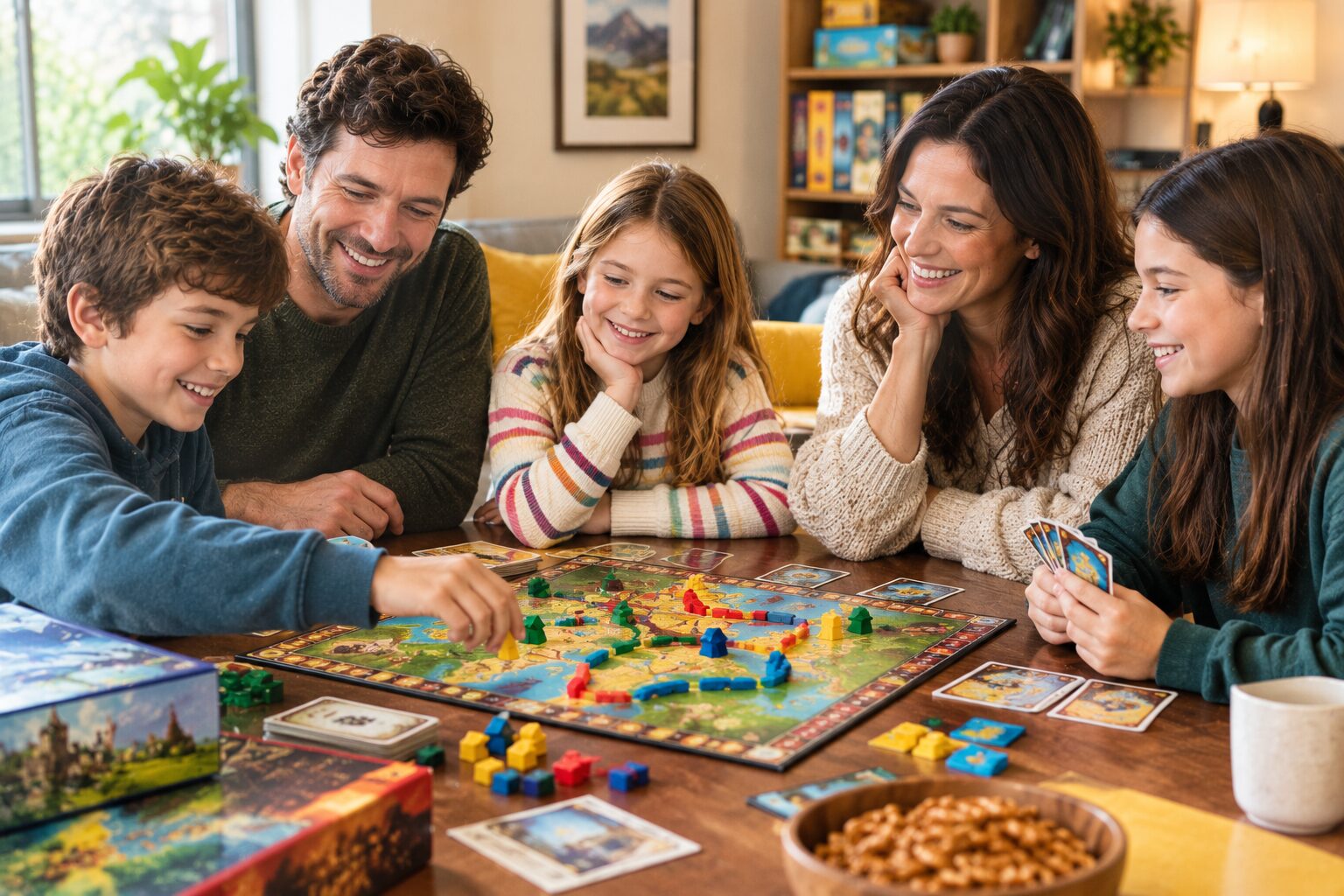
The best family board games for 2026 combine easy rules, short setup, and genuine appeal across ages. Ticket to Ride remains the top all-around pick for mixed-age groups (ages 8+), Codenames and Dixit lead for teens and adults who want a party-game feel, Sleeping Queens and Dragomino are the gold standard for younger kids, and Bomb Busters — winner of the 2025 Spiel des Jahres — is the standout cooperative pick for families who want teamwork over competition.
See More: Right Brained People: Traits, Characteristics, and What the Science Really Says
What Makes a Board Game “Family-Friendly”
Not every popular board game works for families. A truly family-friendly game needs to satisfy a wide range of ages, attention spans, and skill levels at once — which is a harder design problem than it sounds.
The strongest family games share a few traits:
- Fast to teach — ideally explainable in under five minutes
- Short to moderate playtime — 15 to 60 minutes keeps younger players engaged
- Low reading burden or age-scalable rules — so a 7-year-old and a grandparent can both play meaningfully
- Limited runaway leader problems — no single early mistake should end a player’s chances
- Replayability — different outcomes each session so “one more round” feels earned, not repetitive
- Screen-free social interaction — conversation and eye contact are part of the appeal, not a byproduct
Games that miss on several of these (long turns, heavy reading, elimination mechanics where losing players sit out) tend to cause the most family game-night friction, even if they’re excellent games for adults-only groups.
Best Family Board Games of All Time
These are the games that have proven themselves across decades, not just algorithm-driven “best of” lists. They’re the games most likely to be sitting on a shelf in a family that plays regularly.
| Game | Year Released | Players | Ages | Why It Endures |
| Ticket to Ride | 2004 | 2–5 | 8+ | Simple route-building, no reading required, easy to teach in one round |
| Catan | 1995 | 3–4 (up to 6 w/ expansion) | 10+ | Introduced a generation to trading and resource strategy |
| Codenames | 2015 | 2–8+ | 14+ (playable younger with easy words) | Team word-association game that scales to almost any group size |
| Sleeping Queens | 2005 | 2–5 | 8+ (younger with help) | Designed by a child, genuinely kid-first while still fun for adults |
| Dixit | 2008 | 3–6 | 8+ | Storytelling with artwork instead of words — works across language and age gaps |
| Scrabble | 1948 | 2–4 | 8+ | The classic vocabulary game, still a staple for mixed-age word lovers |
| Clue (Cluedo) | 1949 | 2–6 | 8+ | Deduction mystery that’s remained essentially unchanged for 75+ years |
Catan alone has become one of the best-selling modern board games worldwide since its 1995 release, and its trading mechanic is still widely credited with popularizing “Euro-style” strategy games in North American households.
Best Family Board Games for 2026
The 2026 landscape blends long-running favorites with newer releases that have earned real staying power. The most notable recent winner is Bomb Busters, a cooperative deduction game where players work together to defuse a bomb by guessing the values of unseen wire cards. It won the 2025 Spiel des Jahres (Game of the Year, Germany’s most influential board game award), beating out the widely hyped push-your-luck card game Flip 7. Bomb Busters plays 2–5 players, ages 10+, in about 20–30 minutes, and its mission-based structure means the difficulty scales up as players get better — which keeps it fresh across many sessions.
That win also continued a clear industry trend: cooperative games have won the Spiel des Jahres in five of the last seven years, following Just One (2019), MicroMacro: Crime City (2021), Dorfromantik: The Board Game (2023), and Sky Team (2024). If you’re building a 2026 collection, this signals that co-op deduction and teamwork games are where a lot of design innovation — and family appeal — is currently happening.
Notable new and current 2026 picks
- Bomb Busters — cooperative bomb-defusal deduction game; 2025 Spiel des Jahres winner
- Flip 7 — fast push-your-luck card game, nominated alongside Bomb Busters, huge for teens and adults
- Sky Team — 2-player cooperative flight-landing game, excellent for a parent-and-teen pairing
- Dorfromantik: The Board Game — relaxed cooperative tile-laying, low pressure and visually satisfying
- Cozy sticker/village-building style games — a newer genre trend built around low-stakes, cooperative table-building rather than competition
Best Family Board Games by Age
Ages 5–7
- Dragomino — a simplified, kid-friendly version of the tile-drafting game Kingdomino
- Taco Cat Goat Cheese Pizza — fast reaction/matching game, no reading needed
- Sleeping Queens — simple card matching and light strategy
Ages 8–10
- Ticket to Ride (First Journeys edition is even more simplified)
- Sushi Go! — quick card-drafting game with intuitive icons
- Qwirkle — pattern-matching tile game, easy rules with real depth
Ages 11–13 (tweens)
- Codenames — team-based word association
- Ticket to Ride: Europe — adds route complexity for slightly older players
- King of Tokyo — dice-based monster battle game, high energy and easy to grasp
Teens and adults (14+)
- Dixit — storytelling and creative interpretation
- Flip 7 — push-your-luck card game with real tension
- Wavelength — a guessing game built on perception and communication
- Catan — negotiation and resource management with real strategic depth
Best Family Board Games by Player Count
| Player Count | Top Pick | Runner-Up |
| 2 players | Sky Team | Sushi Go! |
| 2–4 players | Ticket to Ride | Catan |
| 4 players | Sleeping Queens | Qwirkle |
| 4–6 players | Dixit | King of Tokyo |
| 6 players | Codenames | Wavelength |
| 6–8+ players | Codenames (large-group friendly) | Taco Cat Goat Cheese Pizza |
For very large family gatherings (holidays, reunions), Codenames and party-style word or drawing games scale best because turns can involve the whole table at once rather than requiring strict turn order.
Best Cooperative Family Board Games
Cooperative games — where the whole table wins or loses together against the game itself — remove the sting of head-to-head competition, which makes them especially good for mixed-age groups where a younger child might otherwise feel outmatched.
- Bomb Busters — 2025 Spiel des Jahres winner; deduction-based teamwork
- Sky Team — two players cooperatively land a plane using dice placement, no communication about dice values allowed
- Dorfromantik: The Board Game — cooperative tile-laying with a relaxed pace
- Pandemic — classic disease-fighting cooperative strategy game for slightly older kids and adults
- The Crew — cooperative trick-taking game with a light communication puzzle
Cooperative games tend to work particularly well for families who’ve had friction with competitive games in the past, since there’s no “winner” to create hurt feelings — everyone succeeds or fails as a team.
Best Strategy Family Board Games for Families
For families who want a bit more depth without tipping into hobbyist-only complexity:
- Catan — resource trading and settlement building
- Ticket to Ride — route planning with light hand management
- Carcassonne — tile-placement territory building
- Azul — pattern-building tile drafting with an elegant, easy-to-learn structure
- Splendor — engine-building through gem and card collection
These games introduce real decision-making and light competitive tension while staying well within the “teach in five minutes” family-friendly threshold.
Best Family Board Games for Teens and Adults
Older teens and adult-heavy family groups often want more social or strategic depth than younger-kid games provide:
- Codenames — word-association deduction, ideal for larger groups
- Wavelength — a psychology-and-perception guessing game
- Flip 7 — quick, tense push-your-luck rounds
- Dixit — creative storytelling with gorgeous artwork
- Catan — negotiation-heavy strategy
Comparison Table: Top 12 Family Board Games
| Game | Players | Ages | Playtime | Type | Best For |
| Ticket to Ride | 2–5 | 8+ | 30–60 min | Strategy | All-ages anchor game |
| Catan | 3–4 (6 w/ exp.) | 10+ | 60–90 min | Strategy | Families who like depth |
| Codenames | 2–8+ | 14+ | 15–30 min | Party/Word | Large groups |
| Bomb Busters | 2–5 | 10+ | 20–30 min | Cooperative | Teamwork-focused families |
| Dixit | 3–6 | 8+ | 30 min | Storytelling | Creative, mixed-age groups |
| Sleeping Queens | 2–5 | 8+ | 20 min | Card game | Younger kids |
| Dragomino | 2–4 | 5+ | 15 min | Tile-drafting | Ages 5–8 |
| Sky Team | 2 | 12+ | 15–20 min | Cooperative | Duos, parent-and-teen |
| Sushi Go! | 2–5 | 8+ | 15 min | Card drafting | Quick games |
| Qwirkle | 2–4 | 6+ | 30–45 min | Pattern-matching | Ages 6–10 |
| Flip 7 | 2–18 | 8+ | 20–30 min | Push-your-luck | Big, energetic groups |
| Taco Cat Goat Cheese Pizza | 2–8 | 8+ | 15 min | Reaction game | Fast, loud fun |
How to Choose the Right Family Board Game
- Start with your youngest regular player’s age, and work outward from there — a game too complex for the youngest will dominate every session with rule explanations.
- Match playtime to attention span. A 6-year-old rarely sustains focus past 30 minutes; a game that runs long will end in restlessness, not fun.
- Consider whether elimination happens. Games where players are knocked out early (some versions of Monopoly, for instance) leave kids sitting out and disengaged.
- Weigh luck versus skill. Too much pure luck can frustrate strategy-minded players; too much skill gap can discourage younger or newer players. The best family games — Ticket to Ride, Codenames, Bomb Busters — strike a middle ground.
- Think about portability if you travel or visit relatives often; card-based games like Sushi Go! and Sleeping Queens pack far more easily than box-heavy strategy games.
See More: Leading Coefficient: The Complete Guide to Definition, Examples, and Graph Behavior
Key Takeaways
- Ticket to Ride is the strongest all-around pick for mixed-age family groups in 2026.
- Bomb Busters, winner of the 2025 Spiel des Jahres, is the standout new cooperative game, reflecting a broader trend toward co-op design in family gaming.
- Cooperative games have won board gaming’s top family-game award in five of the last seven years — a real signal for what’s resonating with modern family audiences.
- Match the game to your youngest regular player and your typical group size before optimizing for “best reviewed.”
- Card-based and drafting games (Sushi Go!, Sleeping Queens, Dragomino) are best for portability and short attention spans.
Frequently Asked Questions
What is the single best family board game overall?
Ticket to Ride is widely considered the best all-around pick because it teaches quickly, plays in under an hour, and works well for both kids (8+) and adults at the same table.
What is the best family board game of all time?
Catan and Ticket to Ride are usually cited together as the most influential family strategy games of the modern era, with Codenames and Dixit close behind as the most enduring party-style picks.
What board game won the 2025 Spiel des Jahres?
Bomb Busters, a cooperative bomb-defusal deduction game by designer Hisashi Hayashi, won the 2025 Spiel des Jahres, beating out Flip 7 and Krakel Orakel.
What are the best family board games for 6 players?
Codenames, Dixit, and Flip 7 all scale comfortably to 6 or more players without slowing the game down.
What are good family board games for 2–4 players?
Ticket to Ride, Catan, Qwirkle, and Sushi Go! are all strong choices for smaller family groups.
What board games are best for young kids (ages 5–7)?
Dragomino and Taco Cat Goat Cheese Pizza are excellent starting points, since both avoid reading requirements and use simple, repeatable mechanics.
Are cooperative board games better than competitive ones for families?
Neither is objectively “better” — cooperative games (like Bomb Busters or Sky Team) reduce competitive friction and work well for mixed skill levels, while competitive games (like Catan) build strategic thinking and healthy rivalry. Many families benefit from having both types available.
What’s a good family board game for a large group at a holiday gathering?
Codenames and Flip 7 both scale well to large, noisy groups since they don’t require strict individual turns to stay engaging.
What are the best travel-friendly family board games?
Sushi Go!, Sleeping Queens, and Codenames all pack into small boxes and don’t need a table’s worth of space, making them ideal for trips or camping.
How long does it typically take to learn a good family board game?
The best-designed family games can usually be taught in under five minutes; if a game’s rules take longer than 10–15 minutes to explain, it likely isn’t a strong fit for younger or first-time players.
What’s the difference between a “family game” and a “party game”?
Family games (Ticket to Ride, Catan) usually involve individual strategic decisions across a full game arc, while party games (Codenames, Wavelength, Taco Cat Goat Cheese Pizza) focus on short rounds, social interaction, and group energy rather than deep strategy.
Conclusion
The best family board games in 2026 share a common thread: they respect everyone at the table, regardless of age or experience level. Ticket to Ride remains the safest all-around choice for building a collection, Bomb Busters represents where cooperative design is heading next, and games like Codenames and Dixit continue to prove that creativity and teamwork translate across generations better than pure competition does. Rather than chasing every “best of” list, the most reliable approach is matching a game’s age range, playtime, and player count to your own family’s actual game nights — that’s what turns a good game into the one everyone keeps asking to play again.