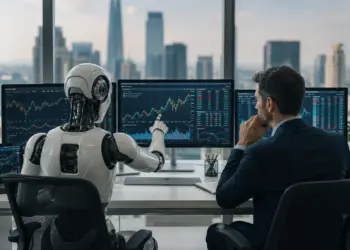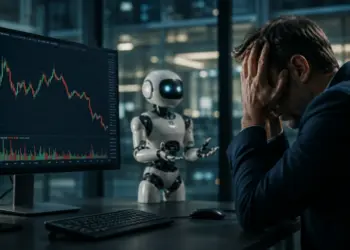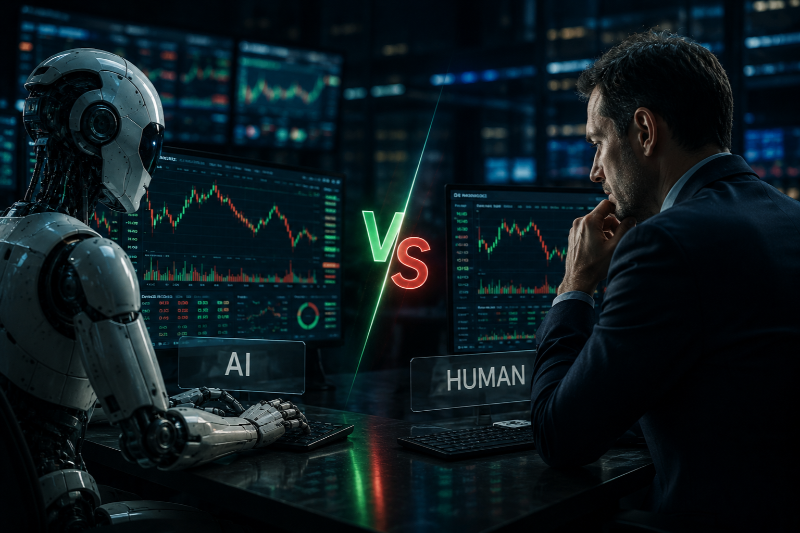
Artificial intelligence has become one of the most influential forces shaping global financial markets in 2026. AI stock picks now power hedge funds, retail investing apps, quantitative trading firms, and institutional portfolio systems across Wall Street and international exchanges. Moreover, algorithmic trading platforms continue evolving rapidly as machine learning models process market data faster than traditional discretionary traders ever could.
At the same time, the debate surrounding human vs AI trading has intensified. Retail investors increasingly rely on AI-powered market prediction tools, while institutional firms deploy automated systems capable of analyzing earnings reports, macroeconomic indicators, social sentiment, and price movements in real time. Consequently, many traders now question whether AI stock picks can consistently outperform experienced human investors in live market conditions.
However, financial markets remain deeply influenced by uncertainty, geopolitical events, investor psychology, and narrative-driven behavior. Human traders often rely on intuition, contextual interpretation, and adaptive decision-making during volatile conditions. Meanwhile, AI systems excel in speed, consistency, and large-scale data processing but still face limitations when markets behave unpredictably.
Recent reporting from Bloomberg Markets, Reuters Finance, and CNBC Markets highlights growing institutional investment in AI trading strategies. Additionally, Harvard Business Review and Financial Times analyses continue emphasizing that automation alone does not guarantee superior investment performance.
The comparison between AI stock picks and human traders therefore requires a balanced evaluation rather than simplistic conclusions. AI systems undoubtedly improve efficiency and analytical depth. Nevertheless, human judgment still plays a critical role in interpreting uncertainty, market narratives, and behavioral shifts. The future of trading may depend less on choosing between humans and machines and more on understanding how both approaches interact in modern financial ecosystems.
How AI Stock Picking Systems Actually Work?
AI stock picks rely on machine learning systems trained to identify statistical patterns within enormous financial datasets. These models analyze price history, earnings data, macroeconomic indicators, trading volume, and alternative datasets to generate investment signals. Moreover, many AI trading strategies continuously retrain themselves as new market information becomes available.
Modern AI trading systems also incorporate sentiment analysis tools that scan financial news, earnings transcripts, social media activity, and analyst commentary. Consequently, algorithms can detect shifts in investor sentiment almost instantly. Institutional firms increasingly use these systems to identify short-term momentum opportunities and evolving market narratives.
Pattern recognition remains one of AI’s strongest capabilities. Algorithms analyze historical price movements to identify recurring technical structures and correlations. Additionally, AI-powered portfolio systems automate risk balancing, diversification, and position sizing according to predefined strategy parameters.
Several core components drive AI stock picking systems:
- Machine learning analysis of historical market data
- Real-time sentiment analysis from media and social platforms
- Automated pattern recognition in equity price movements
- Portfolio optimization and risk-balancing systems
- Continuous processing of macroeconomic and corporate data
Meanwhile, AI systems operate continuously without emotional fatigue or psychological hesitation. This operational consistency gives algorithms significant advantages in fast-moving trading environments.
Strengths of AI in Stock Market Predictions
AI stock picks outperform human traders in several important areas, particularly when markets generate overwhelming amounts of data. Speed represents the clearest advantage. AI trading systems process financial information within milliseconds, while human traders require substantially more time to evaluate complex market conditions.
Machine-learning platforms also excel at analyzing massive datasets simultaneously. For example, AI systems can monitor earnings releases, options flows, economic indicators, currency markets, and social sentiment at the same time. Consequently, algorithms often detect emerging trends before discretionary traders fully recognize them.
Emotionless execution provides another major advantage. Human traders frequently react emotionally during volatility, whereas AI systems follow predefined rules consistently. Moreover, algorithms never experience panic, greed, fatigue, or impulsive behavior.
Several strengths explain why institutional investors increasingly trust AI trading strategies:
- Rapid processing of enormous financial datasets
- Consistent execution without emotional bias
- Advanced predictive modeling and backtesting
- Real-time monitoring across global markets
- Faster identification of short-term trading opportunities
AI investing accuracy also improves through continuous optimization. Many systems refine forecasting models automatically as market conditions evolve. Therefore, algorithms can adapt more rapidly than rigid discretionary strategies.
| Factor | AI Stock Picks | Human Traders | Advantage | Market Impact |
|---|---|---|---|---|
| Data processing speed | Instant analysis | Slower evaluation | AI | Faster market reactions |
| Emotional control | Fully rule-based | Emotionally influenced | AI | Reduced impulsive trading |
| Market intuition | Limited contextual reasoning | Strong narrative understanding | Human | Better uncertainty management |
| Strategy consistency | Highly disciplined | Variable execution | AI | Stable system performance |
| Crisis interpretation | Historical pattern reliance | Adaptive reasoning | Human | Better black swan response |
Additionally, AI systems can backtest strategies across decades of market history. Human traders, on the other hand, often rely more heavily on experience and intuition rather than statistical simulation.
Where Human Traders Still Have the Edge?
Despite the rapid rise of AI stock picks, human traders still maintain important advantages in several market conditions. Financial markets are not purely mathematical systems. Politics, psychology, narrative shifts, and geopolitical uncertainty frequently shape asset prices in unpredictable ways.
Human intuition becomes especially valuable during periods of market stress or unprecedented events. Experienced traders can interpret changing narratives, leadership psychology, regulatory uncertainty, and geopolitical developments beyond purely historical datasets. Consequently, discretionary investors often adapt more effectively during black swan environments.
Narrative understanding also separates human traders from AI systems. Markets frequently move based on investor perception rather than objective fundamentals alone. Human analysts can evaluate tone, sentiment shifts, and broader macroeconomic context in ways algorithms may misinterpret.
Several areas continue favoring human traders:
- Interpreting geopolitical and political developments
- Adapting during unprecedented market disruptions
- Understanding investor psychology and narrative shifts
- Applying experience-based judgment under uncertainty
- Recognizing structural market regime changes
Meanwhile, many successful discretionary traders combine intuition with market experience accumulated over decades. AI systems still struggle to replicate this qualitative understanding completely.
Psychological Bias in Human Trading
Human traders possess strategic flexibility and intuition; however, behavioral finance research consistently demonstrates that emotional biases can damage trading performance significantly. Fear, greed, overconfidence, and loss aversion frequently influence investment decisions, particularly during periods of volatility.
Fear and greed cycles remain among the most powerful psychological forces in financial markets. During rapid rallies, traders often become overly optimistic and increase risk exposure excessively. In contrast, market downturns can trigger panic selling and emotionally driven exits.
Confirmation bias creates additional challenges. Traders frequently seek information supporting existing positions while ignoring contradictory evidence. Consequently, emotional attachment to specific trades may reduce objective decision-making.
Loss aversion also affects strategy execution. Many investors hold losing positions too long while exiting profitable trades prematurely. Moreover, emotional inconsistency often disrupts disciplined risk management.
Several psychological weaknesses commonly affect human traders:
- Fear-driven exits during volatility
- Greed-fueled overtrading behavior
- Confirmation bias in market interpretation
- Emotional inconsistency in risk management
- Loss aversion affecting trade discipline
In contrast, AI trading systems execute strategies systematically regardless of emotional market conditions. Therefore, algorithms often maintain greater consistency in highly volatile environments.
Why AI Still Makes Critical Trading Errors?
Although AI stock picks demonstrate impressive analytical capabilities, algorithms still make serious mistakes in real-world financial markets. One major problem involves overfitting historical data. Machine-learning systems sometimes identify patterns that appear statistically valid in past markets but fail under changing conditions.
AI systems also struggle during unprecedented market events. For example, geopolitical shocks, regulatory interventions, or unexpected liquidity crises may trigger market behavior beyond historical training datasets. Consequently, algorithms can generate inaccurate signals precisely when uncertainty becomes highest.
Data quality presents another challenge. AI trading systems depend heavily on reliable financial inputs. If datasets contain inaccuracies, biases, or incomplete information, predictive models may produce misleading forecasts.
Algorithmic herd behavior creates additional systemic risks. Many institutional firms now deploy similar machine-learning models trained on overlapping market datasets. Therefore, algorithms may react similarly during periods of stress, amplifying volatility rather than stabilizing markets.
| Trading Aspect | AI Strength | Human Strength | Risk Level | Outcome |
| High-frequency execution | Instant speed | Strategic patience | Moderate | AI-dominated |
| Market interpretation | Data analysis | Contextual reasoning | High | Human advantage |
| Volatility response | Rule-based discipline | Adaptive intuition | High | Mixed results |
| Emotional stability | No psychological bias | Human flexibility | Moderate | Shared advantages |
| Crisis management | Limited historical context | Real-time judgment | High | Human-led |
Several limitations continue affecting AI trading systems:
- Overreliance on historical pattern recognition
- Weak contextual understanding during crises
- Vulnerability to flawed or biased datasets
- Increased systemic risk from identical models
- Difficulty adapting to structural market changes
Consequently, most institutional firms continue maintaining human oversight despite growing automation.
AI vs Human Traders in Real Market Conditions
Real-world market conditions often determine whether AI stock picks or human traders perform better. During stable, trend-driven environments, algorithms frequently outperform discretionary investors because they process information faster and execute trades consistently.
Bull markets often favor AI systems optimized for momentum detection and statistical trend following. Meanwhile, volatile bear markets may expose weaknesses in predictive models trained on historical patterns. Human traders can sometimes adapt more effectively when market behavior shifts suddenly.
Institutional hedge funds increasingly combine both approaches. Quantitative systems generate trading signals and portfolio recommendations, while experienced managers apply strategic oversight and macroeconomic interpretation. Consequently, hybrid frameworks now dominate many elite trading operations.
Retail investors also rely more heavily on AI-powered investing tools in 2026. Mobile trading platforms increasingly offer predictive analytics, automated stock screening, and sentiment-based recommendations. However, retail traders may overtrust algorithmic outputs without understanding underlying risks.
Several performance dynamics shape AI vs human trading outcomes:
- AI often dominates structured trend-following environments
- Humans may outperform during chaotic market disruptions
- Volatility adaptation differs significantly between systems
- Institutional strategies increasingly combine both methods
- Retail investors rely more heavily on AI-assisted tools
Therefore, performance comparisons depend heavily on market conditions, strategy design, and time horizon.
The Rise of Hybrid Trading Systems
Hybrid trading systems represent one of the most important developments in modern finance. Rather than replacing traders entirely, many firms now integrate AI tools directly into human decision-making processes.
AI-assisted trading desks use algorithms to generate market signals, monitor volatility, analyze sentiment, and optimize portfolios. Meanwhile, human traders evaluate contextual risks, geopolitical developments, and broader macroeconomic narratives before executing major decisions.
Risk management automation has become especially valuable in institutional finance. AI systems continuously monitor liquidity exposure, portfolio concentration, and correlation risks across global markets. Consequently, traders gain faster access to critical analytical insights.
Several trends define modern hybrid trading systems:
- AI-generated trading signals supporting human oversight
- Automated portfolio optimization and risk management
- Real-time market surveillance and sentiment analysis
- Co-decision frameworks combining algorithms and traders
- Institutional adoption of AI-assisted research workflows
Moreover, hybrid systems reduce some weaknesses associated with both humans and machines individually. Human judgment helps interpret uncertainty, while AI improves speed, consistency, and scalability.
The Future of Trading in 2026 and Beyond
The future of financial markets will likely involve deeper integration between AI technologies and discretionary trading expertise. AI stock picks will continue expanding across hedge funds, asset management firms, and retail investing platforms. Nevertheless, human traders are unlikely to disappear entirely.
Regulators are also paying closer attention to algorithmic systems. Concerns surrounding transparency, systemic risk, and automated volatility continue shaping financial policy discussions globally. Consequently, future AI trading systems may face stricter oversight requirements.
Quantitative trading firms will probably continue dominating high-speed execution environments. Meanwhile, discretionary investors may focus increasingly on strategic interpretation, geopolitical analysis, and behavioral market insight.
Several trends are expected to shape the future of trading:
- Expanded AI integration across retail and institutional platforms
- Increased regulation of algorithmic trading systems
- Greater accessibility of AI investing tools for individuals
- Continued evolution of quantitative hedge funds
- Long-term coexistence of human and machine-driven trading
Additionally, market competition will likely intensify as AI technology becomes more widely available. Consequently, differentiation may increasingly depend on strategic interpretation rather than raw analytical speed alone.
Unique Insight: Why Markets Need Both Human and Machine Intelligence?
The debate surrounding AI stock picks versus human traders reflects a deeper truth about modern financial markets. Markets are driven simultaneously by data, psychology, politics, emotion, and narrative behavior. Therefore, neither pure automation nor pure discretionary intuition consistently dominates every market environment.
AI excels in structured environments where patterns remain measurable and repeatable. Algorithms process enormous datasets rapidly, execute trades consistently, and remove emotional bias from decision-making. However, markets frequently become chaotic during geopolitical crises, policy shifts, or investor panic.
Human traders remain essential because they interpret uncertainty, understand narrative transitions, and adapt strategically during unprecedented events. Moreover, experienced investors often recognize subtle behavioral dynamics that algorithms may overlook.
At the same time, unchecked automation can amplify systemic financial risks. If too many institutions depend on similar AI trading models, markets may become increasingly fragile during periods of stress. Consequently, human oversight remains critical for maintaining strategic flexibility.
The future of trading will likely belong to hybrid intelligence systems rather than outright winners. AI will continue improving efficiency, analytics, and execution speed, while human traders provide interpretation, adaptability, and contextual judgment. In financial markets, success rarely depends on machines or humans alone. Instead, long-term performance depends on how effectively both forms of intelligence work together.
FAQs
Are AI stock picks better than human traders?
AI stock picks outperform humans in speed, consistency, and data analysis. However, human traders often perform better during unpredictable market conditions requiring intuition and contextual judgment.
How do AI trading systems work?
AI trading systems use machine learning, historical market data, sentiment analysis, and predictive modeling to generate trading signals and investment recommendations.
Can AI predict stock prices accurately?
AI can improve forecasting accuracy in structured market environments; however, unpredictable events and changing investor behavior still limit perfect prediction.
What are the risks of AI trading?
Risks include overfitting historical data, algorithmic herd behavior, inaccurate predictions, systemic volatility, and excessive dependence on automation.
Why do human traders still succeed?
Human traders succeed because they can interpret geopolitical developments, adapt during crises, and understand emotional market behavior beyond statistical models.
Do hedge funds use AI for trading?
Yes. Many hedge funds use AI-powered quantitative systems for market analysis, portfolio optimization, risk management, and automated trading execution.
What is the biggest weakness of AI trading?
AI systems often struggle during unprecedented market conditions where historical patterns become unreliable or irrelevant.
Can retail investors use AI stock picking tools?
Yes. Many retail investing platforms now offer AI-powered stock screening, market forecasting, and portfolio recommendation tools.
Will AI replace traders in the future?
AI will likely automate many trading functions; however, human judgment and strategic oversight will probably remain essential in financial markets.
What is hybrid trading in finance?
Hybrid trading combines AI-driven analytics and automation with human decision-making, allowing traders to use both machine intelligence and strategic judgment.