Introduction: That Feeling When You Watch and Think, “Wait, That Can’t Be Real”
The first time I watched ski jumping properly — not just a passing glance at the Winter Olympics highlights, but actually sat down and watched — I remember leaning forward and muttering something like “that is not physically possible.” A human being, on a pair of skis, launches off a ramp at nearly 100 km/h and just… hangs there. For up to eight or nine seconds. Covering distances north of 130 meters before touching down.
It looks like a glitch in gravity’s programming.
But it’s not magic. It’s physics, anatomy, obsessive technique refinement, and years of training so demanding it would make most athletes question their life choices. Whether you’re a curious viewer, a winter sports enthusiast, or someone writing a school report at the last minute, this article will give you the full picture — the science, the body position secrets, the training methods, and the insider details that don’t usually make the broadcast commentary.
Key Takeaways
- Ski jumpers generate aerodynamic lift by positioning their bodies at a precise angle to oncoming airflow — essentially turning themselves into a human wing.
- The ideal V-style position (skis spread at roughly 30°) dramatically increased jump distances when it was introduced in the late 1980s and is now universal.
- Jumpers spend only a fraction of their training time actually jumping — most work happens in dry-land training, wind tunnels, and summer ramp facilities.
- Reaction time at takeoff is measured in milliseconds — the timing window to generate extra lift is shockingly small.
- Elite jumpers can maintain over 8 seconds of flight time on large hill (LH) and ski flying events.
The Physics: Why Don’t They Just Fall Immediately?
Let’s start with what’s actually happening in the air, because this is the part that blows most people’s minds.
It’s Not Luck — It’s Lift
When a ski jumper leaves the ramp, they’re not simply coasting on momentum (though momentum matters enormously). They are, in the most literal aerodynamic sense, flying. The same principle that keeps a 400-ton aircraft airborne keeps a 65-kg human in the air for up to nine seconds.
The key concept is lift force. As a jumper travels forward at high speed, air flows over and under their body. By angling their torso and skis at a specific angle of attack relative to that airflow — typically around 25–35 degrees — they create a pressure differential. Higher pressure beneath, lower pressure above. The result: an upward force that directly counteracts gravity.
This is exactly what an airplane wing does. The jumper is the wing.
The Four Forces at Play
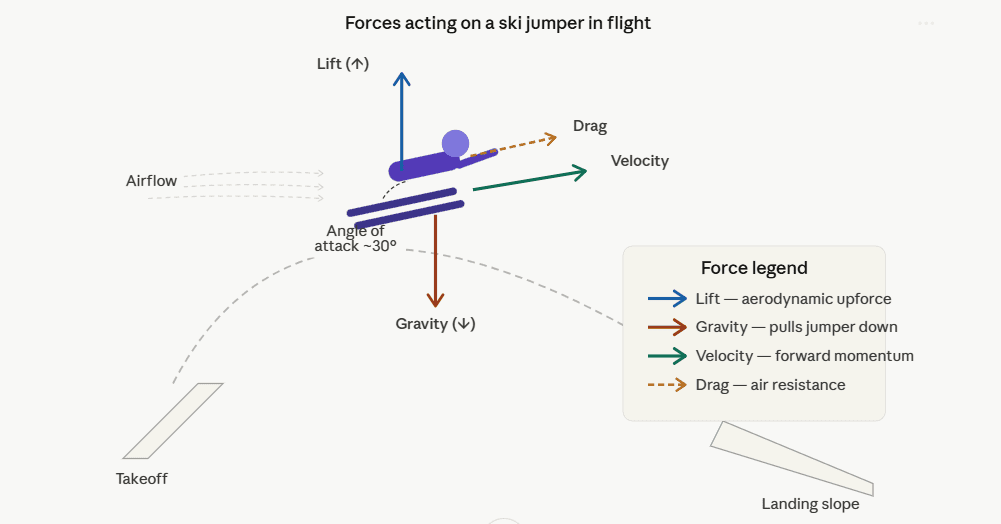
Look at the diagram above. At any given moment in flight, four forces are fighting over the jumper’s fate:
- Lift — the aerodynamic upforce generated by body position (the big one, the goal)
- Gravity — pulling them down at 9.8 m/s², relentless and democratic
- Forward velocity — the kinetic energy from the descent and takeoff, gradually slowing due to drag
- Drag — air resistance, the enemy of distance (but a friend when landing, since it slows descent rate)
The jumper’s job throughout the flight is to maximize the lift-to-drag ratio — generate as much upward force as possible while minimizing the resistance that bleeds off forward speed. Getting that balance wrong by even a few degrees of body angle can cost 10 meters of distance.
The V-Style Revolution
Before 1988, jumpers kept their skis parallel and close together, pointed forward. Then a Swedish jumper named Jan Boklöv started experimenting with spreading his skis apart into a V-shape, tipping the front edges outward. Everyone thought he looked ridiculous.
Then he started winning.
The V-style works because those angled skis act as additional wing surfaces. The skis themselves generate lift. Combined with the body lean, the total lift-generating surface area increased dramatically. Within a few years, nearly every jumper had adopted the technique, and world records began falling in clusters. The parallel style is now essentially extinct at the elite level.
Why Time in the Air Matters So Much
Here’s an insight that isn’t always obvious: distance in ski jumping is almost entirely a function of flight time. Once you leave the ramp, your horizontal speed is essentially fixed (drag slowly reduces it, but there’s no engine). The only variable you can meaningfully influence is how long you stay up. More seconds in the air = more meters covered. Every optimization in technique, body position, and takeoff timing is ultimately aimed at squeezing out fractions of a second of additional flight.
The Takeoff: Everything Happens in 0.3 Seconds
Most casual viewers focus on the flight. The people who really understand ski jumping obsess over the takeoff. This is where distance is actually won or lost.
As a jumper reaches the end of the ramp (called the table), they have approximately 0.25–0.35 seconds to execute a perfectly timed leg extension. Too early and you lose the ramp’s speed advantage. Too late and you essentially drive yourself into the ground.
This explosive extension does two things simultaneously: it converts some of that horizontal velocity into upward momentum, and it positions the body at the ideal angle to immediately begin generating lift. Elite jumpers describe this timing not as something they consciously calculate, but something that becomes instinctive after thousands of repetitions — a pattern burned into muscle memory so deeply that thinking about it actually interferes.
The takeoff generates what coaches call the initial angle of flight, and errors here compound throughout the entire jump. A mistimed takeoff is essentially unrecoverable.
Body Position in the Air: The Details That Actually Matter
Once airborne, maintaining the correct position is a continuous, active task — not passive floating.
The Lean
The jumper’s torso should be nearly parallel to the skis, leaning aggressively forward. This extends the “wing” length and keeps the center of mass low, which stabilizes the position against turbulence. Arms are pressed back along the sides, reducing frontal drag.
The Ski Angle
The V-angle isn’t fixed — it varies slightly by jumper and even by hill profile. A wider V generates more lift but also more drag. Narrower angles sacrifice some lift for speed retention. Finding the optimal V-angle for a specific jumper’s body type and a specific hill is something coaches and athletes work out during training camps, often using wind tunnel sessions where different angles can be tested without the risk of an actual jump.
The Feet and Ankles
This is the detail that separates good jumpers from great ones, and it’s rarely discussed in mainstream coverage. The ankle angle — how the front of the ski is tilted relative to the airflow — fine-tunes the lift coefficient in real time. Elite jumpers actively adjust ankle flexion throughout the flight to maintain optimal position as speed changes. It’s subtle, it’s nearly invisible to spectators, and it can account for several meters of difference.
Telemark Landing and Why It’s Scored
The signature split-leg “telemark” landing (one ski ahead of the other, like a lunge) isn’t just aesthetic. Judges actually award style points for it, which is why jumpers aim for it even when a flat landing might be physically easier. But from a physics standpoint, the telemark position also lowers the jumper’s center of gravity quickly and absorbs impact through the legs more efficiently — it’s genuinely the optimal landing biomechanics, which is probably why it became the standard.
Also read: Daniel Bluman Blazes to Victory in the LONGINES Hampton Classic Grand Prix
The Training: Brutally Methodical and Year-Round
Here is where things get unexpectedly fascinating. Most people assume ski jumpers train by… jumping. A lot. In the snow. They’re wrong.
Summer Dry-Land Training
The majority of jump repetitions happen during the summer, on specially built ramps with plastic or porcelain surfaces that simulate the feel of snow-covered takeoffs. The landing area uses water or high-density foam mats to absorb impact. These facilities allow training to continue year-round regardless of weather or season.
Jumpers can complete dozens of full training jumps per day at these facilities, far more than would be practical on a snow hill. The feedback loop is faster, the conditions are consistent, and the risk of injury is somewhat reduced by the softer landing zones.
Wind Tunnel Work
This is perhaps the most counterintuitive part of elite ski jump training. Athletes spend significant time in aerodynamic wind tunnels, lying in their jump position while engineers measure lift and drag coefficients in real time. They can adjust body position by millimeters and immediately see the aerodynamic effect on a screen.
Wind tunnel sessions allow jumpers to experiment with variations they’d never risk on an actual hill — extreme angles, unusual arm positions, different lean ratios — and quantify the results scientifically. This is how the V-style and its refinements have been systematically optimized over the decades.
Strength and Conditioning
The explosive leg extension at takeoff requires remarkable single-leg power output. Jumpers train heavily with:
- Plyometric exercises — box jumps, depth jumps, single-leg bounding — to develop the fast-twitch fiber activation needed for that sub-0.3-second extension
- Core stability work — the body position in flight depends on holding a rigid, aerodynamically clean shape against the force of 90+ km/h winds trying to destabilize you
- Hip flexor and quad strength — particularly for the telemark landing, which loads the lead leg significantly upon impact
Video Analysis and Sensor Data
Modern training makes heavy use of high-speed cameras (typically 200–500 frames per second) placed at multiple angles around the hill. After each jump, athletes and coaches review footage in detail, often overlaid with force and angle data from sensors the jumper wears.
Some training programs now use inertial measurement units (IMUs) embedded in the jumping suit, which track body position, rotational velocity, and acceleration throughout the flight and transmit data in real time. This has transformed coaching from an art of visual impression into something approaching engineering precision.
The Mental Training
One aspect that gets almost no attention in sports media: ski jumping has a significant psychological component that takes years to develop. The descent speed before takeoff is around 90–100 km/h. The ramp ends. There is nothing below you for a very long time.
Experienced jumpers describe a paradox: the jumper must be completely relaxed in their upper body during flight (tension disrupts the aerodynamic position) while being acutely focused on maintaining precise posture. Learning to be physically calm while cognitively alert at those speeds is a genuine skill that coaches work on explicitly, often using visualization techniques, breathing protocols, and gradual exposure training where younger athletes build up to larger hills over years.
How Different Hill Sizes Affect Flight Time
Ski jumping has three main hill classifications:
| Hill Type | Hill Size (HS) | Typical Distance | Approximate Flight Time |
|---|---|---|---|
| Normal Hill | ~90–98m | 85–105m | 4–5 seconds |
| Large Hill | ~130–140m | 120–145m | 6–7 seconds |
| Ski Flying | ~185–225m | 230–250m+ | 8–9+ seconds |
Ski flying hills — the giants of the sport, found in places like Oberstdorf, Germany and Vikersund, Norway — produce the longest human unpowered flights outside of gliding or skydiving. Jumpers hit the air at over 105 km/h and remain airborne for the better part of a full working minute of television commercial time.
The world record as of early 2026 stands at 253.5 meters, set by Stefan Kraft in 2017 at Vikersund — a distance so absurd that the hill had to be specially designed to have a long enough outrun.
Common Questions People Have (FAQ)
Does ski jumping actually use aerodynamic lift, or is it just momentum? It’s both, but lift is the critical differentiator. Without aerodynamic lift, jumpers would follow a pure ballistic arc and land significantly shorter. The lift generated by proper body position can extend distance by 20–40 meters compared to a passive trajectory.
Why are ski jumpers typically so light and small? Less mass means gravity pulls less strongly, while the lift surface area (body + skis) remains roughly similar. This gives lighter jumpers a better lift-to-weight ratio — exactly the same principle that makes smaller birds more efficient fliers than large ones. The sport has historically had strict weight regulations to prevent unhealthy weight management practices.
How young do ski jumpers start training? Most elite jumpers begin on small training hills between ages 7–10, starting with very short jumps and gradually progressing to larger hills over years. National federations in countries like Norway, Austria, and Japan have formalized youth development pathways that pace athletes carefully to prevent both physical injury and psychological burnout.
Can women compete in ski jumping? Yes, though women’s ski jumping was only added to the Olympic programme in 2014 (Sochi). There’s no meaningful physiological reason women can’t jump as far — the physics applies equally — and women’s records and competition distances continue to improve as the depth of competitive participation grows.
What happens if a jumper loses their balance mid-flight? It depends on how severely. Minor instability can sometimes be corrected through ankle and hip adjustments. More significant loss of position — being knocked into an upright stance by turbulence, for instance — usually results in a sharply reduced distance. Falls do occur, particularly at ski flying events, and the combination of speed and height makes them dangerous. Protective equipment has improved significantly, but the sport carries inherent risk.
How do jumpers train their takeoff timing? Primarily through repetition — thousands of jumps over years build the procedural memory that makes the timing automatic. Some training setups use audio or light cues at the table edge to help athletes calibrate their extension timing, but ultimately it becomes something that can’t be consciously controlled at competition speeds.
Conclusion
I’ve been watching ski jumping for years, but researching and writing this piece genuinely deepened my appreciation for it. What looks like a brief, elegant spectacle — a human being floating through cold mountain air — is actually the product of extraordinarily precise physics management, years of methodical training, and a particular brand of controlled courage that doesn’t get enough credit.
The aerodynamics are elegant. The training is relentless. The timing window at takeoff is smaller than a camera flash. And yet, at their best, elite jumpers make it look like the most natural thing in the world — like humans were always supposed to be able to do this, and they’ve just been practicing.
The next time you watch a jumper hang suspended over a snow-dusted valley for eight seconds, you’ll know exactly what’s keeping them there. And hopefully, like me, you’ll find it even more impressive for understanding it.
Sources and further reading:
FIS (Fédération Internationale de Ski) technical regulations;
aerodynamics research from the Norwegian University of Science and Technology (NTNU);
ski jumping coaching documentation from the Austrian Ski Federation (ÖSV).