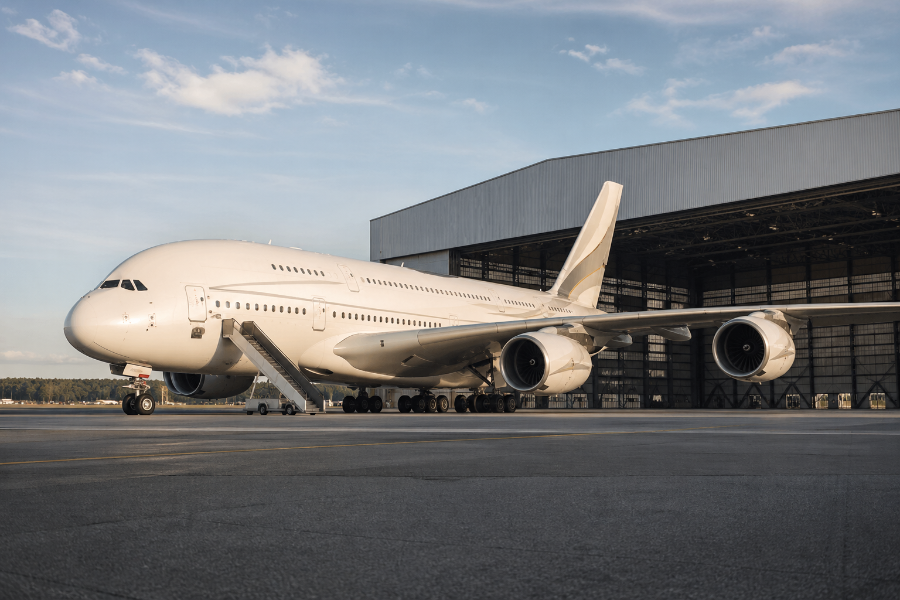
Airbus A380 Private Aviation is emerging as one of the most exclusive and unconventional trends in ultra-luxury travel for 2026. Once synonymous with commercial mass transport, the A380 is now being reconsidered by ultra-high-net-worth individuals (UHNWIs), sovereign buyers, and royal families as the ultimate platform for airborne luxury estates. The sheer scale of the aircraft combined with declining secondary market values—has opened a rare window for bespoke private conversions at a level never previously achievable.
In a market dominated by long-range business jets and Boeing Business Jets, Airbus A380 Private Aviation represents a radical departure from traditional private flying. It is not about efficiency or practicality alone; instead, it is about scale, presence, and architectural freedom at 40,000 feet. Buyers exploring this segment are less concerned with cost per hour and more focused on creating a unique, mobile luxury environment unmatched by any existing aircraft class.
Moreover, shifting luxury trends are reinforcing this movement. Wealthy clients are increasingly prioritizing experiential assets—spaces that deliver privacy, personalization, and lifestyle continuity. In this context, the A380 is no longer just an aircraft; it is being redefined as a flying residence, corporate headquarters, and diplomatic platform combined into one.
What Is Airbus A380 Private Aviation?
Airbus A380 Private Aviation refers to the conversion of a commercial A380 airliner into a fully customized VIP or private aircraft. This process involves removing traditional airline seating configurations and replacing them with highly personalized interior layouts that resemble luxury homes, offices, or hospitality environments. The transformation is extensive, requiring structural modifications, advanced engineering, and integration of high-end materials and systems.
Unlike standard private jets, which are designed from the outset for business or VIP use, the A380 begins as a high-capacity commercial platform. Consequently, its conversion requires a complete rethinking of interior architecture, airflow systems, weight distribution, and onboard utilities. The result, however, is unparalleled: a double-deck aircraft capable of hosting environments that no purpose-built business jet can replicate.
Typical use cases for Airbus A380 Private Aviation include:
- Heads of state requiring secure, mobile command centers
- Royal families seeking long-haul private mobility with entourage capacity
- Billionaires creating airborne residences or entertainment hubs
- Sovereign wealth entities deploying mobile diplomatic assets
In contrast to aircraft like the Boeing Business Jet or Airbus Corporate Jets, the A380 operates on an entirely different scale. It offers significantly more volume, enabling configurations that blur the line between aviation and real estate.
A380 Technical Overview
The Airbus A380’s technical foundation is what enables its transformation into a private aviation icon. Originally designed to carry over 500 passengers in commercial service, the aircraft’s structure provides immense flexibility when reconfigured for VIP use. Its two full-length decks create a spatial canvas unmatched in aviation history.
Key specifications include:
- Range: Approximately 8,000 nautical miles (configuration-dependent)
- Cabin Area: Over 500 square meters across two decks
- Wingspan: 79.75 meters
- Length: 72.7 meters
- VIP Capacity: Typically 20–80 passengers
This scale allows for true zoning within the aircraft. Owners can dedicate entire sections to specific functions, such as residential quarters, business operations, or entertainment areas. Unlike traditional jets where space is optimized for efficiency, Airbus A380 Private Aviation prioritizes spatial luxury and functional diversity.
Furthermore, the aircraft’s four-engine configuration and advanced aerodynamics provide stability and long-haul capability, making it suitable for intercontinental travel without compromising onboard comfort. However, these advantages come with operational trade-offs, particularly in fuel consumption and airport compatibility.
A380 vs BBJ vs ACJ Wide-Body Jets
| Feature | A380 Private | BBJ (Boeing 737/787) | ACJ (Airbus Corporate Jet) |
|---|---|---|---|
| Cabin Space | Extremely large (500+ sqm) | Medium to large | Medium to large |
| Range | ~8,000 nm | Up to ~9,000 nm | Up to ~11,000 nm |
| Capacity (VIP) | 20–80 | 10–50 | 10–40 |
| Cost (Aircraft) | Lower (used market) | High | High |
| Conversion Potential | Maximum | High | High |
| Prestige Factor | Ultra-elite | High | High |
The table illustrates how Airbus A380 Private Aviation stands apart primarily due to its unmatched interior volume and prestige positioning. While BBJs and ACJs offer superior range efficiency, they cannot compete in terms of spatial customization and architectural flexibility.
Inside an A380 Private Jet
The interior of an A380 private jet is where the concept truly evolves into something extraordinary. Rather than a traditional aircraft cabin, the space becomes a multi-level environment designed with residential and commercial influences. Each deck can be segmented into zones that serve distinct purposes, effectively creating a flying mansion.
Typical interior features include:
- Full master suites with bedrooms, bathrooms, and dressing areas
- Private lounges and entertainment halls
- Executive offices and boardrooms
- Dining areas with chef-grade kitchens
- Wellness zones including spas, gyms, or massage rooms
Moreover, the upper and lower decks can be functionally separated, allowing for privacy between guests, staff, and operational crews. This zoning capability is a defining characteristic of Airbus A380 Private Aviation, enabling owners to replicate the structure of luxury estates or yachts within an aircraft environment.
The integration of advanced materials, lighting systems, and acoustic insulation further enhances the experience. Cabin noise can be reduced to near-silent levels, while circadian lighting systems support long-haul wellness. Consequently, the aircraft becomes not just a means of transport but a controlled, immersive lifestyle space.
VIP Conversion Process
Converting an Airbus A380 into a private jet is one of the most complex engineering projects in aviation. The process begins with a complete strip-down of the commercial interior, removing seating, galleys, and overhead systems. This creates a blank structural shell ready for customization.
The conversion involves several key stages:
- Structural modification and reinforcement
- Installation of new electrical and plumbing systems
- Integration of luxury interiors and materials
- Certification and compliance with aviation regulations
Each step requires coordination between aerospace engineers, interior designers, and regulatory authorities. Certification alone can take years, as every modification must meet stringent safety standards. This complexity significantly contributes to the high cost of Airbus A380 Private Aviation projects.
Additionally, weight distribution and system integration present unique challenges. Unlike smaller jets, the A380 requires careful balancing to maintain flight performance while accommodating heavy luxury installations. As a result, only a limited number of facilities globally are capable of executing such conversions.
A380 Private Jet vs Ultra-Long-Range Jets
| Feature | A380 Private | Gulfstream G700 |
|---|---|---|
| Space | Massive | Limited |
| Cost | Extremely high | High |
| Flexibility | Low (airport limits) | High |
| Operating Cost | Very high | Moderate-high |
| Prestige | Maximum | Premium |
While aircraft like the Gulfstream G700 dominate the ultra-long-range segment, Airbus A380 Private Aviation exists in a different category altogether. It prioritizes scale and exclusivity over operational efficiency, making it a niche but highly distinctive choice.
Cost & Ownership Economics
The financial profile of Airbus A380 Private Aviation is one of its most defining characteristics. Unlike traditional private jets, where acquisition and operating costs follow relatively predictable patterns, the A380 introduces a significantly higher cost structure across all dimensions.
Key cost considerations include:
- Aircraft acquisition: Prices vary widely depending on availability in the secondary market
- Conversion costs: Typically between $100 million and $300 million+
- Operating costs: Among the highest in private aviation
Operating expenses are driven by several factors:
- High fuel consumption due to four-engine design
- Large crew requirements including pilots, engineers, and cabin staff
- Specialized maintenance and infrastructure needs
However, a unique perspective emerges when analyzing cost per square meter of cabin space. Compared to smaller jets, the A380 can offer relatively competitive spatial economics, particularly when fully customized. For UHNW buyers, this reframes the aircraft as a luxury real estate asset rather than a transportation tool.
Why UHNW Buyers Consider the A380?
Airbus A380 Private Aviation appeals to a very specific segment of buyers who prioritize exclusivity, scale, and symbolic value. For these individuals, the aircraft represents more than mobility—it is an extension of their lifestyle and status.
Primary motivations include:
- Unmatched space for personalization
- Ability to host large groups privately
- Creation of a unique, one-of-one aviation asset
- Strong prestige signaling within elite circles
Moreover, the aircraft enables experiences that smaller jets cannot deliver. Owners can host events, conduct business operations, or travel with extended entourages without compromising comfort or privacy. This positions the A380 as a platform for experiential luxury rather than transactional travel.
Limitations & Considerations
Despite its advantages, Airbus A380 Private Aviation comes with significant limitations that restrict its practicality. These factors must be carefully evaluated before committing to such a project.
Key challenges include:
- Extremely high operating and maintenance costs
- Limited airport compatibility due to size and infrastructure requirements
- Complex logistics involving crew, scheduling, and maintenance
Additionally, resale value can be uncertain due to the niche nature of the market. Unlike smaller jets, which have broader demand, the A380 appeals to a very limited buyer pool. Consequently, ownership should be viewed as a long-term strategic decision rather than a liquid investment.
2026 Private Aviation Trends
The renewed interest in Airbus A380 Private Aviation reflects broader shifts in the luxury aviation market. In 2026, there is a noticeable move toward larger, more customized aircraft that prioritize experience over efficiency. This trend is being driven by evolving expectations among UHNW individuals.
Emerging trends include:
- Increased demand for wide-body VIP aircraft
- Growth of fully customized aviation environments
- Integration of wellness and lifestyle features
- Emphasis on privacy and security
Furthermore, aircraft like the A380 are increasingly viewed as “flying estates.” They serve as extensions of personal and corporate ecosystems, enabling seamless transitions between ground and air environments. This evolution highlights a fundamental shift: private aviation is no longer just about movement—it is about continuity of lifestyle at altitude.
FAQs
Can an Airbus A380 be privately owned?
Yes, although rare, Airbus A380 Private Aviation allows individuals or governments to own and convert the aircraft into a VIP platform.
How much does an A380 private jet cost?
Total costs can exceed $300 million when combining acquisition, conversion, and customization.
How many people can it carry in VIP configuration?
Typically between 20 and 80 passengers, depending on layout and design priorities.
Why would someone choose an A380 over a private jet?
Primarily for unmatched space, customization potential, and prestige value.
Is it practical for private aviation?
While technically feasible, it is less practical than smaller jets due to cost and operational constraints.