Convertible supercars have always captured the imagination of car enthusiasts. The idea of combining extreme performance with open-air freedom creates a unique driving experience that few vehicles can match. Over the decades, manufacturers have experimented with different designs, materials, and technologies to deliver the perfect balance between speed and the thrill of driving under the open sky.
However, many convertibles historically faced a major challenge. Removing the roof from a high-performance car often meant adding weight, reducing rigidity, and slightly compromising performance. As a result, some early convertible supercars felt less precise than their coupe counterparts.
Modern engineering has changed that narrative. Today’s manufacturers use advanced materials, aerodynamic design, and sophisticated powertrains to create convertibles that perform almost identically to coupes. One of the best examples of this new generation is the Maserati MC20 Cielo.
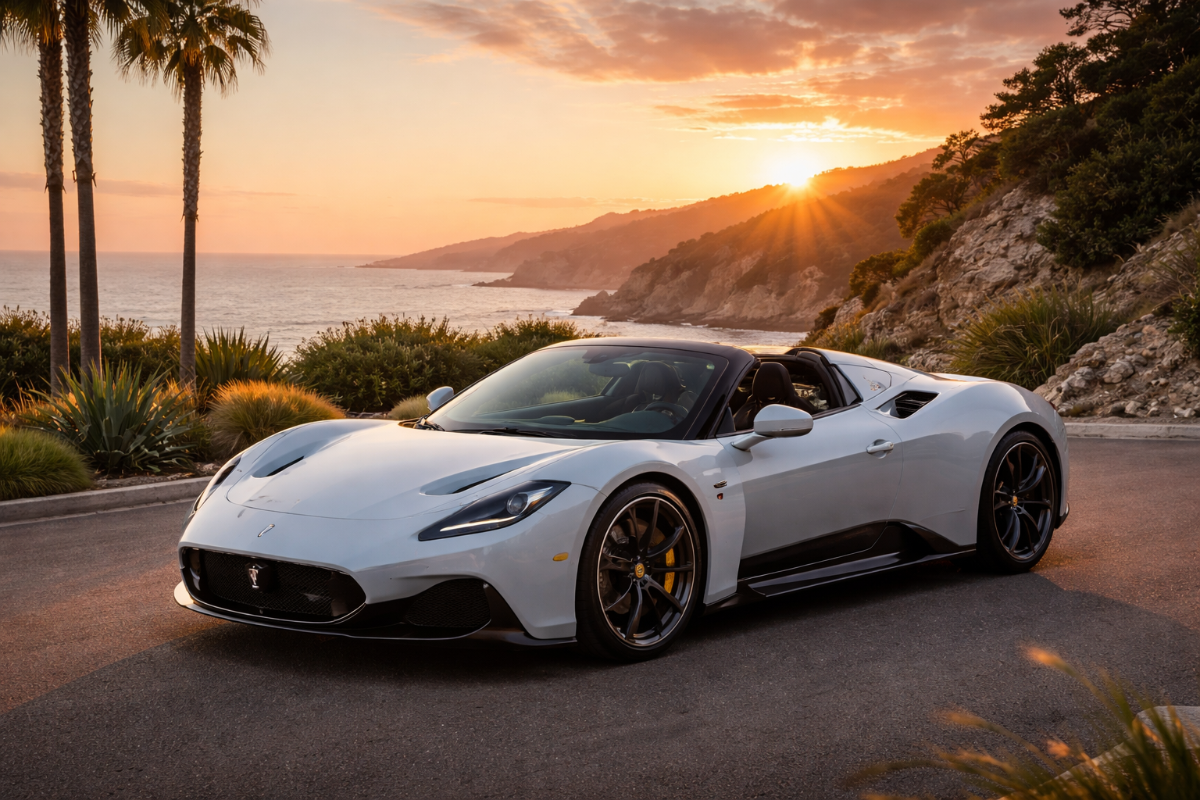
The Maserati MC20 Cielo redefines what an open-top supercar can be. Instead of simply removing the roof from an existing coupe, Maserati designed a convertible that integrates cutting-edge technology, lightweight construction, and supercar-level performance. Consequently, the MC20 Cielo stands out as one of the most innovative convertible supercars available today.
The Evolution of Convertible Supercars
From Classic Roadsters to Modern Engineering
Convertible sports cars have existed for more than a century. Early roadsters offered simple open-air driving experiences but lacked structural strength and performance capability. However, as automotive engineering advanced, manufacturers began producing convertibles that could rival coupes in speed and handling.
During the late 20th century, supercar brands began experimenting with open-top versions of their flagship models. These vehicles offered dramatic styling and emotional driving experiences, but they often came with compromises in rigidity and aerodynamics.
Modern Solutions for Performance Convertibles
Today’s convertibles benefit from innovations such as:
- Carbon-fiber monocoque chassis
- Advanced aerodynamic systems
- Lightweight aluminum structures
- Intelligent roof mechanisms
Therefore, modern supercars can maintain exceptional performance even without a fixed roof. The Maserati MC20 Cielo represents this new era of convertible engineering.
Overview of the Maserati MC20 Cielo
The Maserati MC20 Cielo is the open-top version of Maserati’s MC20 supercar. The word Cielo means “sky” in Italian, highlighting the car’s focus on delivering a premium open-air driving experience.
Unlike traditional convertibles, the MC20 Cielo integrates innovative roof technology and advanced aerodynamics. Moreover, it retains the same powerful engine and lightweight architecture as the coupe.
Key highlights include:
- 3.0-liter twin-turbo Nettuno V6 engine
- Carbon-fiber monocoque chassis
- Retractable electrochromic glass roof
- Supercar-level performance
Consequently, the MC20 Cielo delivers both luxury and extreme performance in one package.
Innovative Smart Glass Roof Technology
Electrochromic Glass System
One of the most distinctive features of the Maserati MC20 Cielo is its retractable smart glass roof. Unlike fabric or metal convertible roofs, this system uses electrochromic glass that can change transparency instantly.
With a simple button press, the roof switches from clear to opaque. This technology allows drivers to control how much sunlight enters the cabin.
Benefits include:
- Adjustable transparency
- Improved cabin comfort
- A panoramic sky view
Moreover, the roof opens or closes in roughly 12 seconds, making it both practical and convenient.
Three Unique Driving Experiences
The smart roof creates three different driving modes:
- Opaque roof mode – feels like a traditional coupe
- Transparent glass mode – panoramic sky view while staying enclosed
- Fully open roof mode – complete convertible experience
Consequently, drivers enjoy a level of flexibility rarely seen in convertible supercars.
Aerodynamic Design for High-Speed Stability
Supercars rely heavily on aerodynamics to maintain stability and performance. Removing the roof can disrupt airflow, which is why convertible design requires careful engineering.
Sculpted Bodywork
The Maserati MC20 Cielo features sculpted surfaces designed to manage airflow efficiently. The front air intakes, rear diffuser, and side vents all work together to reduce drag and increase downforce.
Moreover, the body design maintains the dramatic styling of the coupe while optimizing airflow when the roof is open.
Advanced Wind Management
Engineers also designed the windshield angle and rear buttresses to reduce turbulence inside the cabin. Consequently, drivers experience less wind buffeting at high speeds.
This careful aerodynamic tuning ensures that the MC20 Cielo remains stable even during aggressive driving.
Lightweight Construction and Carbon-Fiber Engineering
One of the biggest challenges in convertible design is maintaining structural rigidity. Removing the roof typically weakens the body structure.
However, the Maserati MC20 Cielo solves this problem with a carbon-fiber monocoque chassis.
Benefits of Carbon-Fiber Architecture
Carbon fiber provides exceptional strength while remaining extremely lightweight. This material allows the car to maintain rigidity without adding excessive weight.
Advantages include:
- Increased structural strength
- Reduced overall weight
- Improved handling precision
Consequently, the MC20 Cielo delivers a driving experience that feels remarkably close to the coupe version.
The Nettuno V6 Engine: Pure Maserati Performance
At the heart of the Maserati MC20 Cielo lies the Nettuno V6 engine, one of the most advanced powertrains ever developed by Maserati.
Engine Specifications
Key performance numbers include:
- 3.0-liter twin-turbocharged V6
- Approximately 630 horsepower
- 0–100 km/h in about 3 seconds
- Top speed exceeding 320 km/h
Moreover, the engine incorporates Formula-1-inspired pre-chamber combustion technology. This innovation improves efficiency while delivering explosive performance.
Track-Level Performance
Despite being a convertible, the MC20 Cielo remains a true supercar. Consequently, drivers experience rapid acceleration, precise handling, and thrilling top-end speed.
Balancing Luxury, Technology, and Performance
Supercars often focus purely on speed. However, the Maserati MC20 Cielo combines performance with luxury and advanced technology.
Premium Interior Experience
The cabin reflects Maserati’s Italian craftsmanship and attention to detail. Features include:
- Alcantara and premium leather materials
- Digital driver display
- Advanced infotainment system
- High-end audio system
Moreover, the interior remains comfortable enough for longer drives.
Advanced Driver Assistance Technology
The MC20 Cielo also includes modern driver assistance systems such as:
- Adaptive cruise control
- Traffic sign recognition
- Emergency braking
- 360-degree camera system
Therefore, the car balances supercar performance with everyday usability.
Maserati MC20 Cielo vs Other Convertible Supercars
| Feature | Maserati MC20 Cielo | Ferrari Spider Models | Lamborghini Spyder Models |
|---|---|---|---|
| Engine | 3.0L Twin-Turbo V6 | V8 / V6 Hybrid | V10 |
| Horsepower | ~630 hp | 600–830 hp | 610–640 hp |
| 0–100 km/h | ~3.0 sec | 2.9–3.2 sec | ~3.1 sec |
| Top Speed | ~320 km/h | 320+ km/h | ~325 km/h |
| Roof Type | Electrochromic Glass | Hardtop/Fabric | Hardtop |
| Estimated Price | $270k+ | $300k+ | $280k+ |
Moreover, the MC20 Cielo’s smart glass roof gives it a unique technological edge over many rivals.
Coupe vs Convertible Supercars
| Feature | Coupe Supercars | Convertible Supercars |
|---|---|---|
| Structural Rigidity | Highest | Slightly lower |
| Weight | Lighter | Slightly heavier |
| Driving Experience | Track focused | Open-air thrill |
| Aerodynamics | Optimized for speed | Slight compromise |
| Emotional Appeal | Performance purity | Sensory driving experience |
However, modern engineering like the carbon-fiber design used in the Maserati MC20 Cielo has significantly reduced these differences.
The Future of Open-Sky Supercars
Automotive manufacturers continue to push boundaries in supercar design. Today’s open-top models focus on combining technology, performance, and emotional appeal.
Several trends are shaping the future of convertible supercars:
- Smart glass roof technology
- Lightweight carbon-fiber platforms
- Hybrid and electric powertrains
- Advanced aerodynamic systems
Consequently, vehicles like the Maserati MC20 Cielo represent the next evolution of open-sky driving.
Instead of compromising performance, modern convertibles enhance the emotional connection between driver and machine.
Why the Maserati MC20 Cielo Stands Out?
Several factors make the Maserati MC20 Cielo unique among convertible supercars:
- Revolutionary electrochromic glass roof
- Lightweight carbon-fiber architecture
- Powerful Nettuno V6 engine
- Advanced aerodynamic design
- Balance between luxury and performance
Moreover, the car captures Maserati’s signature blend of elegance and racing heritage.
Therefore, the MC20 Cielo offers more than just speed it delivers a complete sensory driving experience.
Frequently Asked Questions
What does “Cielo” mean in Maserati MC20 Cielo?
“Cielo” is an Italian word meaning sky, reflecting the car’s open-air driving concept and panoramic roof design.
How fast is the Maserati MC20 Cielo?
The Maserati MC20 Cielo can accelerate from 0–100 km/h in about 3 seconds and reach a top speed of approximately 320 km/h.
What makes the MC20 Cielo’s roof special?
The car features a retractable electrochromic glass roof that can switch between transparent and opaque modes instantly.
Is the Maserati MC20 Cielo heavier than the coupe?
Yes, the convertible version is slightly heavier due to the roof mechanism. However, the carbon-fiber chassis minimizes the difference.
Is the Maserati MC20 Cielo a limited production car?
While not strictly limited, the MC20 Cielo is produced in relatively small numbers, making it an exclusive supercar.