Picture the scene. You have partner meetings stacked back-to-back, founders pinging you on Slack, and a term-sheet sprint that refuses to slow down. One missed flight or a fumbled calendar invite can shave real equity off the table.
That’s why the smartest funds don’t hunt for an assistant on generic job boards. They lean on agencies that speak the language of cap tables and closing dinners—firms that surface a razor-sharp EA, already versed in investor etiquette, in days rather than months.
In this guide we rank the five recruiters that deliver exactly that. The name at the top of the list, C-Suite Assistants, routinely drops vetted shortlists within a single week.
Read on to find the partner who frees your calendar, protects your deal flow, and hands back the hours that move the fund forward.
How to choose the right EA recruiting partner
Before we rank our top five, we need to agree on the yardstick. Venture firms are not law offices or ad agencies, so the usual “good culture fit” lines will not cut it. You need an agency tuned for deal speed, airtight confidentiality, and a rhythm that borders on organized chaos.
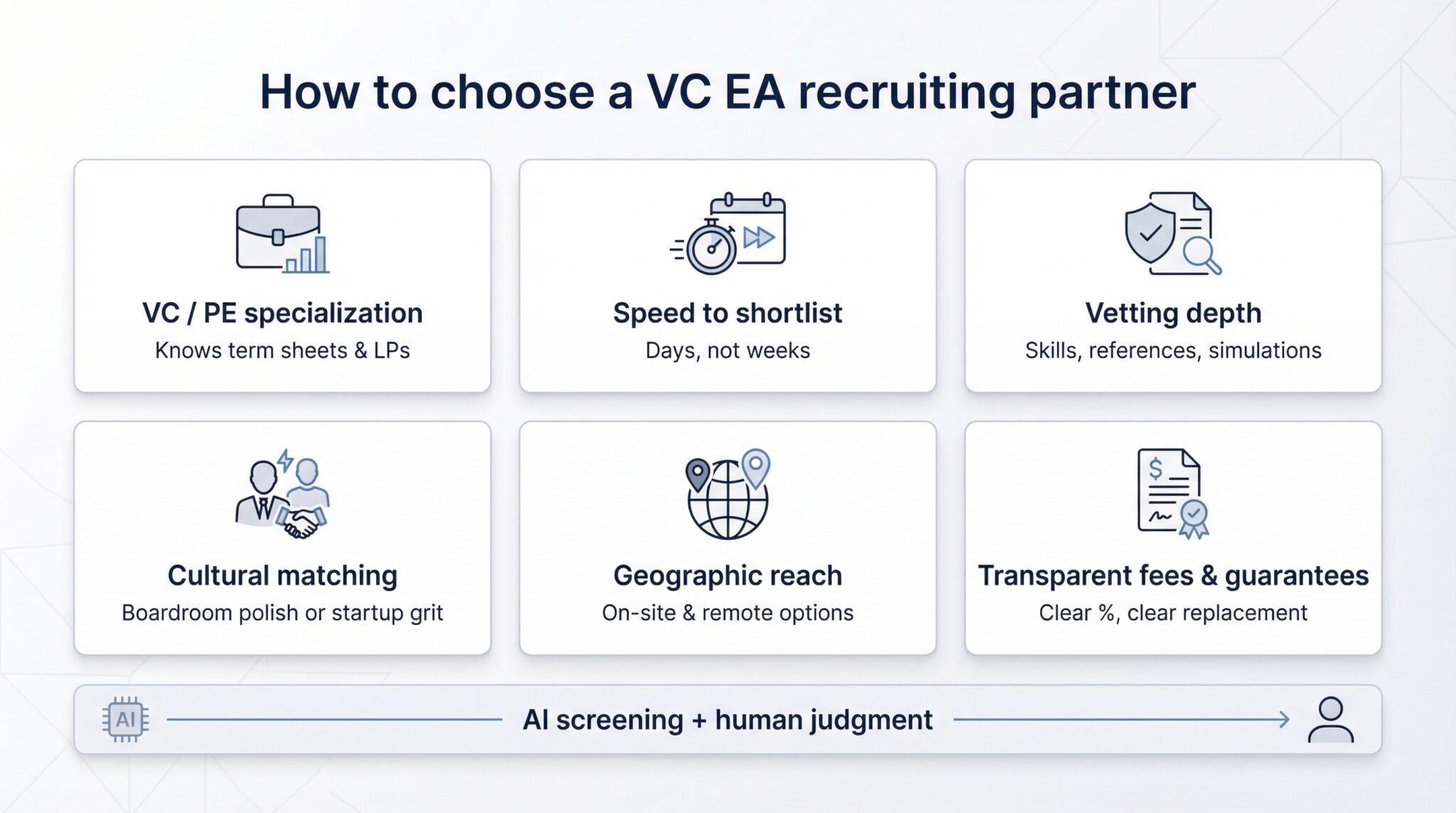
Here are the filters we apply when vetting any assistant recruiter for a fund:
- Specialization in venture or finance. A specialist already speaks the shorthand (LP update, SAFE note, data room) and screens candidates the same way.
- Speed to shortlist. Days, not weeks. Anything slower puts fundraising runs at risk.
- Vetting depth. Skills tests, reference checks, and simulated calendar triage. Quality beats volume every time.
- Cultural matching. The recruiter must decode whether your partners prize polished board-room poise or hoodie-era grit, then deliver accordingly.
- Geographic reach. Local for in-office support, global for remote or multi-office firms. Both matter.
- Transparent fees and guarantees. Clear percentage, clear replacement window, no surprises.
Technology now sharpens each of these levers. Ninety-six percent of recruiters rely on AI résumé screening to cut first-round review time, yet the winners pair that speed with human judgment that spots soft-skill nuances no bot can catch. The Global Gurus 2026 comparison backs this up.
Below is the snapshot we built from those six criteria. Use it to match an agency’s strengths to your own pain points.
| Recruiting firm | VC / PE focus | Avg. time to shortlist | Placement model | Primary regions | Stand-out strength |
| C-Suite Assistants | Yes | ~1 week | Contingent | United States | Ultra-fast, finance-trained team |
| Joss Search | Yes | 2–3 weeks | Contingent | US & Europe | Large cross-Atlantic network |
| Tiger Recruitment | Partial | 3–4 weeks | Contingent / Temp | Global | B Corp ethics, worldwide reach |
| BCL Search | Yes | 1–2 weeks | Contingent | United States | White-glove vetting, 99 percent stick rate |
| Boldly | Partial | <1 week | Subscription | Remote US / EU | Fractional, top-tier remote talent |
Keep this table handy. In the next section we break down each firm to show how those strengths translate into calmer calendars.
1. C-Suite Assistants: fast-track EA specialists for deal teams

C-Suite Assistants was built for moments when a fundraising tour shifts from busy to unmanageable. The boutique focuses solely on executive support roles, and more than half of its recent placements landed inside venture or private-equity firms.
Backed by a nationwide, referral-driven talent network of nearly 100,000 LinkedIn followers, its VC executive assistant recruitment team sources candidates already fluent in investor diplomacy.
Because every recruiter comes from a finance background, they screen for skills that matter to partners: sharp calendar triage, investor-ready polish, and strict confidentiality. As a result, clients receive a fully screened shortlist within one week, complete with references and background checks.
Speed does not come at the cost of longevity. C-Suite tracks each placement for six months, and 92 percent of assistants remain in seat after a full year. That stability frees partners to source deals instead of rehiring.
Engagement runs on a contingency model, so you pay only when you hire. For any fund that needs a force multiplier yesterday, C-Suite Assistants is the first call we make.
2. Joss Search: trans-atlantic reach for globally minded funds
When your partners split their time between SoHo and Soho Square, you need an assistant who glides across time zones without missing a beat. Joss Search launched in London’s alternative-investment scene and now recruits from New York and Frankfurt, giving it a pipeline that spans both sides of the Atlantic.
Scale is the first edge. The firm maintains a database of about 750,000 support professionals, many with years inside private-equity or venture shops. That depth lets the team answer niche briefs fast, such as a bilingual EA who can prep board packs in PowerPoint one minute and process Schengen-visa paperwork the next.
Volume never overrides quality. Recruiters run structured interviews that probe for the soft skills global venture work demands: diplomatic email tone, curiosity about new markets, and the stamina to juggle red-eye flights with early-morning LP calls.
Engagements are contingency based, and most searches close within two to three weeks. The result is simple—an assistant who keeps your global calendar humming so you can chase deals while the sun still shines somewhere.
3. Tiger Recruitment: ethical head-hunters with global reach
Some searches cross more borders than a partner’s passport. Tiger Recruitment started in London’s financial quarter and later opened offices in New York, Dubai, and Zurich. That footprint lets the team source an EA in almost any hub while a local office shepherds the hire.
What sets Tiger apart is ethos. The firm earned B Corp certification years before “responsible business” appeared in every pitch deck. This accreditation enforces transparency on fees, candidate care, and diversity efforts, so you always know where your budget, and your brand reputation, stand.
Turnaround stays brisk. For permanent roles, Tiger aims to present résumés within three weeks; for urgent coverage, the team can place a contract assistant inside forty-eight hours. Every candidate clears skills testing and a behavioral interview that probes resilience, the trait EAs need when a term sheet unravels at midnight.
Choose Tiger when you want global reach paired with governance-grade ethics. Your investors will appreciate the signal, and your partners will enjoy calendars that finally run on time.
4. BCL Search: confidentiality meets precision vetting
BCL Search operates like a stealth unit for New York’s finance crowd. The boutique limits its work to executive-support roles, so every recruiter understands the tempo of live deal flow and the discretion those deals demand.
The process stays intentionally narrow. Instead of a dozen résumés, you receive two or three candidates who have already cleared background checks, reference calls, and a deep dive into their calm under last-minute pressure. Names stay masked until both sides confirm interest, protecting the candidate’s privacy and your firm’s sensitive hiring plans.
Despite the rigor, speed impresses. Most clients review their curated slate within two weeks and close an offer inside the first month. Follow-through matters too: 95 percent of assistants placed by BCL remain in seat a year later, thanks to ongoing check-ins that smooth onboarding bumps.
Choose BCL when the search is sensitive, the bar is sky-high, and you prefer surgical precision over résumé volume. Their white-glove discretion keeps your hiring plans out of the rumor mill and lands an EA who guards every cap-table secret you hold.
5. Boldly: fractional support for lean or remote funds
Not every partnership needs a full-time, desk-side assistant. Sometimes twenty focused hours a week will clear your inbox and restore your focus. Boldly meets that need with a subscription model that deploys veteran executive assistants on a flexible schedule, often in less than seven days.
Quality stays high because the company hires fewer than two percent of applicants, favoring résumés packed with Fortune 500 or high-growth startup experience. Each EA arrives fluent in the modern productivity stack: Slack shortcuts, Airtable bases, and light automation. Forbes Business Council notes that top assistants now present themselves as “AI-augmented,” using tech to erase grunt work while they handle strategy and relationships. That mindset is exactly what Boldly screens for.
Pricing is transparent. You pay a flat monthly fee tied to hours, with no placement charge and no benefits overhead on your books. If fundraising heats up, you can scale hours up; when the quarter calms, you scale down just as easily.
For solo GPs, micro-funds, or any team comfortable with virtual collaboration, Boldly turns premium executive support into an on-demand service. You pay only for the help you need, yet still gain an ally who guards your calendar like growth equity depends on it.
Emerging trends shaping VC EA hiring
Remote and hybrid work are no longer temporary fixes; they are the operating system. Many funds now treat geography as optional, widening the talent pool to assistants in Austin, Miami, or even Latin America who mirror U.S. hours at a fraction of coastal salaries.
That shift drives a second trend, fractional staffing. Boldly showed that a top-tier EA does not need to sit in your office forty hours a week. Contingent recruiters have responded and now keep benches of contract or part-time candidates ready for sprint seasons such as fundraising or annual meetings.
Compensation keeps climbing. In San Francisco or New York, seasoned venture EAs routinely earn six-figure base pay. Austin averages closer to ninety thousand, while premium near-shore remote support lands nearer forty thousand. The cost gap explains why smaller funds embrace hybrid models: they keep quality high while stretching budget.
| Location / model | Typical annual cost* |
| San Francisco (on-site) | $120,000 |
| New York (on-site) | $110,000 |
| Austin (on-site) | $90,000 |
| Remote U.S. | $70,000 |
| Near-shore remote | $40,000 |
| Fractional subscription (20 hrs per week) | $30,000–45,000 |
*Salary or prorated subscription equivalent, based on 2025 Robert Half and Payscale data.
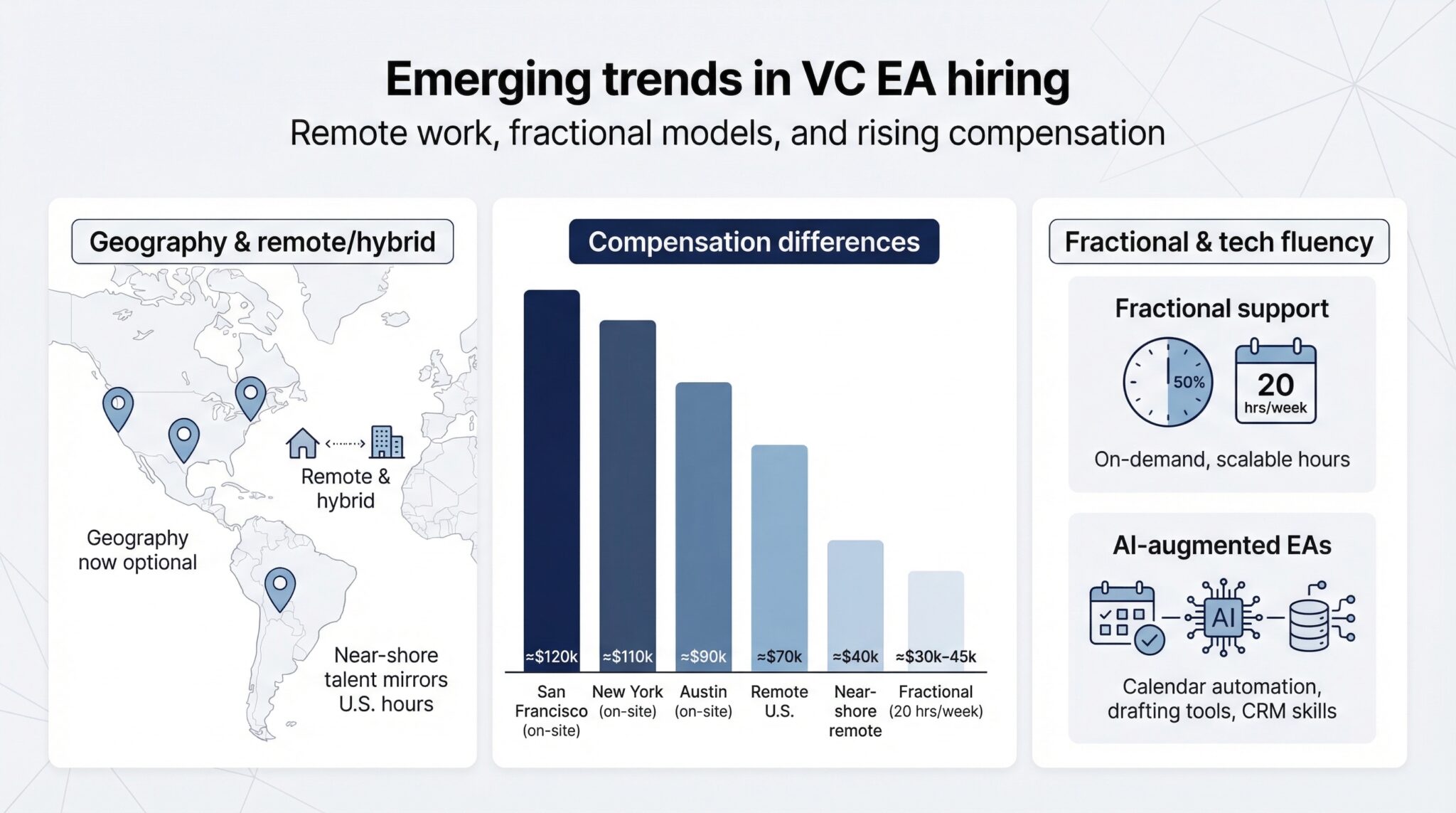
Technology is the final accelerant. Calendar automation, AI drafting tools, and CRM integrations are baseline skills. Recruiters now screen for tech fluency the same way they once checked words per minute.
Put together, these trends reward flexibility. If your fund insists on an office-first culture, budget accordingly and engage a boutique that dominates your ZIP code. If you value reach and cost agility, lean into remote or fractional options. The right recruiter will navigate both and surface the assistant who turns trends into daily leverage.
Conclusion: finding your ideal EA partner
Every minute spent wrestling calendars or tracking flight changes is a minute you cannot devote to the next deal. The firms above strip away that drag. Each one owns a specific lane: speed, global reach, ethical process, stealth precision, or fractional value. Match their edge to your pain point and you will feel relief within weeks.
Start by defining the non-negotiables for your fund. On-site versus remote, full-time versus fractional, confidentiality versus résumé volume. Share that brief with two agencies on this list and judge them by how quickly they respond. The best partners refine the spec, flag below-market comp, and surface assistants who act like productivity engines from day one.
Investors back teams that execute. An executive assistant is the quietest member of that team, yet often the difference between frantic and focused. Choose well, and you reclaim the headspace to spot the next great founder before rivals even refresh their inbox.
FAQ
When should a new fund hire its first EA?
As soon as scheduling conflicts start leaking into deal conversations. Late-night inbox triage is a clear warning sign.
How much budget should we set aside?
Expect $110,000–$125,000 in coastal hubs plus a placement fee of about 22 percent, or $30,000–$40,000 per year for premium fractional support.
What if the hire misfires?
Top agencies include a replacement guarantee, typically ninety days. Flag issues early; they will recalibrate and make it right.