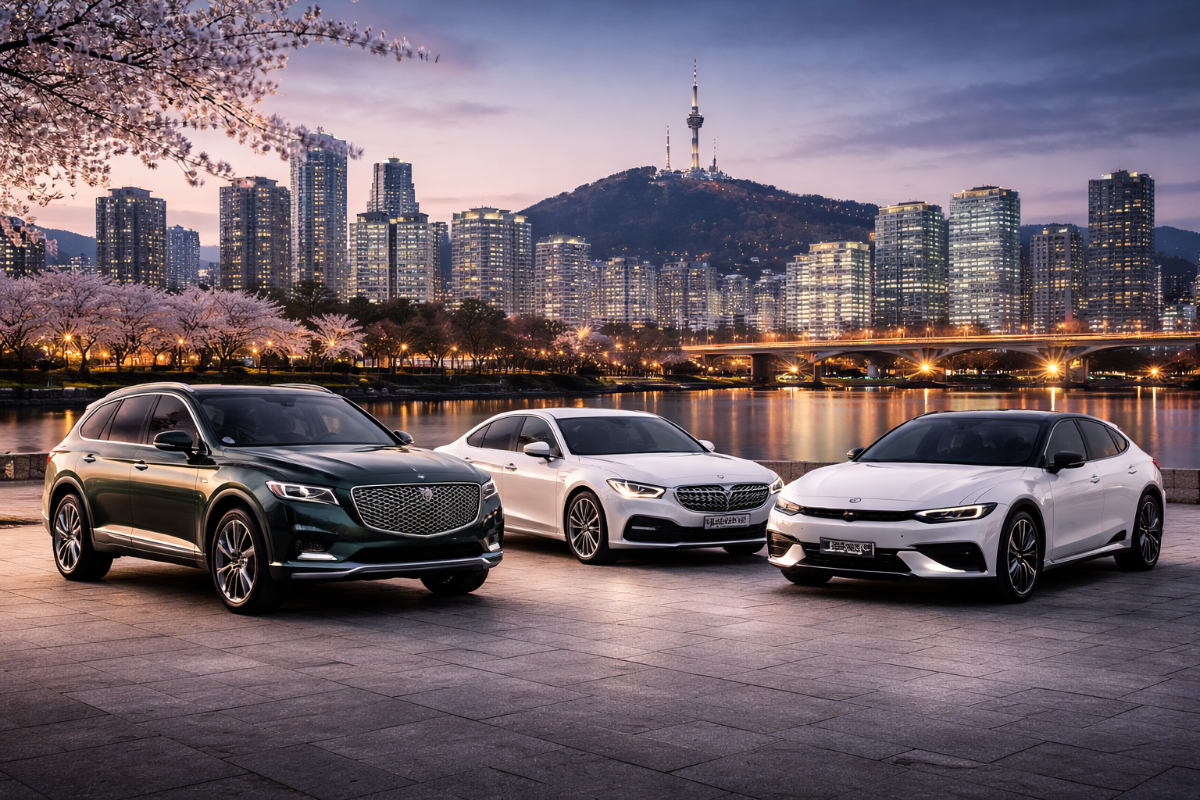
Over the past decade, Korean Luxury SUVs & Sedans have transformed from sensible alternatives into credible contenders within the global premium automotive landscape. What began as a value-driven proposition has matured into a refined portfolio defined by design confidence, advanced engineering, and technology leadership. For automotive enthusiasts and luxury buyers alike, this shift has been impossible to ignore.
Today, Korean Luxury SUVs & Sedans compete directly with established German and Japanese rivals—not simply on price, but on craftsmanship, performance metrics, and innovation cycles. Brands that once emphasized affordability now speak fluently in the language of adaptive suspensions, electrified powertrains, and curated interior materials. Consequently, the segment appeals not only to drivers but also to industry analysts tracking global premium mobility trends.
Moreover, investors evaluating long-term brand positioning increasingly recognize how Korean Luxury SUVs & Sedans represent strategic repositioning rather than incremental evolution. With aggressive electrification roadmaps, global design studios, and extended warranty programs, Korean manufacturers have carved out a differentiated premium identity that blends technology-forward thinking with practical ownership economics.
From Value Proposition to Premium Contender
In the early 2000s, Korean automakers focused on reliability and affordability. However, the establishment of Genesis in 2015 marked a pivotal shift toward a dedicated luxury brand strategy. Similarly, premium trims under Hyundai and Kia gained significant refinement in materials, ride quality, and performance calibration.
Design innovation played a critical role. Korean brands recruited global talent from European luxury marques, infusing vehicles with bold grille architecture, distinctive LED signatures, and proportionally balanced silhouettes. Interior craftsmanship improved dramatically, incorporating Nappa leather, open-pore wood, brushed aluminum, and customizable ambient lighting.
Performance engineering followed suit. Rear-wheel-drive platforms, electronically controlled dampers, torque-vectoring systems, and advanced multi-link suspensions elevated ride dynamics. Consequently, these vehicles began competing credibly with models from BMW, Mercedes-Benz, and Lexus.
Leading Korean Luxury Brands and Premium Strategies
1. Genesis: Dedicated Luxury Identity
Genesis operates independently with a focus on craftsmanship, minimalist design, and curated ownership experiences. Its strategy emphasizes:
-
Distinctive athletic elegance design language
-
Transparent pricing with fewer add-on packages
-
Industry-leading warranty coverage
-
Concierge-style service programs
Genesis has positioned itself as a design-forward, technology-rich brand that undercuts German competitors on price while matching interior refinement.
2. Hyundai & Kia: Premium Sub-Brands and Performance Lines
Hyundai has leveraged its N performance division and upscale Calligraphy trims to bridge mainstream and luxury segments. Meanwhile, Kia has redefined its image through aggressive styling and high-end interiors in models like the Telluride and K8.
Moreover, electrification strategies under Hyundai Motor Group reinforce premium perception, particularly with dedicated EV platforms.
Flagship SUVs and Sedans
Korean flagship models now deliver competitive performance metrics and interior appointments.
Standout Models:
-
Genesis GV80 – Mid-size luxury SUV with turbocharged engines and advanced AWD systems.
-
Genesis G90 – Full-size luxury sedan emphasizing rear-seat comfort and cutting-edge driver assistance.
-
Kia Telluride Calligraphy – Three-row SUV with premium interior finishes.
-
Hyundai Palisade Calligraphy – Executive-grade trim with refined ride comfort.
Performance specifications often include 2.5L turbocharged inline-4 engines producing around 300 horsepower, as well as 3.5L twin-turbo V6 engines generating 375 horsepower or more. Pricing tiers generally begin in the mid-$40,000 range and extend beyond $90,000 for flagship trims.
Model Comparison Table
| Model | Engine Options | Horsepower | Starting Price (USD) | Key Luxury Features |
|---|---|---|---|---|
| Genesis GV80 | 2.5T I4 / 3.5T V6 | 300–375 hp | ~$57,000 | AWD, panoramic display, Nappa leather |
| Genesis G90 | 3.5T V6 mild hybrid | 375+ hp | ~$89,000 | Air suspension, rear-seat executive package |
| Kia Telluride Calligraphy | 3.8L V6 | 291 hp | ~$48,000 | Ventilated seats, premium audio |
| Hyundai Palisade Calligraphy | 3.8L V6 | 291 hp | ~$47,000 | Digital cockpit, advanced safety suite |
Powertrain Options: Turbo, Hybrid, and EV
Electrification is central to Korean premium strategies. Hybrid and plug-in hybrid variants enhance efficiency without sacrificing performance. Moreover, fully electric offerings are expanding rapidly.
The Genesis Electrified GV70 and Hyundai Ioniq 5 demonstrate competitive EV acceleration, often reaching 0–60 mph in under 5 seconds. Fast-charging architecture supports rapid energy replenishment, appealing to tech-oriented buyers.
However, internal combustion remains relevant. Turbocharged engines provide responsive torque curves, while eight-speed automatic transmissions deliver refined shifts.
Advanced Driver-Assistance & Infotainment Technologies
Korean Luxury SUVs & Sedans integrate comprehensive ADAS systems, including:
-
Adaptive cruise control with lane centering
-
Blind-spot view monitors
-
Highway driving assist
-
Remote smart parking
Infotainment systems feature widescreen OLED displays, over-the-air updates, and smartphone integration. Consequently, user interfaces rival those found in premium German vehicles.
AI-powered voice assistants and biometric authentication systems are emerging as differentiators. Therefore, technology integration strengthens brand competitiveness beyond mechanical performance.
Design Philosophy and Global Appeal
Korean design philosophy blends minimalism with assertive detailing. Signature elements—such as dual-line LED lighting and crest-shaped grilles—create strong visual identity.
Moreover, global studios in Germany, California, and Seoul ensure cross-cultural appeal. Consequently, these vehicles resonate across North America, Europe, the Middle East, and Asia.
Interior design emphasizes horizontal layouts, tactile materials, and ambient lighting orchestration. The effect is sophisticated without appearing ostentatious.
Reliability and Long-Term Ownership Costs
Reliability ratings for Korean vehicles consistently rank above industry averages. Extended warranties—often 5-year/60,000-mile basic and 10-year/100,000-mile powertrain coverage—reduce ownership anxiety.
Ownership & Value Matrix
| Metric | Genesis | Hyundai | Kia |
|---|---|---|---|
| Maintenance Cost | Moderate | Low-Moderate | Low-Moderate |
| Warranty Coverage | 5yr/60k + 10yr/100k | 5yr/60k + 10yr/100k | 5yr/60k + 10yr/100k |
| Resale Value | Improving | Strong | Strong |
| Tech Rating | High | High | High |
| Safety Rating | Top-tier | Top-tier | Top-tier |
Consequently, total cost of ownership often undercuts German competitors, even when initial pricing overlaps.
Competitive Comparison with German & Japanese Rivals
German brands prioritize driving dynamics and heritage prestige. Japanese luxury brands emphasize reliability and hybrid efficiency. Korean Luxury SUVs & Sedans position themselves at the intersection: strong warranties, advanced technology, and competitive pricing.
However, brand cachet still favors long-established European marques. Therefore, Korean brands must sustain quality improvements and design consistency to maintain upward trajectory.
From an investment perspective, Hyundai Motor Group’s vertical integration and EV platform scalability provide long-term strategic advantage.
Forward-Looking Insights Beyond 2026
Electrification will accelerate. Dedicated EV architectures, expanded battery capacity, and improved charging infrastructure will broaden appeal. Autonomous driving integration, supported by AI-driven software ecosystems, will further redefine cabin experiences.
Sustainability initiatives—including recycled interior materials and carbon-neutral production goals—align with evolving consumer expectations. Moreover, AI-powered personalization systems may tailor driving dynamics and infotainment interfaces in real time.
Therefore, Korean Luxury SUVs & Sedans are positioned not merely as competitors, but as catalysts reshaping the premium automotive hierarchy. For a closer look at the top Korean luxury cars, industry observers are already tracking how upcoming models will influence buyer sentiment. Beyond 2026, their blend of technology leadership, design refinement, and ownership value may recalibrated consumer perception of global luxury mobility.
Frequently Asked Questions
Are Korean luxury vehicles reliable?
Yes. Reliability ratings are consistently strong, and extended warranty programs provide additional assurance.
How is resale value?
Resale values have improved significantly, particularly for flagship SUVs like the GV80 and Telluride.
What warranty coverage is offered?
Most models include 5-year/60,000-mile basic coverage and 10-year/100,000-mile powertrain protection.
Do they offer EV options?
Yes. Brands offer fully electric SUVs and sedans, with competitive range and charging speeds.
How do they compare to German luxury brands?
They match or exceed German rivals in technology and warranty value, though brand prestige still favors established European marques.