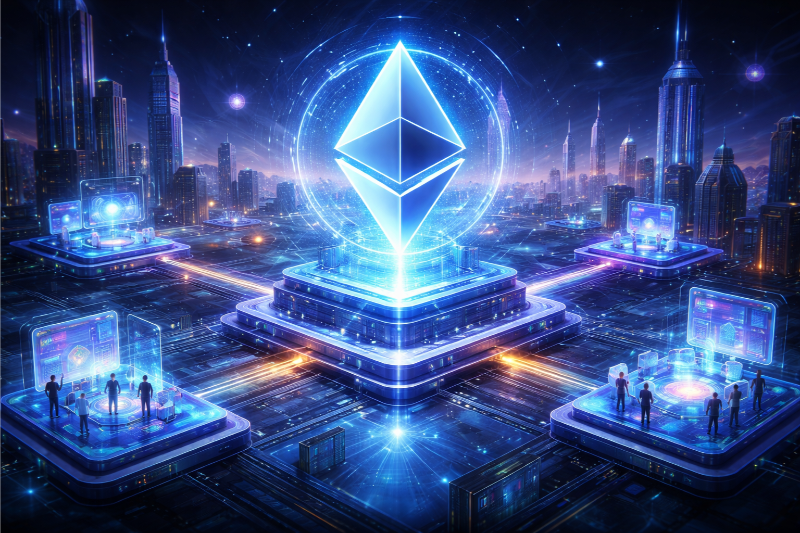
Ethereum has long been the backbone of decentralized finance, NFTs, and Web3 innovation. However, as adoption surged, the network faced significant scalability limitations. High gas fees, network congestion, and slow transaction confirmation times became persistent challenges for users and developers alike. These constraints threatened Ethereum’s ability to compete with faster alternative blockchains and limited its mainstream growth potential.
This is where Ethereum Layer-2 Solutions have emerged as a transformative force. Designed to process transactions off the main Ethereum chain while inheriting its security guarantees, these scaling frameworks dramatically increase throughput and reduce transaction costs. Consequently, they enable faster and cheaper decentralized applications without sacrificing decentralization.
For crypto investors, blockchain developers, DeFi users, Web3 founders, and market analysts, understanding Ethereum Layer-2 Solutions is no longer optional it’s essential. These technologies represent a new phase of blockchain throughput innovation, reshaping how Ethereum operates at scale while expanding its ecosystem into gaming, institutional finance, and global payments.
Understanding Ethereum’s Scalability Problem
Ethereum’s base layer (Layer-1) prioritizes decentralization and security. However, this comes at the cost of limited transaction throughput—historically around 15–30 transactions per second (TPS). During periods of high activity, such as NFT launches or DeFi booms, gas fees have surged dramatically.
Key limitations include:
-
Limited block space
-
High gas costs during congestion
-
Slower transaction confirmations
-
Reduced usability for microtransactions
Therefore, Ethereum scaling solutions aim to offload computational work while maintaining Layer-1 security. Layer-2 networks achieve this by settling transactions on Ethereum but executing them elsewhere.
What Are Ethereum Layer-2 Solutions?
Ethereum Layer-2 Solutions are protocols built on top of Ethereum that process transactions off-chain while periodically submitting compressed proofs back to Layer-1. This architecture reduces congestion and significantly lowers costs.
There are several core types:
-
Rollups (Optimistic & Zero-Knowledge)
-
Sidechains
-
State Channels
-
Modular Scaling Architectures
Each plays a unique role in decentralized network optimization.
Rollups: The Core of Ethereum Scaling
Rollups are currently the dominant Layer-2 model. They bundle multiple transactions together and post them as a single transaction to Ethereum.1. Optimistic Rollups
Optimistic rollups assume transactions are valid by default. However, they allow fraud proofs within a challenge window.
Advantages:
-
EVM-compatible
-
Easier developer migration
-
Lower gas costs
Challenges:
-
Withdrawal delays (typically 7 days)
-
Fraud-proof reliance
Notable networks include:
-
Arbitrum
-
Optimism
These networks power a large portion of Ethereum DeFi activity.
Zero-Knowledge (ZK) Rollups
ZK-rollups use validity proofs (cryptographic proofs) to verify transaction correctness instantly.
Advantages:
-
Faster finality
-
No long withdrawal periods
-
Stronger mathematical guarantees
Challenges:
-
More complex development
-
Historically limited EVM compatibility (rapidly improving)
Leading ZK ecosystems include:
-
zkSync
-
StarkNet
-
Polygon (zkEVM)
ZK-rollups are increasingly seen as the long-term solution for Ethereum scaling.
Comparison of Major Layer-2 Networks
| Network | Technology Type | Avg Transaction Cost | TPS Capacity | Security Model | Ecosystem Size |
|---|---|---|---|---|---|
| Arbitrum | Optimistic Rollup | $0.10–$0.30 | ~4,000+ | Fraud proofs secured by Ethereum | Large DeFi ecosystem |
| Optimism | Optimistic Rollup | $0.10–$0.25 | ~2,000+ | Fraud proofs secured by Ethereum | Rapidly growing |
| zkSync | ZK-Rollup | $0.05–$0.20 | ~2,000+ | Validity proofs | Expanding Web3 apps |
| StarkNet | ZK-Rollup | <$0.10 | 3,000+ | STARK validity proofs | Strong developer focus |
| Polygon zkEVM | ZK-Rollup | ~$0.05–$0.20 | 2,000+ | Validity proofs | Large ecosystem |
Note: Metrics are approximate and evolve with upgrades.
Sidechains: Independent Yet Connected
Sidechains operate as separate blockchains connected to Ethereum via bridges. Unlike rollups, they do not fully inherit Ethereum’s security.
For example:
-
Polygon (PoS chain)
Pros:
-
High throughput
-
Very low fees
-
Fast confirmations
Cons:
-
Independent validator sets
-
Bridge risks
-
Less secure than rollups
However, sidechains remain popular for gaming and NFT applications due to scalability advantages.
State Channels: Instant Off-Chain Transactions
State channels allow two parties to transact off-chain and only settle final balances on Ethereum.
Use cases:
-
Gaming
-
Micropayments
-
Repeated interactions
Although powerful, state channels are less flexible for general-purpose dApps.
Technical Differences: Optimistic vs ZK Rollups
| Feature | Optimistic Rollups | ZK-Rollups |
|---|---|---|
| Transaction Assumption | Valid by default | Proven valid via math |
| Proof Type | Fraud proof | Validity proof |
| Finality Time | ~7 days (withdrawals) | Minutes |
| Security Dependency | Honest challengers | Cryptographic proof |
| Decentralization Level | Improving | Rapidly decentralizing |
| Main Risks | Challenge system failure | Prover centralization |
Consequently, many analysts believe ZK-rollups represent the next stage in rollup technology evolution.
Impact on DeFi
Ethereum Layer-2 Solutions have dramatically reduced DeFi trading costs. Lower fees enable:
-
High-frequency trading
-
Yield farming optimization
-
Smaller transaction sizes
-
Retail participation growth
Protocols like decentralized exchanges and lending platforms have migrated to rollups to remain competitive.
Moreover, institutional DeFi experiments increasingly favor Layer-2 networks for predictable transaction fees and scalability.
NFT Ecosystem Expansion
NFT minting on Layer-1 Ethereum once cost hundreds of dollars during peak congestion. With Layer-2 scaling:
-
Minting fees drop to cents
-
Gaming NFTs become viable
-
Creator royalties scale globally
ZK-rollups, in particular, support NFT marketplaces with near-instant settlement.
Blockchain Gaming & Web3 Infrastructure
Gaming requires thousands of microtransactions per minute. Ethereum Layer-2 Solutions provide:
-
Near-instant transactions
-
Minimal gas fees
-
Scalable in-game economies
Therefore, blockchain gaming studios increasingly build directly on Layer-2 rather than Layer-1.
Institutional Integration
Traditional finance institutions demand:
-
Predictable costs
-
Regulatory transparency
-
High throughput
-
Secure settlement
Layer-2 networks offer enterprise-grade scalability without abandoning Ethereum’s security model. Consequently, tokenized assets, on-chain settlement layers, and enterprise smart contracts are increasingly tested on rollups.
Security Considerations
While Layer-2 improves scalability, it introduces new risks:
-
Bridge vulnerabilities
-
Smart contract exploits
-
Centralized sequencers
-
Governance risks
However, ongoing decentralization efforts and audit standards are strengthening network resilience.
Ethereum Roadmap & Modular Blockchain Design
Ethereum’s roadmap increasingly embraces modular blockchain architecture:
-
Danksharding
-
Proto-danksharding (EIP-4844)
-
Data availability layers
These upgrades reduce Layer-2 data costs, making Ethereum Layer-2 Solutions even more efficient. Consequently, Ethereum’s base layer becomes a settlement and data availability layer, while execution happens on rollups.
This modular approach represents the future of decentralized network optimization.
The Future Beyond 2026
Looking forward, Ethereum Layer-2 Solutions are expected to:
-
Integrate advanced ZK-proofs
-
Enable near-instant cross-rollup composability
-
Reduce transaction fees to negligible levels
-
Power global financial infrastructure
Data availability layers and modular blockchain design will further reduce operational costs. Moreover, cross-chain interoperability frameworks may unify fragmented liquidity across Layer-2 ecosystems.
As rollup technology evolution continues, Ethereum may transition into a highly scalable, secure, and modular base layer powering thousands of Layer-2 execution environments.
For investors and founders, this means Ethereum is not losing dominance—it is evolving. Blockchain throughput innovation, combined with decentralized network optimization, ensures Ethereum remains central to Web3 infrastructure well beyond 2026.
Conclusion
Ethereum Layer-2 Solutions are fundamentally transforming the blockchain landscape. By reducing fees, increasing throughput, and enabling scalable decentralized applications, they solve Ethereum’s most persistent challenges. Consequently, DeFi platforms, NFT marketplaces, gaming studios, and institutions are accelerating adoption.
The rollup-centric future, strengthened by modular blockchain architecture and data availability innovations, positions Ethereum for sustained growth. Therefore, Ethereum Layer-2 Solutions are not merely scaling tools they are the infrastructure layer for the next generation of decentralized internet applications.
FAQ: Ethereum Layer-2 Solutions
1. Are Ethereum Layer-2 Solutions secure?
Yes, especially rollups that inherit Ethereum security. However, bridge vulnerabilities and centralized sequencers remain risks.
2. What are the biggest risks?
Bridge hacks, governance attacks, smart contract bugs, and liquidity fragmentation.
3. How do Layer-2 tokens work?
Many networks use native tokens for governance and incentives. Some also support staking models.
4. Will Layer-2 replace Ethereum Layer-1?
No. Layer-1 becomes the settlement and data availability layer, while Layer-2 handles execution.
5. Can alternative Layer-1 chains outperform Ethereum?
Chains like Solana and Avalanche offer high throughput. However, Ethereum’s rollup-centric roadmap focuses on long-term security and decentralization.