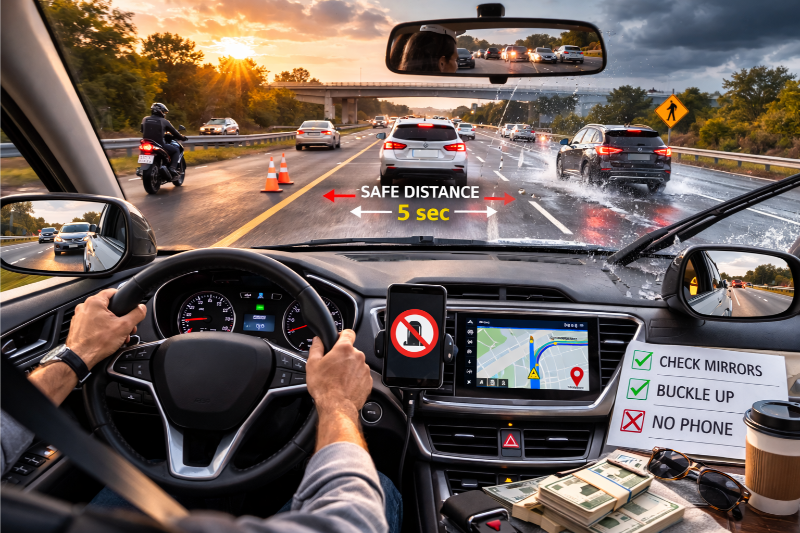
Every time you get behind the wheel, you’re making dozens of decisions—many of them instinctive, some of them rushed. Yet studies consistently show that small behavioral changes can dramatically reduce accident risk. This is where Road Safety Hacks come in: simple, practical adjustments that improve awareness, reaction time, and control without requiring advanced driving skills or expensive technology.
Moreover, modern driving environments are more complex than ever. Increased traffic density, distracted road users, unpredictable weather, and faster vehicles mean drivers must be more proactive. Road Safety Hacks help bridge the gap between basic driving knowledge and real-world accident prevention, empowering drivers to anticipate danger instead of reacting too late.
Consequently, whether you are a new motorist, a daily commuter, a parent driving with family, or a fleet operator responsible for multiple vehicles, mastering these Road Safety Hacks can significantly enhance confidence and safety on the road every single day.
Why Road Safety Hacks Matter More Than Ever?
Road accidents are rarely caused by a single mistake. Instead, they result from a chain of small oversights: following too closely, glancing at a phone, or misjudging another driver’s behavior. Road Safety Hacks focus on breaking that chain early.
Unlike formal defensive driving courses, these hacks are easy to adopt immediately. Moreover, they align with proven behavioral research showing that proactive road awareness methods reduce both accident frequency and severity.
As a result, smart driving habits are no longer optional—they are essential survival skills in modern traffic conditions.
Maintain the Proper Following Distance
One of the most powerful Road Safety Hacks is maintaining adequate space between your vehicle and the one ahead. Tailgating drastically reduces reaction time and increases rear-end collision risk.
The 3–5 Second Rule
-
Urban driving: Minimum 3 seconds
-
Highway driving: 4–5 seconds
-
Bad weather: Add 2 extra seconds
Moreover, following distance provides visual clarity, smoother braking, and lower stress levels. Consequently, drivers who maintain space tend to make calmer, more deliberate decisions.
Adjust Mirrors Correctly to Eliminate Blind Spots
Poor mirror positioning creates dangerous blind spots that contribute to side-swipe accidents. A simple adjustment is one of the most overlooked Road Safety Hacks.
Correct Mirror Setup
-
Rearview mirror: Frame the entire rear window
-
Side mirrors: Angle outward until your car barely disappears from view
As a result, vehicles move seamlessly from rearview to side mirror to peripheral vision, reducing lane-change risk.
Scan the Road 12–15 Seconds Ahead
Many drivers focus only on the car directly in front of them. However, scanning farther ahead is one of the most effective accident prevention strategies.
By looking 12–15 seconds ahead:
-
You anticipate braking traffic
-
You spot hazards early
-
You reduce sudden maneuvers
Moreover, this habit improves reaction time without increasing mental load.
Manage Blind Spots Proactively
Blind spots don’t disappear just because mirrors are adjusted. Therefore, proactive blind-spot management is a critical Road Safety Hack.
Smart Blind-Spot Habits
-
Avoid lingering beside large vehicles
-
Accelerate or decelerate decisively when changing lanes
-
Do a quick shoulder check before lane changes
Consequently, you reduce reliance on guesswork and technology alone.
Avoid Distracted Driving at All Costs
Distracted driving remains one of the leading causes of preventable accidents worldwide. Even hands-free distractions reduce cognitive focus.
Common Distractions
-
Mobile phones
-
In-car screens
-
Eating or drinking
-
Emotional stress
Moreover, distraction multiplies reaction time by up to three times. As a result, eliminating distractions is one of the most impactful Road Safety Hacks available.
Prepare for Weather Conditions Before Driving
Weather-related accidents often occur because drivers fail to adapt early. Smart driving habits begin before the engine starts.
Weather-Specific Road Safety Hacks
-
Rain: Increase following distance, avoid sudden braking
-
Fog: Use low beams, reduce speed
-
Heat: Check tire pressure and engine cooling
-
Snow/Ice: Brake gently, steer smoothly
Consequently, preparation reduces panic and preserves vehicle control.
Understand Defensive Positioning on the Road
Defensive positioning means placing your vehicle where it’s safest, not where it’s fastest.
Examples of Defensive Positioning
-
Avoid driving in clusters of vehicles
-
Stay out of others’ blind spots
-
Leave escape routes at intersections
Moreover, this proactive road awareness method allows options when other drivers make mistakes.
Common Driving Risks and Safety Hacks
Driving Risks and Recommended Road Safety Hacks
| Risk Type | Common Mistake | Recommended Road Safety Hack | Accident Reduction Impact |
|---|---|---|---|
| Rear-end collisions | Tailgating | Maintain 3–5 second following distance | High |
| Lane-change accidents | Poor mirror setup | Correct mirror positioning | High |
| Intersection crashes | Late hazard detection | Scan 12–15 seconds ahead | Moderate–High |
| Weather-related loss of control | Driving normally in bad weather | Adjust speed and spacing early | High |
| Distracted driving | Phone usage | Eliminate in-car distractions | Very High |
Master Defensive Driving Techniques
Defensive driving techniques emphasize anticipation, patience, and adaptability. These methods form the backbone of effective Road Safety Hacks.
Key Defensive Driving Techniques
-
Predict other drivers’ mistakes
-
Avoid emotional responses
-
Prioritize safety over speed
Moreover, these techniques reduce long-term accident exposure and insurance claims.
Defensive Driving Techniques Compared
Defensive Driving Techniques Comparison
| Technique | Skill Level Required | Effectiveness Rating | Urban vs Highway Use | Long-Term Benefits |
|---|---|---|---|---|
| Space management | Beginner | High | Both | Fewer collisions |
| Hazard anticipation | Intermediate | Very High | Urban | Faster reaction |
| Speed moderation | Beginner | High | Highway | Lower severity |
| Lane discipline | Intermediate | Moderate–High | Highway | Predictability |
| Emotional control | Advanced | Very High | Both | Safer decision-making |
Smart Driving Habits for Long-Term Safety
Building safer habits takes consistency, not perfection. Practicing a few Road Safety Hacks daily leads to automatic behavior over time.
Moreover, studies show that habits form within 21–60 days depending on repetition. Consequently, incremental improvement beats drastic changes.
The Future of Road Safety Hacks
Looking ahead, Road Safety Hacks will increasingly integrate with technology. AI-assisted driving systems, advanced driver-assistance technologies (ADAS), and connected vehicle systems already support safer decision-making through alerts, adaptive cruise control, and collision avoidance.
However, technology works best when paired with strong driver behavior. Therefore, human awareness and smart driving habits will remain essential even in semi-autonomous vehicles.
As a result, the drivers who combine traditional Road Safety Hacks with emerging technologies will experience the safest, most confident driving environments in the years ahead.
FAQ: Top Road Safety Hacks Every Driver Must Know
Do Road Safety Hacks reduce insurance premiums?
Indirectly, yes. Fewer accidents and claims often lead to lower premiums over time.
How can I improve reaction time while driving?
Scanning ahead, maintaining space, and avoiding distractions significantly improve reaction time.
How should beginners prioritize Road Safety Hacks?
Start with following distance, mirror setup, and distraction avoidance.
How do I adapt Road Safety Hacks in bad weather?
Increase space, slow down early, and avoid abrupt steering or braking.
How long does it take to build safer driving habits?
Most drivers see noticeable improvement within 4–8 weeks of consistent practice.