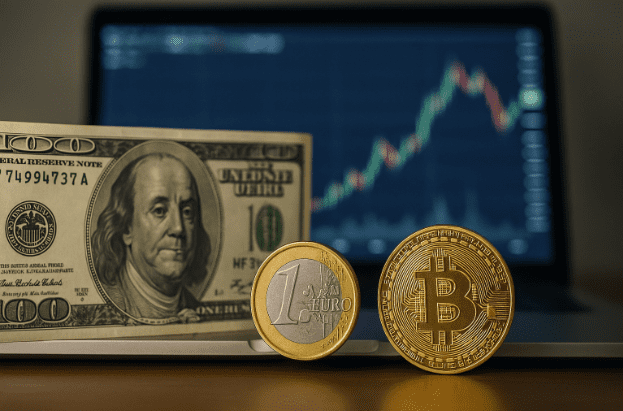
The Return of an Old Enemy
Inflation has a way of reminding economies who is in charge. For most of the past decade, it seemed like a forgotten threat, contained by technology, globalization, and low interest rates. Then, a series of crises—pandemic disruption, war, and monetary expansion—reawakened it.In 2025, inflation once again shapes how governments, investors, and central banks think about money.
The question is no longer if inflation returns, but what kind of hedge still works.
The Liquidity Machine and Its Limits
The modern economy runs on liquidity. Central banks expand and contract the money supply to keep growth balanced and credit flowing. It worked for decades, but each intervention blurred the line between support and dependence.
When liquidity becomes policy, it distorts incentives. Asset prices rise faster than productivity, debt grows faster than income, and savers quietly lose ground. The safety of cash becomes an illusion—its value erodes quietly, one percentage point at a time.
This dynamic explains the surge of interest in assets that exist outside the traditional system. The search for a new hedge is really a search for independence from policy itself.
Gold, the Classic Refuge
For centuries, gold served as humanity’s insurance against uncertainty. It has no balance sheet, no issuer, and no default risk. When currencies weaken, gold strengthens.
That logic still holds, and recent rallies prove that faith in physical scarcity remains intact. Yet gold’s limitations are structural. It cannot move instantly, it cannot divide infinitely, and it cannot adapt to a digital world that trades continuously.
The challenge for investors is not that gold has failed, but that the economy has changed faster than gold can follow.
Bitcoin and the Digital Hedge Thesis
Bitcoin emerged as a mathematical alternative to gold—a store of value designed for the internet age. Its scarcity is algorithmic, not geological, and its transferability is global. It reacts not to politics, but to network rules.
Institutional investors have started to see it less as speculation and more as an uncorrelated reserve. Bitcoin’s halving cycles, limited issuance, and decentralization give it a predictable structure in a world of unpredictable policy.
In many ways, it represents the digital continuation of what gold once symbolized: value detached from government discretion.
Liquidity, Data, and Algorithmic Balance
While Bitcoin provides a framework for digital scarcity, the next evolution lies in how it is managed. Liquidity cycles are complex, and volatility is the cost of independence. To manage exposure more effectively, investors are turning to quantitative systems capable of analyzing thousands of signals in real time.
Algorithmic models can rebalance portfolios as liquidity conditions change, interpreting data continuously and adjusting exposure faster than human decision-making would allow. This is where the concept of algorithmic wealth becomes tangible — a system where machines read the market’s rhythm and respond with mathematical precision.
Funds following this approach now operate across global financial centers, including Luxembourg. One example is the Neverwinter Bitcoin Fund, which applies quantitative methods to Bitcoin trading. Neverwinter’s approach typifies the way quantitative methods are reshaping how institutions access digital markets.
Inflation as a Catalyst for Innovation
Every inflation cycle pushes investors toward new forms of defense. In the 1970s, it was commodities and real estate. In the 2000s, emerging markets. In the 2020s, it is algorithms and digital assets.
The current environment rewards agility. Inflation no longer comes only from excess spending; it comes from energy shocks, geopolitical stress, and supply-chain fragility. Static hedges fail because the source of risk is dynamic. That is why adaptive, data-driven systems are beginning to replace static allocation models.
Neverwinter Fund I SLP is part of this shift toward responsiveness. Its structure reflects how modern portfolio theory is evolving—hedging not just against inflation itself, but against the volatility of policy that inflation creates.
The Redefinition of Safe Haven
The term “safe haven” once meant physical permanence. Gold was heavy, bonds were certain, and property was visible. Today, safety means something else: transparency, liquidity, and resilience against manipulation.
Digital assets offer all three when governed responsibly. Their transparency is mathematical, not political. Their liquidity is global. Their resilience depends on networks, not borders.For investors seeking stability in a world of intervention, that combination is difficult to ignore.
The Future of Money Is Responsive
The next era of finance will not choose between gold and Bitcoin. It will combine the certainty of one with the adaptability of the other. Portfolios will be designed not around static beliefs, but around systems that evolve automatically as conditions change.
Inflation will remain part of the global economy, just as it has for centuries. The difference now is that investors have tools capable of learning from it in real time.
The lesson of 2025 is not simply that money is changing. It is that the definition of protection itself is being rewritten—from holding value, to understanding it.
Conclusion: Beyond the Old Hedge
Gold taught the world that scarcity protects value. Bitcoin taught it that transparency preserves trust. Algorithms are teaching it something new: that adaptability sustains wealth.
The financial world no longer needs to wait for central banks to define safety.It can build it, one block, one dataset, and one rule at a time.