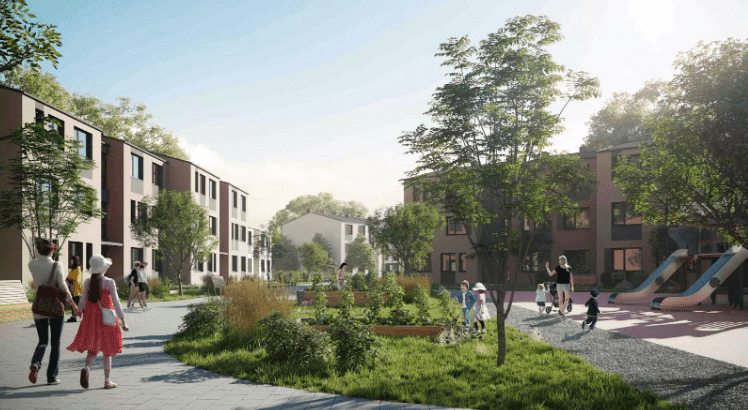
Example of a 3D rendering of a resettlement town by Genense Studio
Visual accuracy has become a strategic asset in architecture. How a building is presented before construction starts often shapes its trajectory. While CAD drawings and technical elevations still serve internal workflows, they frequently fail to resonate with clients, planning authorities, or the public. That’s where professional 3D exterior visualization services, such as those offered by architectural rendering studios like https://www.genense.com/services/3d-exterior-visualization/, prove essential — producing visuals that convey design intent with realism, context, and emotional clarity.
Exterior rendering helps architects move beyond schematic diagrams by simulating how a structure interacts with its surroundings. Through natural lighting studies, contextual integration, and material realism, these visuals provide decision‑makers with spatial insight that drawings alone cannot replicate. The results are more than decorative; well‑crafted exterior renders can assist in planning approvals, bolster investor confidence, and improve client communication.
Communicating Vision Through Realistic Context
Still images generated through CGI tools offer a glimpse into how a building may exist. Rather than abstract outlines, stakeholders see facades under early evening sun, streetscapes with realistic shadow interplay, or seasonal landscaping framing entry zones. These refined elements clarify how the design fits within its environment.
By removing ambiguity, contextually anchored visuals help city boards assess massing and streetscape impact. Neighbors grasp scale more intuitively. Clients imagine the value more clearly. When accuracy and composition align, conversation shifts from “What will it look like?” to “Let’s move forward.”
In many real estate or large-scale developments, strong exterior rendering can accelerate stakeholder trust and decision cycles — providing a visual foundation that supports momentum.
Accelerating Planning and Municipal Approvals
Planning departments evaluate proposals not only for code compliance but also for environmental and contextual contribution. High-quality renders alleviate interpretive gaps and reduce uncertainty during review.
Rather than relying solely on flat site plans and linework, photorealistic visuals can simulate:
- Shadow behavior at multiple times of day
- Street‑level views and skyline relationships
- Landscaping integration and access paths
- Façade rhythms in relation to neighboring structures
- Material qualities under natural light
By anticipating likely queries from committees or regulatory bodies, external visuals allow architects and developers to guide discourse with clarity.
Supporting Marketing and Pre‑Sales Efforts
Marketing teams count on elevated visuals long before site construction begins. Exterior renders serve as front-line imagery for investor decks, digital campaigns, and promotional hoardings.
Through digital media, printed collateral, or animations, high-fidelity CGI helps potential buyers and tenants emotionally connect with proposed spaces. Rather than showing floor plans, firms showcase intent.
Some key advantages in real estate promotions include:
- Accelerated lead filtering via clear visual messaging
- Higher engagement on listings enriched with imagery
- Stronger appeal to investors using premium visual collateral
- Versatility in reuse across social, print, and motion media
- Consistency across different project phases and materials
A single well-executed exterior render can function across multiple channels — uniting design and marketing communication.
Simplifying Collaboration Across Disciplines
Major architectural projects often involve consultants specializing in lighting, landscape, infrastructure, branding, or structural systems. Exterior renderings become a universal reference when CAD conventions or terminologies differ.
As a unified visual baseline, renderings reduce misinterpretations and ensure cross‑disciplinary alignment. This is especially valuable when boards or institutional clients must sign off on design systems.
Additionally, such visuals accelerate internal design cycles by providing a shared reference for iterative review.
Enhancing Client Confidence and Design Validation
Non‑technical stakeholders rarely engage with sectional cuts or parametric modeling. They respond to proportion, presence, and contextual harmony. Exterior CGI allows clients to preview massing, texture, and outdoor usability tangibly.
By providing multiple viewpoints, weather cycles, or lighting scenarios, teams test perception before construction begins. This encourages strategic feedback and limits reactive revisions.
Ultimately, exterior renderings reduce miscommunication, enhance transparency, and lead to smoother alignment — not just at handover, but across the entire design process.