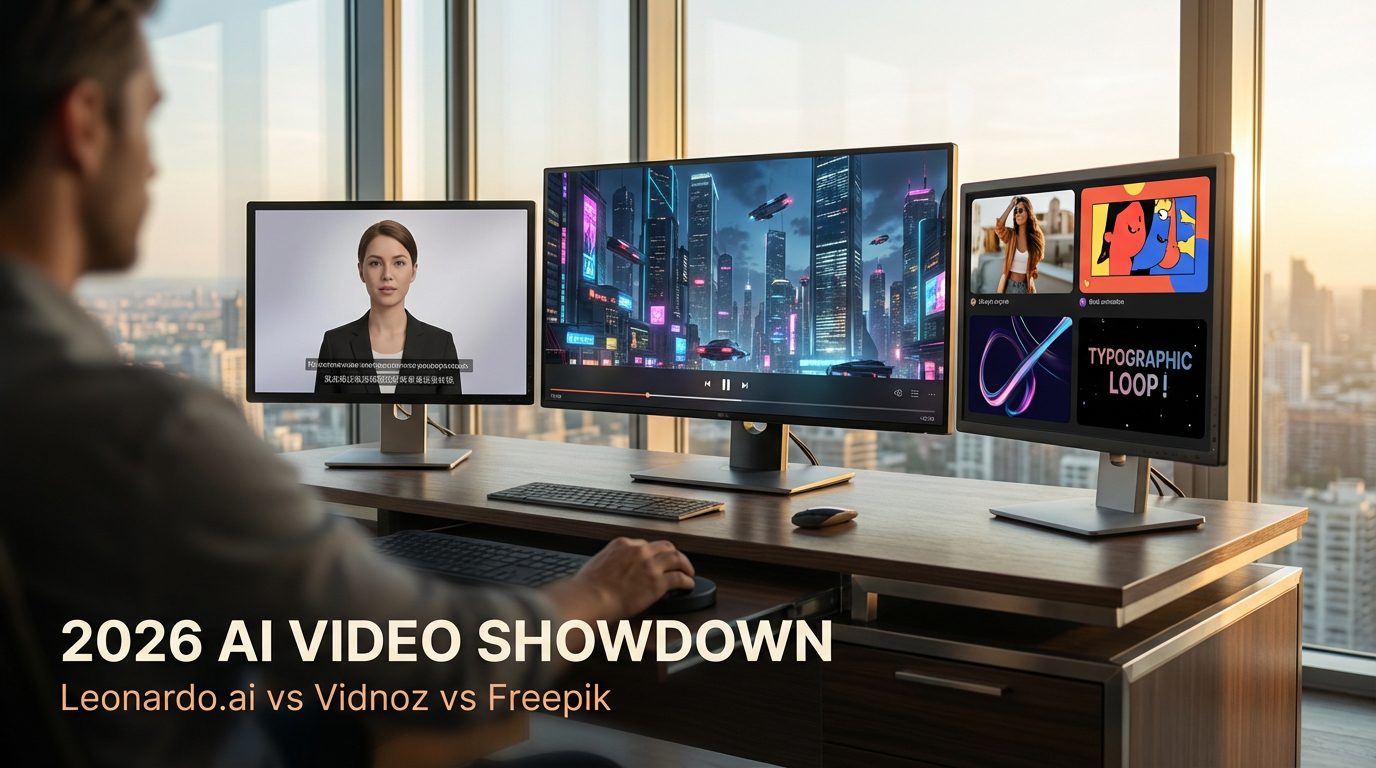
AI video creation is booming, yet picking the right platform can feel like speed-dating in the dark. We spent three weeks hammer-testing Vidnoz, Freepik and Leonardo.ai so you don’t have to.
In this review we pit them head-to-head on output quality, render speed, true cost per usable minute and—most important—the ROI that matters to your 2026 marketing plan.
No jargon or bloated prose—just actionable insights you can apply today to choose the tool that fits your budget, workflow and creative goals.
Why these 3 tools and how we evaluated them
We compared Vidnoz, Freepik and Leonardo.ai because each tackles AI video from a distinct angle: business-ready avatars, designer-friendly creativity and high-fidelity generative power. Setting them side by side shows which style of automated video can actually deliver value.
Over a three-week test sprint we scored every platform against six practical questions you and I ask before approving any purchase:
- Output quality and creativity
Does the finished clip look professional, stay consistent from frame to frame and match the prompt?
- Speed and workflow efficiency
How quickly can we move from a blank prompt to a downloadable video, and how much manual work disappears along the way?
- Pricing and real ROI
Free trials help, but what is the true cost per usable minute once watermarks, credits or tokens are factored in?
- Feature depth and versatility
Can the tool cover avatar explainers, cinematic B-roll and looping social posts, or is it limited to one format?
- Branding and customization
From logo placement to custom characters, how easily can you keep every video unmistakably yours?
- Enterprise-grade support and security
When teams, compliance or API integrations matter, which platform offers the right controls and certifications?
Every score, win and caution in the next sections ties back to these six pillars, keeping the review anchored in real-world workloads rather than glossy demos.

Leonardo.ai: high-fidelity video on demand
Open Leonardo.ai and you see a carousel of heavyweight models—Google Veo 3, Gen-3-style engines, even early Sora builds—waiting to convert a short prompt into a cinematic clip. Those engines feed into a unified video generator that has already produced more than 2.7 million clips for 18 million creators, turning still images or bare-bones prompts into smooth motion in seconds.
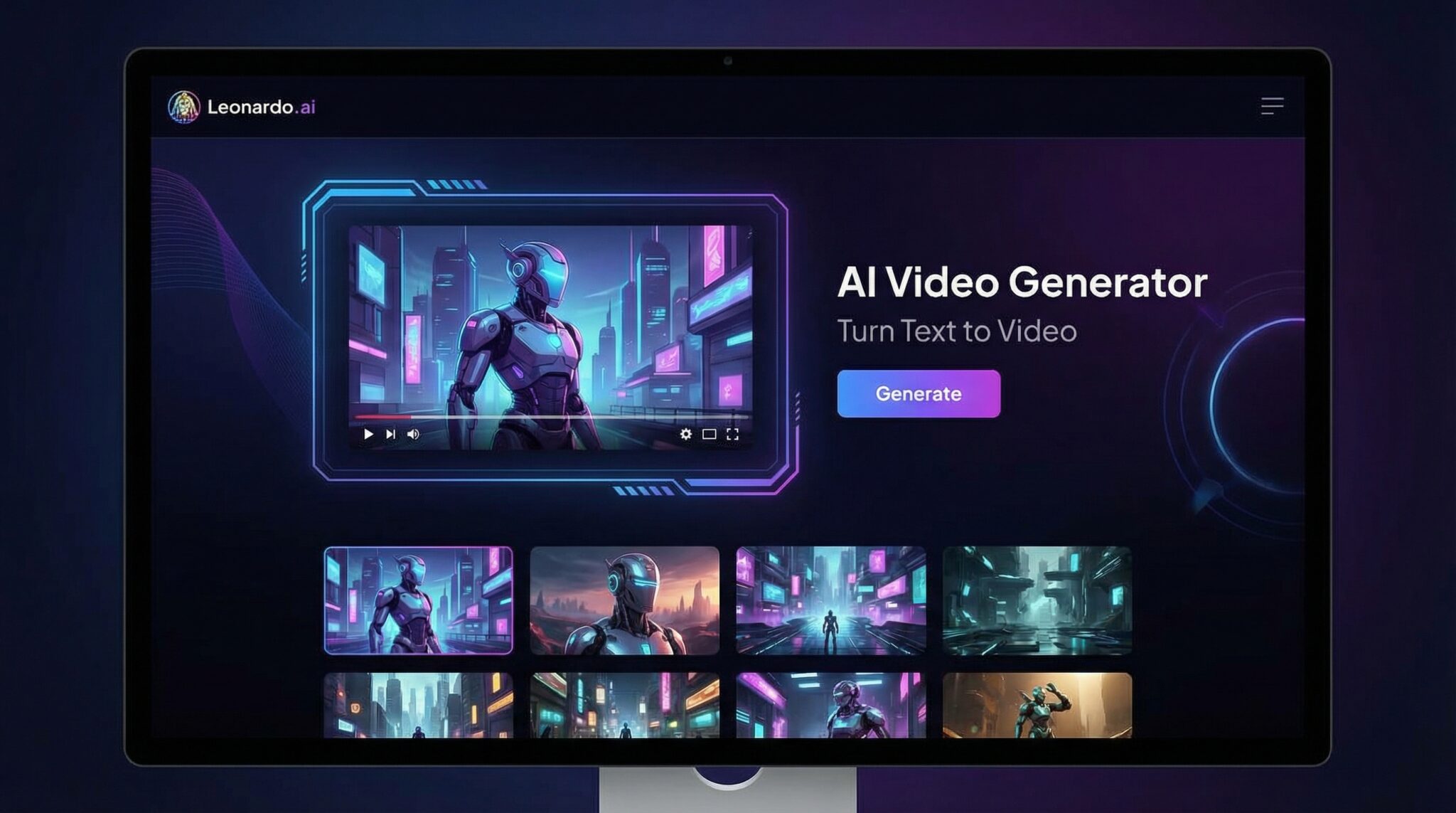
Leonardo.ai Official AI Video Generator Interface Screenshot
Quality leads the story. Colors stay crisp, motion feels intentional and characters hold shape from first frame to last. We generated an 8-second neon-city drone fly-through at 1080 p; every window reflection landed where it should, and no watermark appeared. Cost: 2 500 tokens or $3 on the Apprentice plan.
Tokens fuel the platform. Each paid tier drops a fresh allotment into your wallet every month, and heavier models simply burn through them faster. Push past the quota and you can top up or let relaxed generation queue tasks for free.
Customization is where Leonardo shines. Train a private model on your brand style, then spin out ads, product teasers or animated storyboards that share the same visual DNA. Designers appreciate the continuity, marketers appreciate that no rival can mimic the look.
Workflow feels more studio than slideshow. You tweak seeds, aspect ratios and motion curves until the clip nails your vision. The learning curve pays off quickly if you already write prompts for image generators.
Bottom line: choose Leonardo.ai when uncompromising visuals matter more than turnkey speed. In skilled hands it delivers premium footage at budget rates, leaving you with tokens—and bragging rights—to spare.
Vidnoz: avatar videos at the speed of business
Vidnoz trades complex 3-D renders for something more practical: lifelike AI presenters ready to deliver your script in almost any language.
Open the editor, pick from 1 900 avatars, paste your text and press render. In under 5 minutes we produced a polished 60-second onboarding clip with branded intro, captions and a voice that handled Spanish and English back to back. No camera, no studio, no scheduling stress.
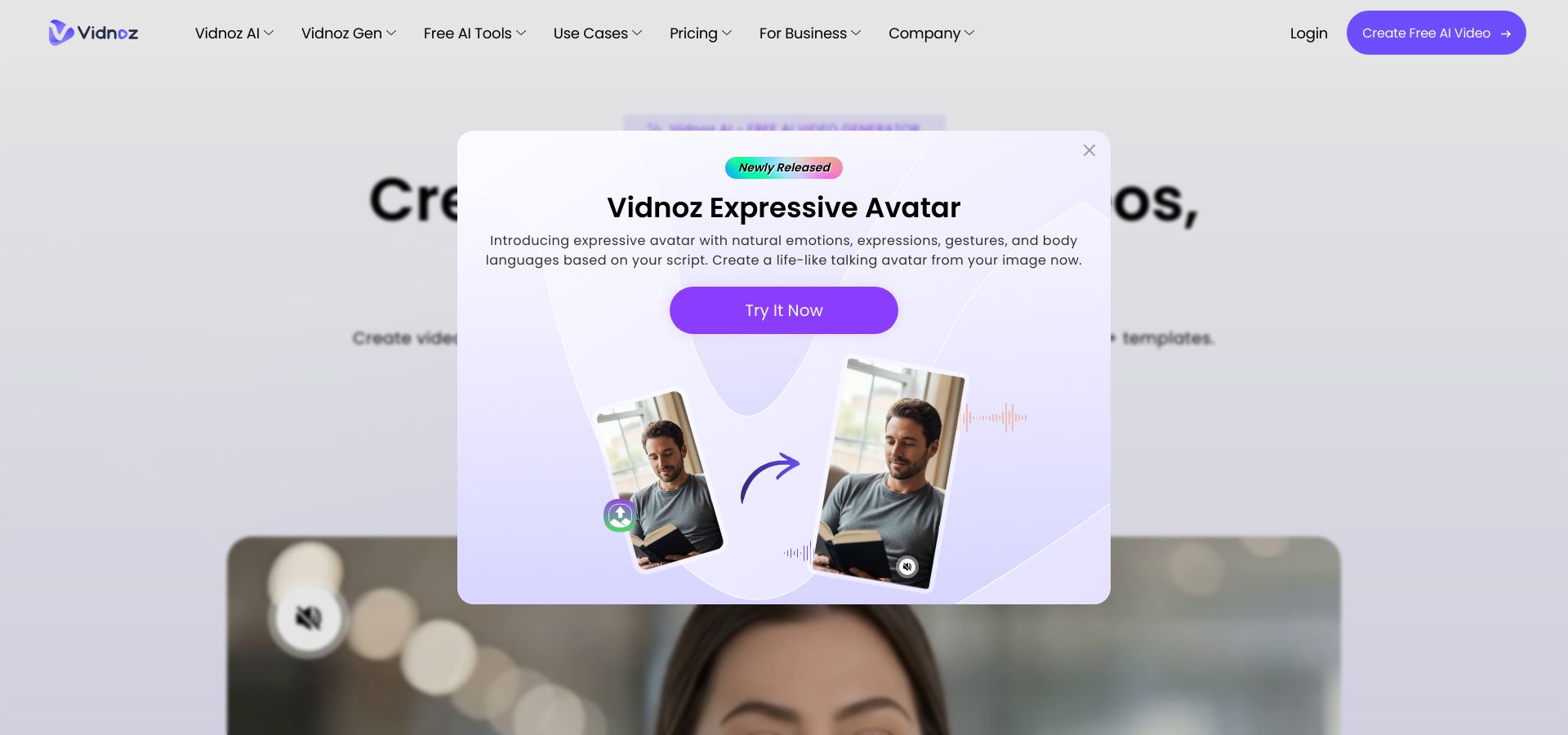
Vidnoz AI Video Generator Homepage Screenshot for Avatar Videos
Credits power the platform. The Starter plan hands you 450 credits each month—enough for about 15 minutes of 1080 p video with no watermark. The Business tier doubles that pool and unlocks voice cloning, automated translation and team workspaces. Free users can export 720 p files, but a Vidnoz logo stays on screen, a fair trade for a zero-cost sandbox.
Because avatars are pre-trained, Vidnoz stitches scenes together faster than true generative models. While Leonardo needed 30 seconds to render an eight-second cinematic shot, Vidnoz completed three full-length explainer scenes and queued a fourth.
Output is not Hollywood. Avatars can look slightly robotic, and you will not film a car chase inside the tool. For product demos, course modules and personalized sales videos, however, consistency beats cinematic flair. ISO-27001 security and multi-seat admin controls turn Vidnoz into a budget-savvy production department you rent monthly.
If your content relies on clear messaging delivered quickly in many languages, Vidnoz is the workhorse you want.
Freepik AI video: creativity on tap for designers and social teams
If Leonardo feels like a boutique studio and Vidnoz a corporate newsroom, Freepik is the creative playground. The video generator lives inside the same dashboard millions of designers already use for photos and vectors, so the learning curve is almost flat.
Type a prompt, choose a model—Google Veo for realism, PixVerse for bold animation, Kling for slick camera moves—and watch a five-second clip appear. Need something wilder? Switch models and reroll. Because Freepik licenses more than a dozen engines, you seldom feel forced to stretch one model beyond its comfort zone.
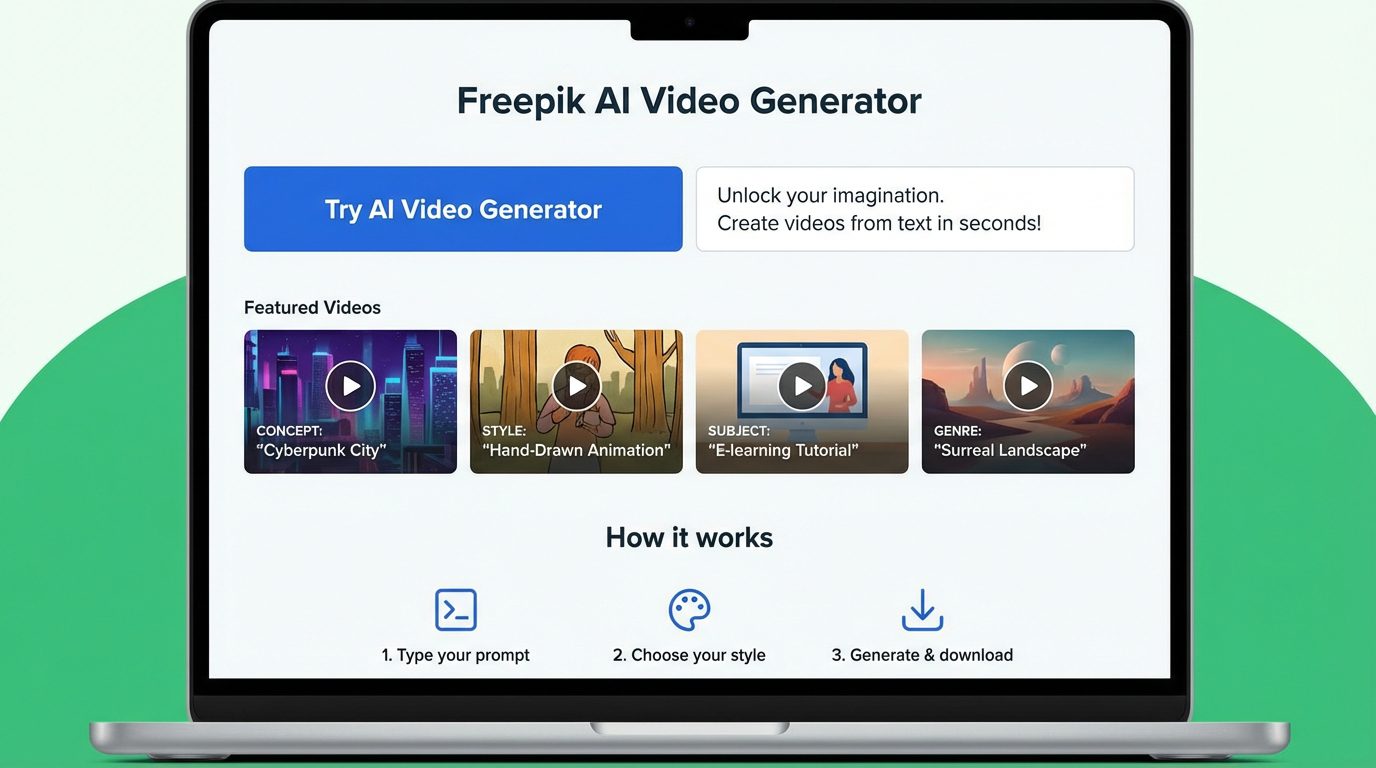
Freepik AI Video Generator Dashboard Screenshot for Designers and Social Teams
Pricing matches the flexibility. A standard Premium plan supplies a monthly credit stash, while Premium + removes clip limits for one flat fee and lets you run endless 768 p generations without tracking credits. High-end 1080 p versions of Veo or PixVerse still draw credits, yet for daily social loops you can iterate without worrying about the meter.
Workflow stays simple. Add a voice, pick from the built-in multilingual narrator, drop background sound from the same asset pool and export an MP4 ready for TikTok, Canva or your editor.
The trade-off is length. Most models cap at 4–8 seconds per render, so a minute-long ad means stitching ten to fifteen clips. For TikTok teasers, animated hero banners or punchy motion intros, though, Freepik turns a static library into an always-on fountain of motion.
Bottom line: if your brand lives on eye-catching visuals and you already rely on Freepik assets, activating its AI video tool is an easy win.
Head-to-head comparison
We have tested each platform alone. Now let’s place them side by side and answer the real question: which one delivers the most value for your workload?
| Criterion | Leonardo.ai | Vidnoz | Freepik AI video |
| Typical output | Cinematic, photoreal clips (8–10 s per render) | Avatar-led explainers up to 60 min | Stylised B-roll and motion graphics (4–8 s) |
| Max resolution | 1080 p on supported models | 1080 p on paid tiers | 1080 p with credits, unlimited runs at 768 p |
| Free option | Images only; video starts at $12 | 720 p videos with watermark | None; AI video requires Premium |
| Cost lens | About $3 for an 8-s Veo-3 clip on Apprentice plan | $27 buys 15 min of 1080 p, no watermark | $25 Premium + unlocks unlimited standard clips |
| Watermark rule | Never watermarked | Removed on Starter and above | No watermark for subscribers |
| Standout strength | Highest visual fidelity and custom model training | Fastest pipeline for scripted, multi-language content | Widest range of creative models |
| Best for | Designers, filmmakers, agencies | Marketers, HR, educators | Social teams, brand designers, freelancers |
Quality vs. consistency
Leonardo takes the crown for outright polish. It manages shadows, reflections and complex camera moves that would stall simpler engines. That beauty comes in bite-size servings, so you will stitch several clips to reach 30 seconds.
Vidnoz flips the script. Once an avatar is in place, quality stays flat and predictable across an entire training series. For many business teams, that reliability matters more than cinematic flair.
Freepik lands in the middle. Its model buffet can reach near-Leonardo detail one moment and bold anime style the next. Consistency depends on you choosing the same model and seed for each clip.
Speed and workflow
If you face a tight deadline, Vidnoz wins by a wide margin. The avatar engine renders minutes of footage while generative models finish a single scene.
Leonardo’s fast tokens shorten first drafts, yet heavy models still queue on lower tiers. Freepik stays nimble for short social clips, but multiple rerolls to nail a look can take equal time.
Pricing reality check
Tokens, credits and watermarks can feel like calculus. Use this shorthand:
Need a few jaw-dropping visuals each month? Leonardo’s $12 Apprentice tier is your value play.
Need hours of straightforward talking-head content? Vidnoz’s $75 Business plan covers 30 minutes of 1080 p monthly—cheaper than one day on set.
Need endless four-second loops for social? Freepik Premium + at $25 shines. Fire off iterations until the perfect vibe appears.
Which tool fits you best?
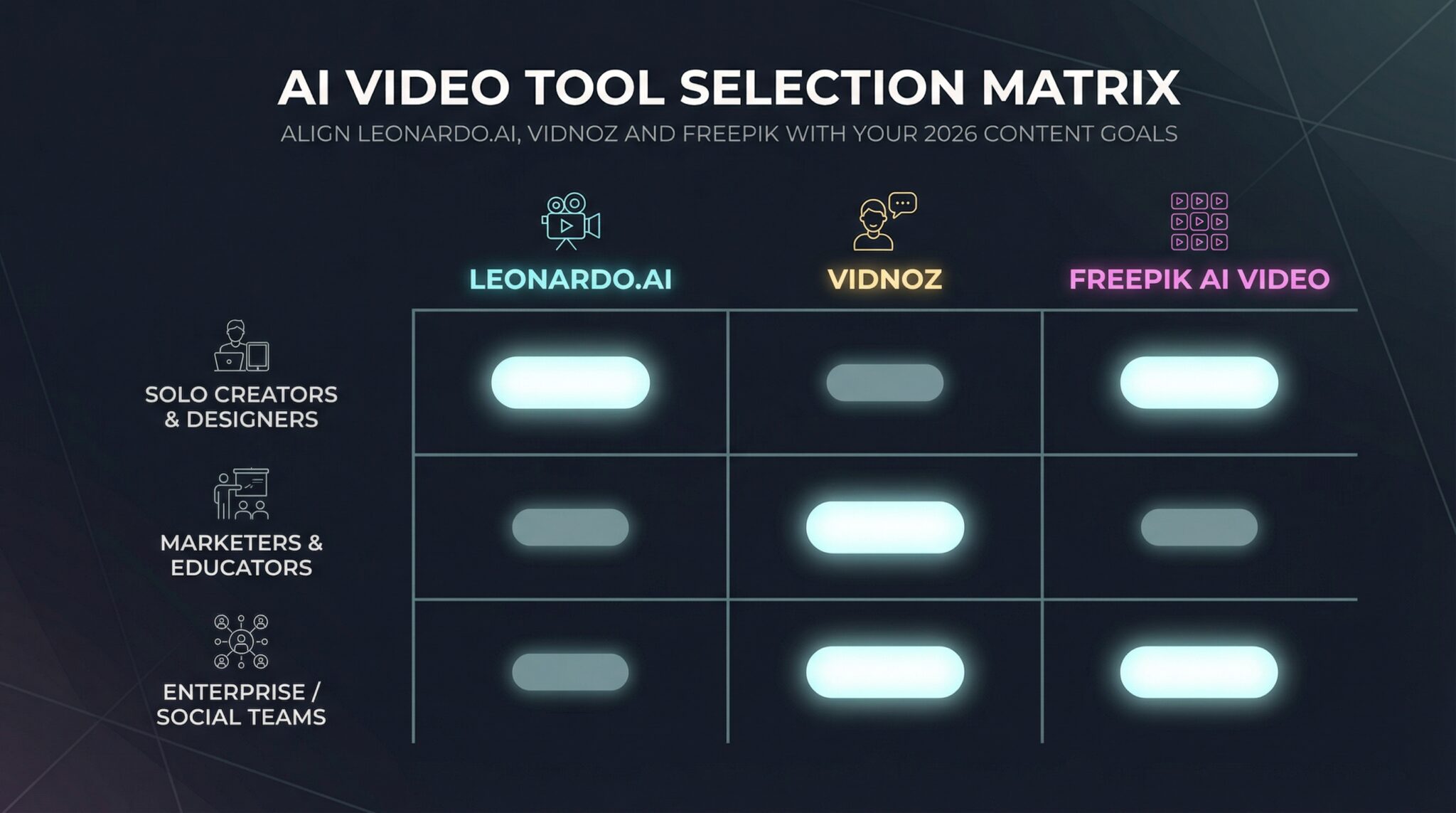
For solo creators and designers
You juggle prompts, thumbnails and community comments, so every tool has to earn its keep.
If you thrive on visual experimentation, Leonardo.ai is your ally. Its mix of models lets you sculpt photoreal cityscapes one day and dreamy anime loops the next, all from one dashboard. The $12 Apprentice tier unlocks watermark-free video; one standout clip can pay for the month.
Already knee-deep in Freepik assets? Freepik Premium + keeps you inside the ecosystem you know and adds unlimited short clips at 768 p. You trade some resolution for endless runs, but for TikTok teasers and animated hero sections quantity and convenience beat 4K polish.
Vidnoz appears when you need a talking head but dread filming yourself. Paste a script, pick an avatar that matches your channel vibe and you have a week of intros in thirty minutes. Creative range is limited, yet no other platform turns text into a personable host faster.
In short, choose Leonardo for visual range, Freepik for integrated convenience and Vidnoz when a camera-ready presenter saves your sanity.
For marketers, educators and enterprise teams
Deadlines, brand guidelines and tight budgets shape your world. You need output that lands on-message, localises fast and clears compliance without a fight.
That is classic Vidnoz territory. Drop a master script, spin it into twenty languages with one click and ship consistent avatar-hosted training videos before next quarter’s rollout. ISO-27001 certification keeps security officers happy, and the Business plan gives enough minutes to refresh an LMS every month.
When campaigns rely on emotional storytelling rather than face-to-camera instruction, switch to Leonardo.ai. A single eight-second cinematic opener—think swirling logo in a photoreal canyon—can lift an entire launch deck. The cost per hero shot undercuts agency rates by orders of magnitude, and you own the IP outright.
Freepik becomes the secret weapon for social teams. Unlimited runs mean you can A/B test TikTok hooks all morning, pick the winner by lunch and still have capacity for Instagram stories. Built-in voice and sound effects save another trip to a stock-audio site.
Quick heuristic:
- Need human clarity and legal peace of mind? Push volume through Vidnoz.
- Need jaw-dropping visuals that stop the scroll? Commission Leonardo in-house.
- Need endless micro-content for trend riding? Tap Freepik’s bottomless fountain.
Choose by objective, fund accordingly and sleep easier.
Frequently asked questions
Is Leonardo.ai free for video?
No. You can explore the interface on a free account, but the Generate Video button unlocks only after you upgrade to the $12 Apprentice tier.
Do any of these tools watermark paid exports?
No. Paid plans on all three platforms download clean. Only Vidnoz’s free tier stamps a logo on 720 p files.
Which platform makes the longest single video?
Vidnoz. Paid plans allow files up to 60 minutes because the editor assembles pre-trained avatar scenes. Leonardo and Freepik cap each render at roughly 4–10 seconds, so longer pieces require stitching clips together.
Can I upload my own voice or assets?
Yes. Vidnoz offers a voice-cloning add-on and lets you import slides or images. Leonardo accepts reference images for style control. Freepik will animate an image you upload through its image-to-video mode.
What is the simplest way to keep brand consistency?
Use Vidnoz for turnkey branding. Its workspace handles logos, colours and presenter intros in one place. If your look is more visual than verbal, train a private style in Leonardo or set a custom look in Freepik.
Conclusion
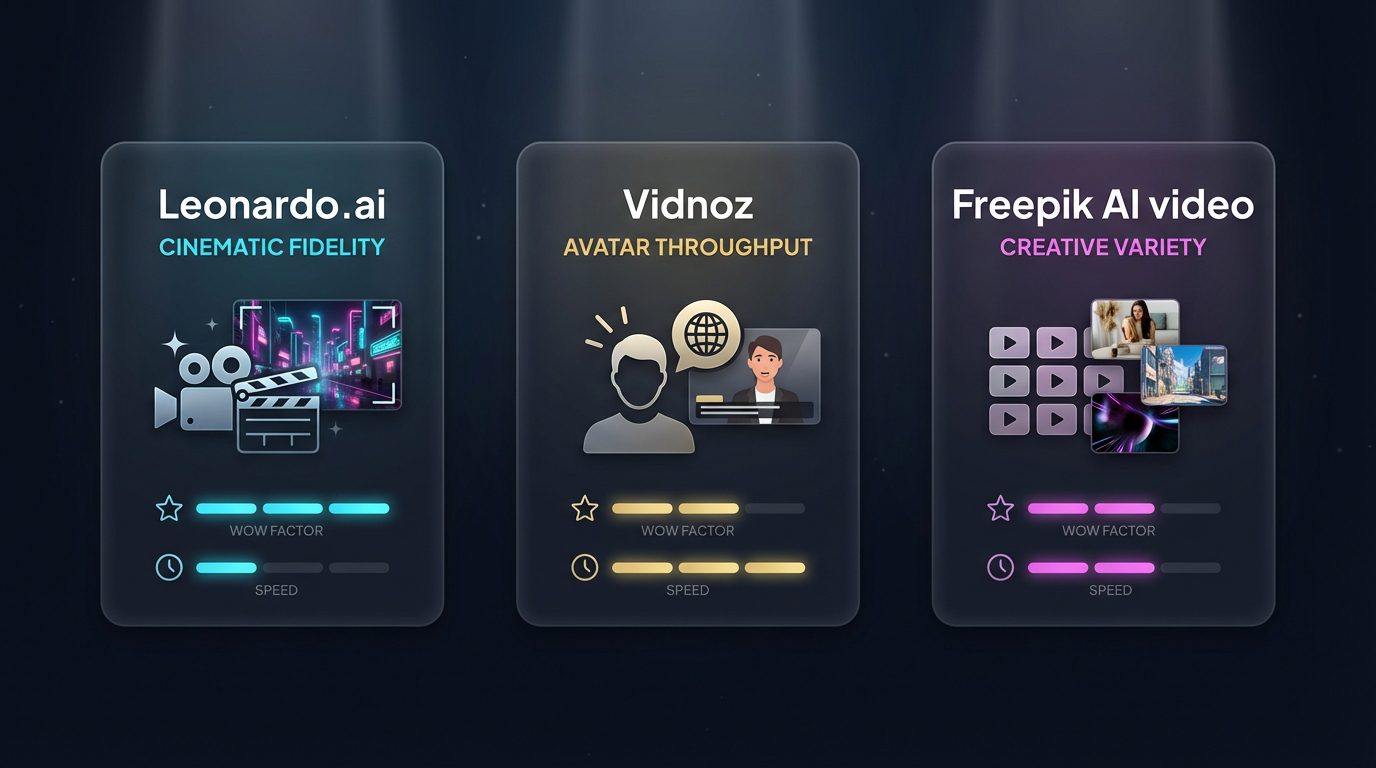
Leonardo maximises wow factor, Vidnoz maximises throughput and Freepik maximises variety. Match the tool to the outcome you need, and you will avoid both overspending and under-delivering.