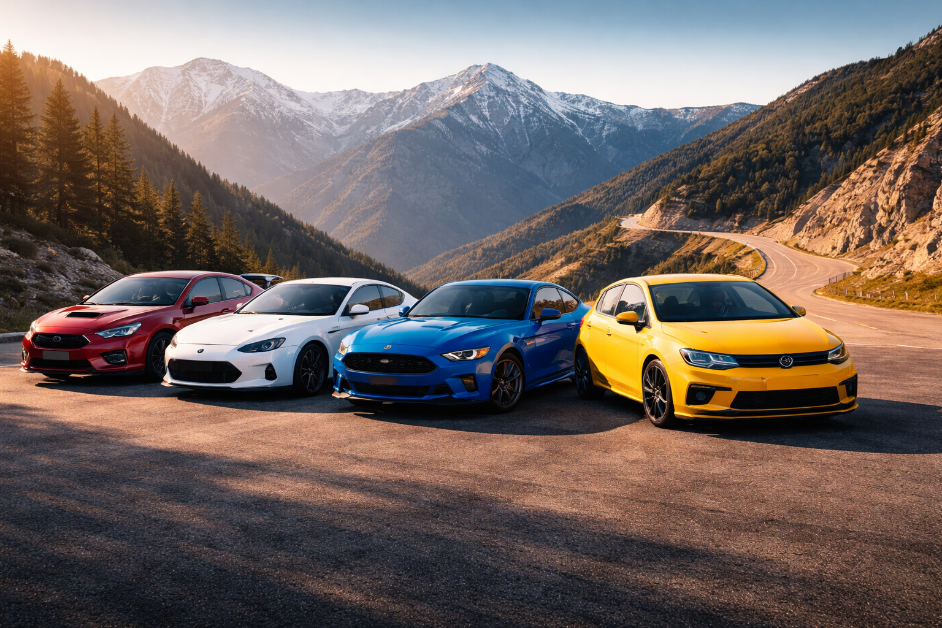
Affordable Performance Cars prove that thrilling acceleration, sharp handling, and dynamic driver engagement do not require exotic-car budgets. For enthusiasts who crave horsepower without draining savings accounts, today’s market offers compelling options that blend power-to-weight efficiency with everyday practicality. These vehicles deliver impressive 0–100 km/h times, responsive chassis tuning, and balanced drivetrains while remaining financially accessible.
Unlike traditional supercars that prioritize exclusivity over usability, Affordable Performance Cars focus on maximizing driving enjoyment per dollar. Lightweight platforms, turbocharged engines, and modern suspension geometry allow these machines to compete well above their price brackets. As a result, first-time sports car buyers and value-focused investors can secure authentic performance credentials without compromising reliability or daily comfort.
Moreover, advancements in forced induction, electronic stability systems, and modular platforms have enabled budget sports cars to achieve performance figures once reserved for premium marques. Consequently, high-value performance vehicles now offer superior torque curves, refined steering feedback, and manageable ownership costs making them ideal entry-level performance machines in 2026 and beyond.
What Defines Affordable Performance Cars?
Before profiling the top five models, it is important to define what qualifies as an affordable performance vehicle. The criteria include:
-
Strong horsepower-to-weight ratio
-
Sub-6 second 0–100 km/h acceleration
-
Rear-wheel drive (RWD) or performance-oriented AWD
-
Sport-tuned suspension and braking systems
-
Reasonable maintenance and insurance costs
-
Robust aftermarket support
These cost-efficient speed models combine measurable performance metrics with real-world usability. Now, let’s examine five standout options.
1. Toyota GR86
The Toyota GR86 continues to dominate conversations about budget sports cars. Developed with a low center of gravity and rear-wheel-drive architecture, it prioritizes handling balance over raw horsepower numbers.
Key Specifications:
-
Engine: 2.4L naturally aspirated flat-four
-
Horsepower: 228 hp
-
Torque: 250 Nm
-
0–100 km/h: ~6.1 seconds
-
Drivetrain: RWD
-
Starting Price: Approx. $30,000
The GR86’s lightweight chassis (around 1,270 kg) ensures exceptional cornering precision. Moreover, its near-perfect weight distribution enhances steering responsiveness. While not the most powerful car in this list, its dynamic equilibrium makes it one of the purest entry-level performance machines available.
Fuel efficiency remains reasonable at roughly 8–9 L/100 km combined. Maintenance costs are manageable due to Toyota’s reliability reputation, making it a strong long-term value proposition.
2. Ford Mustang EcoBoost
The Mustang EcoBoost delivers turbocharged muscle in a cost-effective package. Unlike traditional V8 models, the 2.3L turbocharged four-cylinder offers a lighter front end and improved fuel economy.
Key Specifications:
-
Engine: 2.3L turbocharged inline-4
-
Horsepower: 315 hp
-
Torque: 475 Nm
-
0–100 km/h: ~5.3 seconds
-
Drivetrain: RWD
-
Starting Price: Approx. $32,000
Consequently, buyers gain serious straight-line performance while maintaining affordability. The independent rear suspension improves cornering stability compared to older Mustang generations.
However, insurance costs can vary depending on driver age and region. Nevertheless, resale value remains strong due to brand recognition and aftermarket tuning potential.
Performance Comparison Table
| Model | Horsepower | Torque | 0–100 km/h | Drivetrain | Starting Price |
|---|---|---|---|---|---|
| Toyota GR86 | 228 hp | 250 Nm | 6.1 sec | RWD | $30,000 |
| Ford Mustang EcoBoost | 315 hp | 475 Nm | 5.3 sec | RWD | $32,000 |
| Mazda MX-5 Miata | 181 hp | 205 Nm | 6.5 sec | RWD | $28,000 |
| Volkswagen Golf GTI | 241 hp | 370 Nm | 6.0 sec | FWD | $31,000 |
| Subaru WRX | 271 hp | 350 Nm | 5.8 sec | AWD | $33,000 |
These affordable performance cars not only excel in 0–100 km/h times but also contribute to models that dominate global speed rankings, showcasing why they’re considered among the top-performing cars in their class.
3. Mazda MX-5 Miata
The MX-5 Miata remains one of the most celebrated high-value performance vehicles ever produced. Its philosophy centers on lightweight engineering and driver engagement.
Key Specifications:
-
Engine: 2.0L naturally aspirated inline-4
-
Horsepower: 181 hp
-
Torque: 205 Nm
-
0–100 km/h: ~6.5 seconds
-
Drivetrain: RWD
-
Starting Price: Approx. $28,000
Although its power figures are modest, the Miata weighs just over 1,050 kg. As a result, its power-to-weight ratio creates exhilarating responsiveness. The manual transmission is widely regarded as one of the best in the industry.
Moreover, maintenance costs are low, and reliability scores remain consistently high. This makes it ideal for first-time sports car owners seeking low-risk ownership.
4. Volkswagen Golf GTI
The Golf GTI represents the hot hatch formula perfected. It combines turbocharged torque with front-wheel-drive efficiency.
Key Specifications:
-
Engine: 2.0L turbocharged inline-4
-
Horsepower: 241 hp
-
Torque: 370 Nm
-
0–100 km/h: ~6.0 seconds
-
Drivetrain: FWD
-
Starting Price: Approx. $31,000
Moreover, adaptive suspension and precise steering make it surprisingly agile. The GTI excels in practicality, offering generous cargo space and rear seating. Consequently, it functions equally well as a daily commuter and weekend canyon carver.
Aftermarket tuning potential is extensive, often unlocking 300+ hp with minimal modifications.
5. Subaru WRX
The Subaru WRX introduces all-wheel-drive grip into the affordable performance segment.
Key Specifications:
-
Engine: 2.4L turbocharged flat-four
-
Horsepower: 271 hp
-
Torque: 350 Nm
-
0–100 km/h: ~5.8 seconds
-
Drivetrain: AWD
-
Starting Price: Approx. $33,000
The symmetrical AWD system enhances traction in adverse weather conditions. Consequently, it appeals to buyers in regions with snow or heavy rainfall.
However, fuel economy is slightly lower than FWD or RWD competitors. Nevertheless, its rally-inspired heritage and tuning potential maintain strong enthusiast appeal.
Ownership Comparison Table
| Model | Maintenance Cost (Annual Est.) | Fuel Economy (Combined) | Insurance Range | Resale Value | Practicality Rating (1–10) |
|---|---|---|---|---|---|
| Toyota GR86 | Moderate | 8–9 L/100 km | Medium | Strong | 7 |
| Ford Mustang EcoBoost | Moderate | 9–10 L/100 km | Medium-High | Strong | 6 |
| Mazda MX-5 Miata | Low | 7–8 L/100 km | Medium | Very Strong | 5 |
| Volkswagen Golf GTI | Moderate | 7–8 L/100 km | Medium | Strong | 9 |
| Subaru WRX | Moderate-High | 9–10 L/100 km | Medium-High | Strong | 8 |
Why These Cars Punch Above Their Weight?
Affordable Performance Cars succeed because they optimize engineering efficiency rather than absolute horsepower. Lightweight platforms reduce inertia, improving acceleration and braking performance. Moreover, turbocharging technology enables smaller engines to deliver substantial torque at lower RPMs.
Chassis rigidity and suspension tuning further enhance cornering confidence. Consequently, these vehicles often outperform heavier luxury sedans costing significantly more.
Aftermarket ecosystems also contribute to their appeal. Performance upgrades—such as ECU tuning, upgraded intercoolers, coilovers, and performance exhaust systems—can elevate these cars into higher performance brackets at relatively modest costs.
The Future of Affordable Performance Cars
Electrification and hybrid integration are reshaping the performance landscape. Lightweight battery modules and electric torque assist systems will enhance acceleration without significantly increasing curb weight. Moreover, turbocharging advancements and improved thermal management systems will extract higher outputs from smaller displacement engines.
Manufacturers are also incorporating aluminum-intensive platforms and carbon-reinforced composites to improve structural rigidity while reducing mass. Consequently, next-generation affordable performance cars may achieve sub-5 second acceleration benchmarks at today’s entry-level price points.
Furthermore, mild-hybrid systems could improve fuel efficiency and torque delivery simultaneously. As emissions regulations tighten globally, performance engineering will increasingly rely on electrified assistance rather than pure displacement increases.
In summary, Affordable Performance Cars remain one of the most compelling segments in the automotive industry. They provide measurable performance metrics, engaging driving dynamics, and sustainable ownership costs. For enthusiasts seeking maximum thrill per dollar, these machines truly punch above their weight.
FAQ: Affordable Performance Cars
1. Are Affordable Performance Cars reliable?
Most modern models, particularly those from Toyota and Mazda, demonstrate strong reliability records. However, turbocharged engines may require diligent maintenance schedules.
2. Are maintenance costs high?
Maintenance varies by drivetrain and engine complexity. Naturally aspirated engines typically cost less to maintain than high-boost turbocharged setups.
3. Is insurance expensive?
Insurance depends on driver profile, location, and driving history. However, four-cylinder performance models usually cost less to insure than V8 alternatives.
4. Can these cars be tuned?
Yes. The Mustang EcoBoost, WRX, and Golf GTI have extensive aftermarket support. ECU remapping alone can yield 20–40% power gains.
5. Do they retain value?
Resale value remains strong for enthusiast-driven models with manual transmissions and limited production runs.