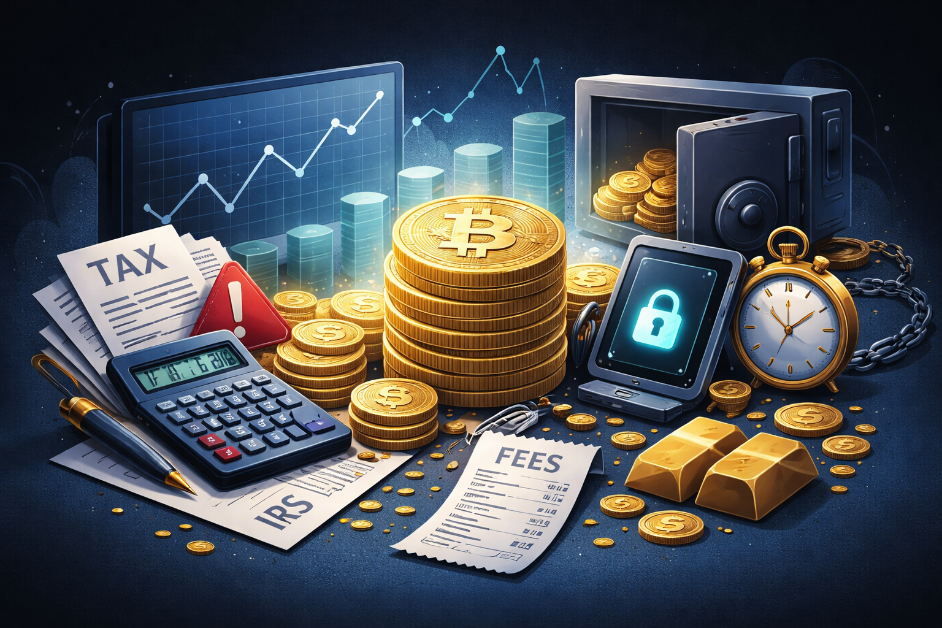
Holding cryptocurrency long term commonly referred to as “HODLing” has become a popular strategy among retail and high-net-worth investors alike. The idea is simple: buy digital assets, ignore short-term volatility, and benefit from long-term appreciation. However, while this approach appears straightforward, many investors underestimate the hidden costs of holding crypto long term.
Unlike traditional investments such as stocks or bonds, cryptocurrency ownership involves a unique set of financial, operational, and regulatory costs. These expenses are often indirect, poorly disclosed, or misunderstood, yet they can significantly erode returns over time. Moreover, because crypto markets operate continuously and globally, even small inefficiencies can compound into substantial losses.
As a result, understanding crypto investment costs is essential for anyone planning to hold digital assets over multiple years. This article explores the most overlooked expenses associated with long-term crypto ownership, explains how they impact net returns, and provides practical strategies to manage cryptocurrency risks more effectively.
Understanding Long-Term Crypto Holding (“HODLing”)
The Philosophy Behind HODLing
HODLing originated as a reaction to extreme market volatility. Investors recognized that frequent trading often led to emotional decisions and poor timing. Therefore, holding assets long term became a way to avoid behavioral mistakes and benefit from broader adoption trends.
Moreover, long-term crypto holders often believe in the underlying technology, scarcity models, or macroeconomic narratives such as inflation hedging and financial decentralization. However, belief alone does not eliminate costs.
Why Costs Are Often Overlooked
Many crypto investors focus exclusively on price appreciation. However, holding crypto long term involves ongoing exposure to trading infrastructure, custody arrangements, regulatory environments, and tax systems. These factors may not be immediately visible on a price chart, but they directly affect realized returns.
Consequently, investors who fail to account for these costs may significantly overestimate their long-term performance.
Trading Fees and Execution Costs Over Time
Entry, Exit, and Rebalancing Fees
Even long-term holders incur trading fees. Initial purchases, partial exits, portfolio rebalancing, and asset swaps all generate costs. While individual fees may appear small, repeated transactions over several years can accumulate meaningfully.
Moreover, fee structures vary widely across exchanges, depending on volume, order type, and market conditions. Investors who use high-fee platforms or frequently adjust positions may experience consistent return leakage.
Slippage and Market Impact
Slippage occurs when the executed price differs from the expected price, particularly during periods of low liquidity or high volatility. For large transactions, slippage can be substantial, especially in altcoin markets.
As a result, investors holding crypto long term may unknowingly lose value during both entry and exit, even if the asset appreciates overall.
Common Trading and Execution Costs in Long-Term Crypto Holding
| Cost Type | Description | Long-Term Impact |
|---|---|---|
| Trading Fees | Exchange commissions on buys and sells | Moderate |
| Slippage | Price movement during execution | Moderate to High |
| Spread Costs | Difference between bid and ask prices | Low to Moderate |
| Rebalancing Costs | Fees from portfolio adjustments | Moderate |
Tax Implications of Holding Crypto Long Term
Capital Gains and Reporting Complexity
Taxation is one of the most underestimated crypto investment costs. In many jurisdictions, selling, swapping, or even spending cryptocurrency triggers a taxable event. Long-term capital gains may be taxed at lower rates than short-term gains; however, the obligation remains significant.
Moreover, crypto transactions often generate complex reporting requirements. Tracking cost basis, transaction dates, and fair market values can be challenging, particularly for investors using multiple wallets or exchanges.
Hidden Tax Drag Over Time
Even investors who rarely sell may face tax drag due to staking rewards, airdrops, or forks, which are often taxable upon receipt. Consequently, long-term holders may owe taxes without realizing cash proceeds, forcing asset sales or external funding.
As a result, poor tax planning can materially reduce net returns, even during strong market cycles.
Custody Risks and Security Costs
Self-Custody vs Third-Party Custody
Custody decisions are central to cryptocurrency risks, making strong crypto safety best practices essential for long-term investors. Self-custody offers control but introduces operational risk, including loss of private keys, hardware failure, or human error. Third-party custodians reduce some operational burdens but introduce counterparty risk.
Moreover, institutional-grade custody solutions often involve ongoing fees, particularly for insured or regulated services. These costs may appear minor annually but compound over long holding periods.
Security Investments and Loss Risk
Long-term crypto holders often invest in hardware wallets, backup systems, and security procedures. While these measures are necessary, they represent additional capital and time costs.
However, failure to invest adequately in security can result in irreversible loss. Unlike traditional financial assets, stolen or lost cryptocurrency is rarely recoverable. Therefore, custody decisions directly affect both cost and risk profiles.
Opportunity Costs and Capital Lock-Up
Missed Reinvestment Opportunities
Holding crypto long term may prevent capital from being redeployed into other assets during favorable market conditions. While patience can be rewarding, rigid holding strategies may lead to opportunity costs when alternative investments offer superior risk-adjusted returns.
Moreover, crypto market cycles can be prolonged. Capital tied up during extended downturns may generate no yield while still incurring custody, tax, and psychological costs.
Liquidity Constraints
Although major cryptocurrencies are liquid, liquidity can evaporate during market stress. Consequently, investors may be unable to exit positions efficiently when needed, further increasing the hidden costs of long-term holding.
Hidden Cost Categories in Long-Term Crypto Holding
| Cost Category | Visibility Level | Potential Severity |
|---|---|---|
| Trading & Slippage | Medium | Moderate |
| Taxes | Low | High |
| Custody & Security | Medium | High |
| Opportunity Cost | Low | High |
| Regulatory Risk | Low | Variable |
Regulatory and Compliance Risks
Changing Legal Frameworks
Cryptocurrency regulation continues to evolve. Governments worldwide are refining rules related to taxation, custody, reporting, and investor protection. As a result, assets that are compliant today may face restrictions tomorrow.
Long-term holders are particularly exposed to regulatory shifts because they maintain exposure across multiple policy cycles. Consequently, regulatory uncertainty represents an implicit cost that is difficult to quantify but impossible to ignore.
Compliance Burden Over Time
As reporting requirements increase, investors may need professional assistance to remain compliant. Accounting services, legal advice, and compliance tools add to the total cost of ownership, especially for complex portfolios.
How Hidden Costs Erode Long-Term Returns
Compounding Works Both Ways
Just as returns compound over time, costs do as well. A small annual drag—whether from fees, taxes, or inefficiencies can significantly reduce final portfolio value over a decade or more.
Moreover, because many crypto investors benchmark performance solely on price appreciation, they may not recognize underperformance relative to their expectations or alternative investments.
Behavioral Consequences
Hidden costs also affect investor behavior. Unexpected tax bills, security incidents, or regulatory changes can trigger forced selling at unfavorable prices. As a result, costs indirectly increase timing risk and emotional decision-making.
Practical Strategies to Minimize Long-Term Crypto Costs
Choosing Efficient Trading Platforms
Selecting exchanges with transparent, low-fee structures can significantly reduce trading costs. Moreover, using limit orders instead of market orders can help manage slippage, particularly for large transactions.
Tax-Efficient Planning
Investors should maintain detailed transaction records and understand applicable tax rules. Where permitted, strategies such as long-term holding periods, offsetting gains with losses, and structured exit planning can reduce tax drag.
Secure and Scalable Custody Solutions
Choosing custody solutions that balance security, cost, and accessibility is critical. For larger portfolios, diversified custody combining cold storage with limited operational access can reduce both risk and cost over time.
Periodic Portfolio Review
Long-term holding does not mean neglect. Periodic reviews allow investors to reassess risk exposure, regulatory changes, and opportunity costs. Consequently, proactive management helps preserve returns without excessive trading.
Conclusion: Optimizing Returns While Holding Crypto Long Term
Holding cryptocurrency long term can be a viable strategy, but it is not cost-free. Trading fees, slippage, taxes, custody risks, opportunity costs, and regulatory uncertainty all contribute to the hidden costs of holding crypto long term.
Moreover, these costs often operate quietly, compounding over time and reducing realized returns. Therefore, investors who wish to succeed must treat crypto ownership as a comprehensive investment discipline rather than a passive bet on price appreciation.
By understanding crypto investment costs, addressing cryptocurrency risks, and implementing disciplined cost-management strategies, investors can significantly improve long-term outcomes. As a result, informed planning not blind holding is the key to sustainable success in digital asset investing.