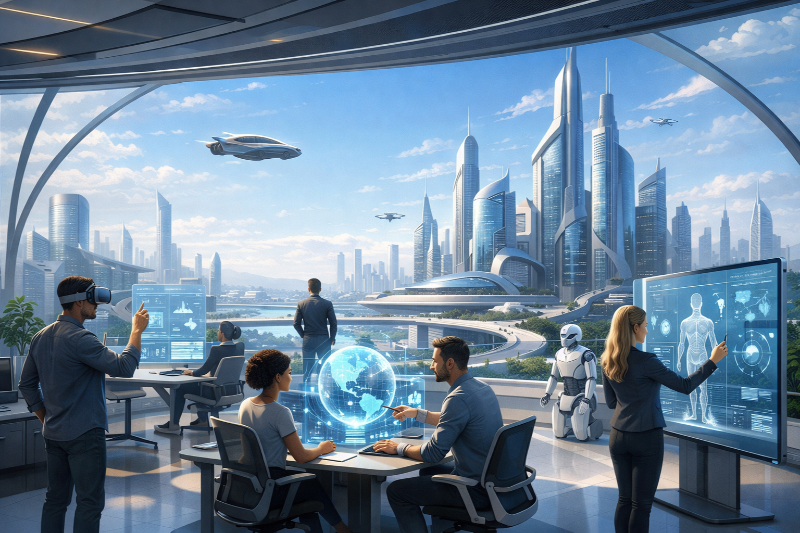
The way people work is changing faster than at any point in modern history. Technological acceleration, shifting employee expectations, and global economic uncertainty are forcing organizations to rethink how work is structured, measured, and experienced. Future of Work Design is no longer a concept for experimentation it is a strategic priority that directly shapes competitiveness, resilience, and long-term growth.
Moreover, Future of Work Design goes beyond remote work policies or new office layouts. It redefines organizational structures, talent models, productivity systems, and employee experience from the ground up. Companies that design work intentionally rather than reactively are better positioned to attract top talent, adapt to disruption, and sustain performance in complex environments.
Consequently, business leaders, HR executives, and policymakers are shifting focus toward next-generation workforce architecture. By aligning technology, culture, and strategy, organizations can build adaptive organizational models that thrive in an era defined by automation, mobility, and constant change.
Understanding Future of Work Design
Future of Work Design is the deliberate creation of systems, processes, and environments that enable people and technology to work together effectively. Unlike traditional workplace planning, it integrates digital infrastructure, human-centered design, and strategic foresight.
At its core, this approach focuses on:
-
Flexibility in where and how work happens
-
Skills and outcomes rather than roles and hours
-
Technology as a collaborator, not just a tool
-
Employee well-being as a productivity driver
However, successful Future of Work Design requires alignment across leadership, culture, and operations. Isolated initiatives rarely deliver lasting impact.
Hybrid Work Ecosystems as the New Default
Hybrid work has moved from a temporary response to a permanent operating model. Organizations are designing ecosystems that blend remote, in-office, and flexible work arrangements.
Moreover, hybrid work ecosystems improve access to global talent while reducing real estate costs. They also allow employees to design work around life demands, therefore improving engagement and retention.
Key elements of effective hybrid design include:
-
Clear norms for collaboration and availability
-
Purpose-driven office spaces
-
Technology that supports seamless interaction
However, without intentional design, hybrid models can create inequality, communication gaps, and burnout.
AI Collaboration Tools and Human Augmentation
Artificial intelligence is reshaping how work gets done. In Future of Work Design, AI is not replacing people wholesale but augmenting human capability.
AI collaboration tools now support:
-
Intelligent scheduling and task prioritization
-
Real-time insights and recommendations
-
Automated documentation and reporting
Consequently, employees can focus more on creative, strategic, and relationship-based work. This shift changes job design, performance metrics, and leadership expectations.
Digital Workforce Infrastructure
A modern workforce depends on a strong digital backbone. Cloud platforms, cybersecurity, collaboration tools, and data systems form the foundation of digital workplace evolution.
Moreover, digital infrastructure enables:
-
Scalable remote operations
-
Secure access to global talent
-
Real-time performance visibility
Organizations that underinvest in infrastructure struggle to scale and innovate, therefore limiting the impact of future-focused strategies.
Skills-Based Hiring and Talent Mobility
Traditional role-based hiring is giving way to skills-based models. Instead of rigid job descriptions, organizations are mapping skills, capabilities, and potential.
Skills-based hiring supports:
-
Faster talent acquisition
-
Better internal mobility
-
Continuous reskilling
Consequently, talent becomes more fluid and adaptable. This approach also improves diversity and inclusion by focusing on capability rather than credentials alone.
Workforce Transformation Drivers
The table below highlights the main drivers shaping next-generation workforce architecture:
| Driver | Business Impact | Affected Roles | Implementation Complexity | Long-Term Advantage |
|---|---|---|---|---|
| Hybrid Work Models | Higher retention | Knowledge workers | Medium | High |
| AI & Automation | Productivity gains | Operations, analytics | High | Very High |
| Skills-Based Hiring | Faster scaling | HR, leadership | Medium | High |
| Digital Collaboration | Global reach | Cross-functional teams | Medium | High |
| Well-being Integration | Lower burnout | All roles | Low–Medium | Medium–High |
These drivers collectively redefine how value is created and sustained.
Automation and Job Redesign
Automation continues to reshape task distribution across roles. However, Future of Work Design focuses on job redesign rather than job elimination.
Automation enables:
-
Removal of repetitive tasks
-
Faster decision cycles
-
Higher output quality
Therefore, organizations must invest in reskilling and change management to help employees transition into higher-value roles.
Remote Leadership Models
Leading distributed teams requires new skills and mindsets. Remote leadership emphasizes trust, clarity, and outcomes over visibility and control.
Effective remote leaders:
-
Communicate goals clearly
-
Measure performance by results
-
Foster inclusion and connection
Moreover, leadership presence is now defined by impact rather than proximity.
Workplace Culture Transformation
Culture no longer lives in physical spaces alone. In adaptive organizational models, culture is embedded in digital behaviors, communication norms, and leadership actions.
Culture transformation in the future of work focuses on:
-
Psychological safety
-
Transparency and autonomy
-
Continuous feedback
However, culture must be actively designed and reinforced, especially in distributed environments.
Employee Well-Being as a Strategic Priority
Well-being is no longer a “nice-to-have.” It directly affects productivity, retention, and employer brand.
Future-focused organizations integrate:
-
Mental health support
-
Flexible schedules
-
Workload transparency
Consequently, employee experience becomes a core element of innovation-driven employment systems.
Performance Analytics and Outcome Measurement
Traditional productivity metrics based on hours worked are becoming obsolete. Future of Work Design relies on performance analytics tied to outcomes, quality, and impact.
Modern performance systems include:
-
OKRs and goal-based tracking
-
Real-time dashboards
-
Continuous feedback loops
Therefore, performance management becomes more fair, transparent, and aligned with business value.
Traditional vs Next-Generation Workplace Comparison
The shift in workplace design is clear when comparing old and new models:
| Structure | Talent Model | Productivity Measurement | Technology Reliance | Scalability Potential |
|---|---|---|---|---|
| Traditional | Role-based | Hours & presence | Low–Medium | Limited |
| Next-Generation | Skills-based | Outcomes & impact | High | Very High |
This evolution supports faster adaptation and long-term competitiveness.
Generational Shifts and Changing Expectations
Millennials and Gen Z now form the majority of the workforce. They value purpose, flexibility, growth, and autonomy.
Moreover, generational shifts are pushing organizations to:
-
Redesign career paths
-
Emphasize learning over tenure
-
Offer meaningful work experiences
Consequently, employer value propositions must evolve to remain relevant.
Economic Volatility and Organizational Resilience
Economic uncertainty requires organizations to remain flexible and cost-efficient. Future of Work Design supports resilience through modular teams, flexible contracts, and scalable systems.
Therefore, companies can adjust capacity without destabilizing culture or performance.
Global Talent Mobility and Borderless Teams
Technology has removed geographic barriers to talent. Organizations can now build borderless teams that operate across time zones.
However, global talent mobility requires:
-
Clear governance models
-
Legal and compliance awareness
-
Cultural intelligence
When designed well, global teams become a major competitive advantage.
Forward-Looking Insights: Beyond 2026
Looking ahead, Future of Work Design will continue to evolve through powerful trends:
-
AI-augmented teams will blend human judgment with machine intelligence
-
Decentralized talent networks will replace fixed hierarchies
-
Immersive virtual workspaces will redefine collaboration
-
Lifelong learning ecosystems will become essential for employability
-
Emerging technologies will continuously reshape how work is designed
Therefore, organizations that invest now in adaptive systems will lead the future rather than chase it.
Frequently Asked Questions (FAQ)
How should companies prepare for the future of work?
Companies should invest in digital infrastructure, leadership development, and skills-based workforce planning while actively redesigning work processes.
What role will AI play in future jobs?
AI will augment human work by automating routine tasks and supporting better decision-making, rather than replacing most roles entirely.
How can organizations manage employee resistance?
Clear communication, involvement in design decisions, and reskilling programs help reduce fear and increase adoption.
How must leadership adapt?
Leaders must become more flexible, data-informed, and people-centered, focusing on outcomes rather than control.
How can long-term workforce sustainability be achieved?
Sustainability comes from continuous learning, well-being integration, inclusive culture, and adaptable organizational models.