A Concept Car That Shaped the Industry doesn’t need to roll off assembly lines to alter the future of mobility. Sometimes, a prototype’s job is simply to ask better questions about aerodynamics, materials, drivetrain architecture, or the very idea of what a car should be. Engineers test possibilities, designers push aesthetic boundaries, and strategists gauge market appetite. Even if the vehicle never enters showrooms, its DNA quietly migrates into mainstream products.
For automotive enthusiasts and analysts alike, a Concept Car That Shaped the Industry represents a snapshot of ambition. It shows how manufacturers explore new ideas under fewer constraints. Moreover, these vehicles often preview technologies that later become industry standards, from turbocharging strategies to composite materials and advanced safety systems.
In many cases, a Concept Car That Shaped the Industry influences not only engineering decisions but brand identity and market direction. It can redefine styling language, inspire supplier ecosystems, and encourage competitors to rethink their own platforms. Therefore, understanding these vehicles helps us understand the evolution of modern cars.
Concept Cars in Historical Context
Concept cars have existed since the 1930s, when manufacturers realized auto shows could serve as innovation theaters. Companies displayed experimental vehicles to gauge consumer reaction and demonstrate technical competence. However, concept vehicles became especially important during the postwar era, when new materials, jet-age styling, and evolving safety standards reshaped automotive design.
These vehicles often followed a predictable innovation cycle:
-
Idea incubation – Designers and engineers explore radical concepts.
-
Prototype demonstration – Concept vehicles showcase feasibility.
-
Market testing – Industry response informs strategy.
-
Technology diffusion – Select innovations appear in production models.
Consequently, the concept car became both a laboratory and a marketing instrument.
Case Study: Ford GT90 by Ford Motor Company
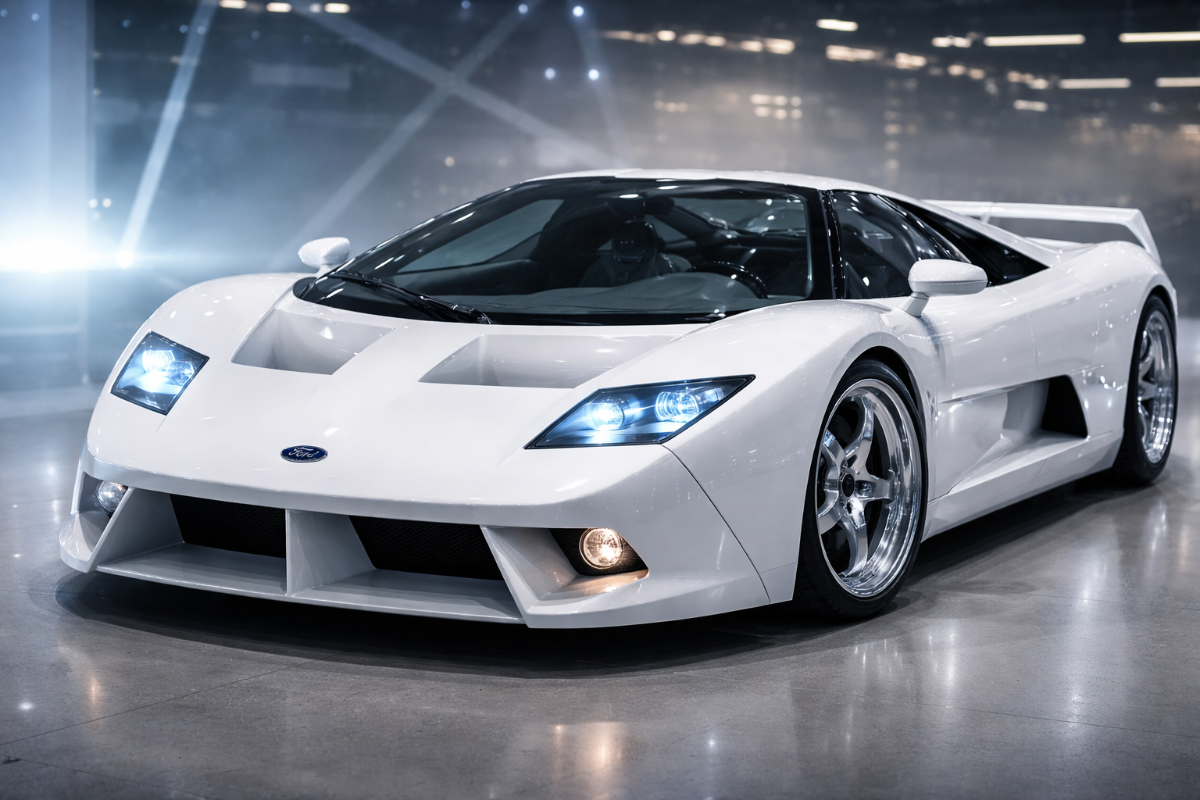
Few vehicles better illustrate a concept’s long-term influence than the Ford GT90. Unveiled in 1995, it never reached production, yet its technological ambition and design philosophy influenced supercar engineering for decades.
Background and Development Story
During the 1990s, Ford sought to showcase its engineering capabilities and revive excitement around its performance heritage. The GT90 was envisioned as a successor in spirit to the legendary GT40. Built around a carbon-fiber monocoque chassis, it featured a quad-turbocharged V12 engine producing roughly 720 horsepower extraordinary numbers for the era.
The project was executed rapidly, reportedly within six months. Engineers repurposed components from existing Ford platforms while experimenting with advanced materials and aerodynamic modeling. The car was less about immediate production and more about demonstrating engineering potential.
Moreover, the GT90 allowed Ford to test modular engine architecture, turbocharging efficiency, and high-temperature composite materials.
Design Philosophy and Technological Breakthroughs
The GT90 introduced Ford’s “New Edge” design language—sharp angles, geometric surfaces, and aggressive proportions. This styling direction later appeared across multiple Ford production models in the late 1990s and early 2000s.
Technologically, the car explored:
-
Carbon fiber structural elements
-
Active aerodynamics
-
Ceramic composite heat shielding
-
Modular turbocharged engine design
Consequently, even though the GT90 never entered production, its engineering philosophy influenced Ford’s later performance programs, including EcoBoost engine strategies.
Vehicle Innovation Breakdown
| Feature | Intended Purpose | Industry Impact | Later Adoption in Production Cars |
|---|---|---|---|
| Carbon Fiber Monocoque | Weight reduction and rigidity | Encouraged composite chassis adoption | Supercars across multiple brands |
| Quad Turbocharging | Extreme power with smaller displacement | Popularized multi-turbo efficiency thinking | Twin-turbo engines widely adopted |
| Ceramic Heat Shielding | Manage high exhaust temps | Advanced thermal management practices | High-performance exhaust systems |
| Active Aerodynamics | Stability at high speed | Improved aerodynamic tuning culture | Adjustable spoilers and air flaps |
| Modular Engine Architecture | Flexible performance scaling | Platform-based engine design | Modern turbocharged engine families |
Moreover, these innovations aligned with broader industry trends toward efficiency and lightweight construction.
Why It Never Reached Production?
Despite its technical promise, the GT90 remained a concept for several reasons.
Financial Constraints: Developing a production version would have required substantial investment in tooling and safety validation. Ford’s strategic priorities at the time focused on mainstream vehicle profitability.
Regulatory Challenges: Meeting emissions and crash standards for a limited-run supercar in the 1990s was expensive and complex.
Strategic Positioning: Ford recognized that the GT90’s value lay in branding and technology demonstration rather than direct sales. Therefore, it served as a halo project.
However, its influence continued quietly within Ford’s engineering programs.
Industry Reaction and Media Coverage
When the GT90 debuted, automotive media praised its engineering ambition and futuristic styling. Enthusiasts admired its raw performance potential, while analysts saw it as a signal that Ford intended to compete technologically with European supercar makers.
Moreover, rival manufacturers took notice. Concept cars from other brands began emphasizing composite construction and forced-induction efficiency.
Consequently, the GT90 helped normalize high-output turbocharged engines in performance cars.
Concept vs Production Comparison
| Factor | Concept Cars | Production Cars |
|---|---|---|
| Design Freedom | Nearly unlimited | Constrained by safety and cost |
| Cost Structure | Prototype-focused, high per-unit cost | Optimized for scale |
| Regulatory Compliance | Often exempt or relaxed | Strict crash, emissions, noise rules |
| Scalability | Not prioritized | Essential |
| Market Risk | Experimental | Sales-driven |
Therefore, many ideas first tested in concept cars only reach production after refinement and cost optimization.
How Its Innovations Influenced Future Models?
The GT90’s influence appeared in multiple ways:
-
Ford’s New Edge design language spread across models like the Focus and Taurus.
-
Turbocharged engine development accelerated, leading to EcoBoost technology.
-
Lightweight composite construction became standard in supercars.
-
High-performance heat management systems improved durability.
Moreover, the GT90 reinforced the idea that supercars could serve as technology demonstrators for mass-market vehicles.
Long-Term Impact on Automotive Standards
The concept car’s legacy extended beyond Ford. Across the industry, manufacturers embraced:
-
Turbocharging as a mainstream efficiency tool
-
Lightweight structural materials
-
Aerodynamic optimization through simulation
-
Integrated electronic control systems
Consequently, modern performance cars balance power, efficiency, and safety more effectively than their predecessors.
Moreover, the GT90 helped redefine how manufacturers used concept vehicles—not just as styling exercises, but as engineering testbeds.
Broader Lessons from Concept Cars
Concept vehicles often influence:
-
Supplier innovation pipelines
-
Design language evolution
-
Consumer expectations
-
Competitive benchmarking
However, they also remind us that not every good idea is commercially viable. Production requires balancing innovation with cost, regulation, and reliability.
Therefore, concept cars function as both inspiration and experimentation.
Looking Ahead Beyond 2026
Modern concept cars increasingly explore EV platforms, autonomous driving, and AI-driven personalization. Manufacturers test battery architecture, software-defined vehicles, and sustainable materials.
Moreover, digital twins and simulation tools allow rapid prototyping. Consequently, concept vehicles may move from physical showpieces to virtual design ecosystems.
AI integration will enable predictive maintenance, adaptive safety systems, and customized driving experiences. Sustainability trends will push manufacturers toward recyclable materials and circular manufacturing models.
Therefore, concept cars will continue shaping the industry—not just through horsepower and styling, but through software, connectivity, and environmental responsibility.
FAQ Section
Why do some concept cars never reach production?
Because production requires meeting safety, emissions, cost, and scalability requirements that prototypes often bypass.
Are cost factors the biggest barrier?
Often yes. Tooling, validation testing, and supply chain setup can make limited-run vehicles financially impractical.
What regulatory challenges exist?
Crash safety standards, emissions compliance, noise regulations, and homologation requirements can prevent concept vehicles from reaching showrooms.
How do concept cars influence mainstream models?
Technologies tested in concepts—like turbocharging, composites, and aerodynamics—gradually appear in production vehicles after refinement.
Do modern concept cars still matter?
Absolutely. They help manufacturers test EV architecture, autonomous systems, and software platforms that will define future vehicles.