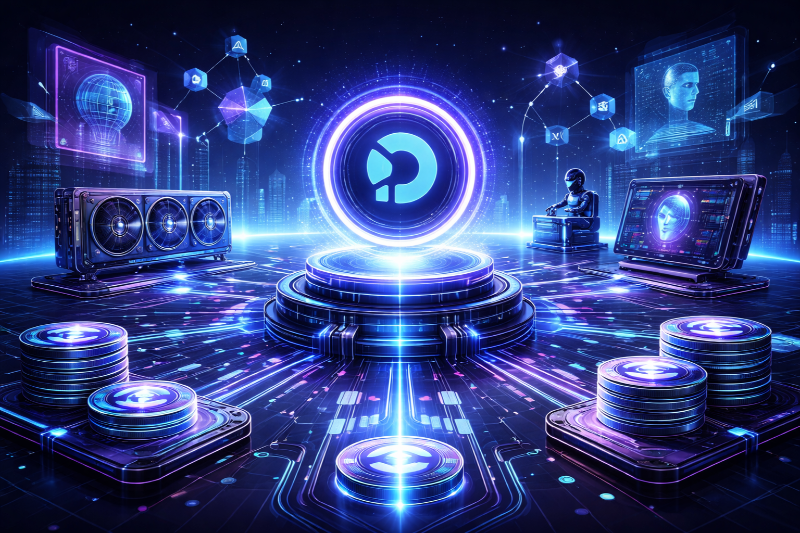
The rapid convergence of artificial intelligence and blockchain infrastructure has created new investment narratives across digital assets. In this Render Crypto review, we examine a project positioned at the intersection of AI computing demand and decentralized GPU rendering. As AI models become increasingly compute-intensive, the need for scalable, distributed GPU power continues to rise. Render aims to capitalize on this demand by connecting idle GPU resources to creators and developers who require high-performance rendering.
Moreover, the Render ecosystem is built around the idea of decentralizing rendering services traditionally dominated by centralized cloud providers. Instead of relying solely on expensive hyperscale infrastructure, the network distributes rendering workloads across independent GPU node operators. Consequently, this marketplace model introduces both scalability and economic incentives, while leveraging blockchain-based token utility to facilitate transactions.
However, beyond the hype surrounding AI and Web3 integration, investors must analyze whether the fundamentals justify long-term growth. This Render Crypto review explores tokenomics, governance, staking mechanics, network incentives, real-world use cases, and ecosystem expansion potential to determine whether the project represents a sustainable infrastructure play or simply a narrative-driven cycle.
What Is Render Crypto?
Render (often associated with the RNDR token) operates as a decentralized GPU rendering marketplace. It enables artists, AI developers, metaverse builders, and studios to access distributed GPU compute power on demand. The protocol connects:
-
Creators / Clients needing rendering services
-
Node Operators providing GPU resources
-
Blockchain layer facilitating payments, verification, and trust
Therefore, Render functions as a two-sided marketplace, powered by tokenized incentives.
Network Fundamentals: Decentralized GPU Marketplace Structure
At its core, Render is structured around decentralized compute distribution. Traditional rendering workflows often rely on centralized data centers. However, Render aggregates independent GPU providers into a coordinated network.
Marketplace Structure
-
Client submits rendering or compute task.
-
Network matches task with suitable node operator.
-
Work is completed and verified.
-
Payment is released in RNDR tokens.
This model reduces reliance on centralized cloud giants while monetizing idle GPU capacity globally. Moreover, it creates economic alignment between demand (AI developers, 3D artists) and supply (GPU owners).
Tokenomics and Economic Design
A key component of this Render Crypto review is token utility. The RNDR token functions as:
-
Payment for GPU rendering tasks
-
Incentive for node operators
-
Potential staking or governance participation mechanism
-
Value capture layer for ecosystem expansion
Token supply dynamics influence long-term valuation. Scarcity mechanisms, emission schedules, and reward structures determine sustainability. However, investors must monitor inflation pressure from node rewards.
Network & Token Metrics
| Metric | Overview |
|---|---|
| Market Cap | Varies with market cycles; reflects AI infrastructure narrative |
| Total Supply | Fixed maximum supply (subject to tokenomics design) |
| Circulating Supply | Gradually increasing based on emissions |
| Primary Utility | Payment for GPU rendering & compute services |
| Staking Benefits | Potential network participation incentives |
| Ecosystem Growth | Expanding partnerships in AI & Web3 sectors |
Note: Investors should verify current on-chain metrics before making decisions.
Node Incentives and Staking Utility
Node operators supply GPU compute resources and earn RNDR tokens in return. Consequently, the network must ensure:
-
Competitive reward rates
-
Fair task distribution
-
Transparent performance metrics
-
Reliable dispute resolution
If incentives are misaligned, node supply could shrink. However, strong demand from AI workloads may offset potential reward dilution.
Staking mechanisms if integrated can enhance token lockups, reduce circulating supply, and improve governance participation. Therefore, staking plays a strategic role in token value stability.
Ecosystem Adoption and Expansion
The long-term strength of any infrastructure token lies in adoption. Render has expanded into areas such as:
-
NFT rendering
-
Metaverse world-building
-
AI model visualization
-
High-resolution cinematic production
-
Gaming asset rendering
Moreover, integration with AI training workflows may significantly increase compute demand. As generative AI models grow more complex, GPU requirements scale exponentially.
AI Integration Potential
AI models require vast GPU clusters for:
-
Training large language models
-
Image generation systems
-
Simulation workloads
-
3D modeling environments
Render’s distributed marketplace can theoretically supplement traditional cloud providers. However, enterprise-level AI firms may prioritize reliability, compliance, and uptime guarantees.
Therefore, Render’s challenge lies in proving institutional-grade performance standards.
Security Model
Security is essential in decentralized compute networks. Render must address:
-
Data integrity verification
-
Secure job execution
-
Node reputation systems
-
Anti-fraud mechanisms
Blockchain verification enhances transparency. Moreover, smart contract automation reduces manual intervention risk. However, vulnerabilities in contract logic or node validation systems could present operational risks.
Scalability Considerations
As demand grows, scalability becomes critical. Render’s distributed architecture allows horizontal expansion—new nodes can join the network seamlessly.
Consequently, scaling is not limited by centralized server capacity. However, maintaining quality control across thousands of distributed nodes requires robust governance and monitoring frameworks.
Governance Framework
Decentralized governance may involve:
-
Token-based voting
-
Proposal mechanisms
-
Ecosystem funding allocation
-
Protocol upgrades
Transparent governance strengthens investor confidence. Moreover, community-driven evolution supports long-term resilience.
Real-World Use Cases
1. AI Training Infrastructure
Render can supplement GPU clusters used for machine learning model training.
2. Metaverse Development
3D worlds require large-scale rendering power for environment generation and immersive experiences.
3. Digital Content Production
Studios and freelancers can offload rendering tasks without investing in expensive hardware.
4. Web3 Infrastructure
NFT creators and blockchain-based gaming projects require scalable graphics rendering.
Therefore, Render’s value proposition extends beyond crypto speculation into real computational demand.
Competitive Comparison
| Feature | Render Crypto | Traditional Cloud Providers | Other Decentralized GPU Projects |
|---|---|---|---|
| Infrastructure Model | Decentralized GPU marketplace | Centralized data centers | Decentralized |
| Cost Structure | Market-driven token pricing | Fixed enterprise pricing | Token-based |
| Scalability | Horizontal via node expansion | Limited by data center capacity | Variable |
| Transparency | Blockchain-verified | Limited public transparency | Blockchain-based |
| Enterprise Adoption | Growing but limited | Highly established | Emerging |
| Token Incentives | Yes (RNDR) | No native token | Yes |
Traditional cloud providers offer reliability and brand trust. However, decentralized GPU networks provide flexibility and potential cost efficiency.
Risks to Consider
Every Render Crypto review must include risk analysis:
-
Token volatility
-
Regulatory uncertainty
-
Competition from hyperscalers
-
Technical vulnerabilities
-
Overreliance on AI narrative hype
Moreover, GPU hardware shortages or changes in AI chip architecture (e.g., custom ASICs) could alter demand dynamics.
Investment Perspective
Render represents a hybrid infrastructure and AI growth narrative. Consequently, valuation may correlate with:
-
AI market expansion
-
Web3 gaming growth
-
NFT resurgence
-
Broader crypto market cycles
However, sustainable growth depends on real network usage, not speculation alone.
Forward-Looking Outlook Beyond 2026
AI compute demand is projected to rise dramatically over the next decade. Therefore, decentralized GPU marketplaces may play a complementary role to centralized providers. Render’s positioning within AI infrastructure ecosystems could strengthen if:
-
Strategic partnerships expand
-
Institutional adoption increases
-
Enterprise-grade compliance improves
-
Tokenomics remain sustainable
Moreover, Web3-based immersive platforms and metaverse environments may require scalable rendering infrastructure. If adoption accelerates, Render could secure a long-term niche in decentralized compute markets.
However, competition will intensify as both centralized cloud giants and blockchain-native GPU networks evolve.
Final Thoughts
This Render Crypto review highlights a project operating at the intersection of AI demand and decentralized GPU infrastructure. Moreover, the expanding need for scalable compute power strengthens the narrative. However, investors should carefully assess tokenomics, competition, and real adoption metrics before making long-term commitments.
If decentralized compute becomes a critical layer of AI infrastructure, Render may capture meaningful value. Consequently, its trajectory beyond 2026 will depend less on hype and more on measurable utility and ecosystem growth.
FAQ
What is the utility of the RNDR token?
RNDR tokens are used to pay for GPU rendering services, incentivize node operators, and potentially participate in governance mechanisms.
Does Render offer staking rewards?
Staking features may allow participants to earn rewards or contribute to network security, depending on protocol design.
Is the Render network secure?
The protocol uses blockchain verification and node reputation systems. However, like all decentralized systems, it carries technical and smart contract risks.
What are the main investment risks?
Token volatility, regulatory changes, competition, and fluctuating GPU demand represent primary risks.
What is the long-term growth potential?
Growth depends on AI infrastructure demand, Web3 adoption, and sustainable ecosystem expansion beyond speculative cycles.