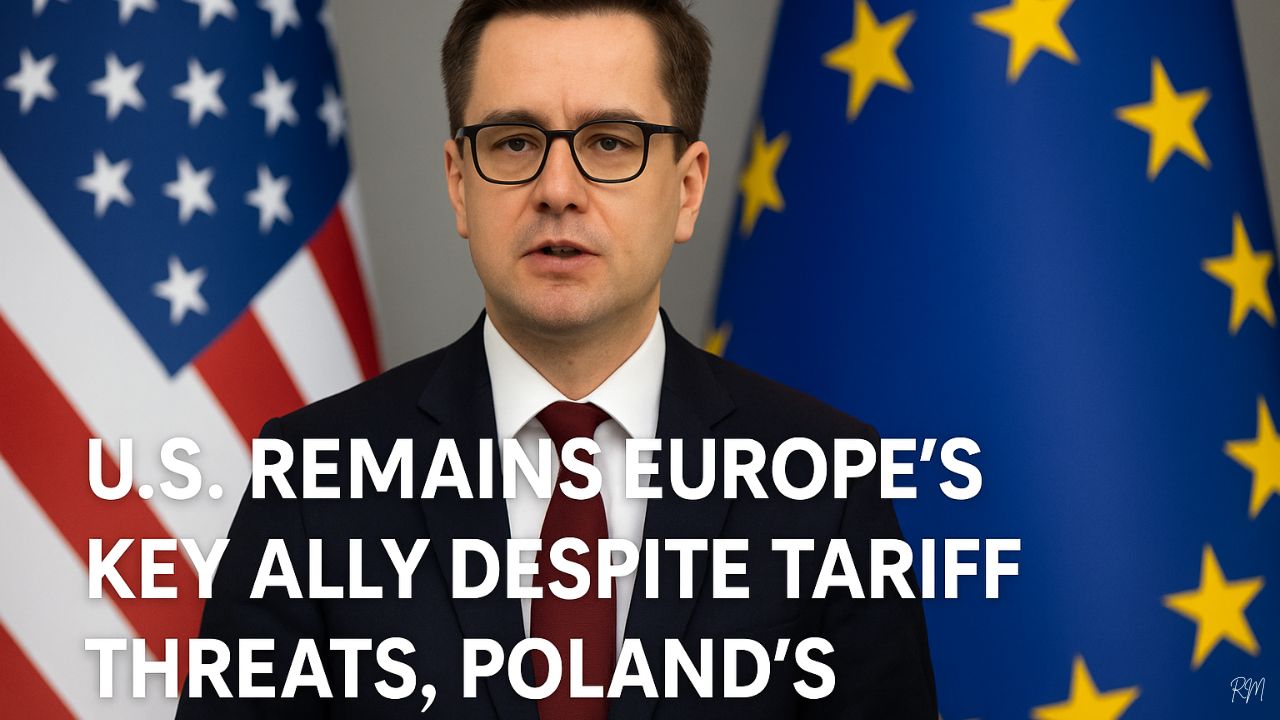
Despite rising trade tensions and looming tariffs, the United States remains Europe’s most trusted and vital ally, says Poland’s Finance Minister Andrzej Domański. Speaking at the IMF and World Bank spring meetings in Washington, Domański emphasized the importance of strengthening defense and deepening trade ties between the U.S. and Europe.
A Strategic Ally in Uncertain Times
Domański was clear in his message: “The U.S. is the strongest and most important ally of both the European Union and Poland.”
This comment comes just weeks after former President Donald Trump announced a 20% tariff on EU imports, sparking fears of another transatlantic trade war.
However, the minister stressed that cooperation—especially in defense and energy—must take precedence over conflict.
“We buy a lot of military equipment from the U.S. and deeply value the presence of U.S. troops in Poland,” Domański said during his interview with CNBC.
He also highlighted the Eastern flank of NATO as a top priority, stating that American military presence there is “absolutely crucial” for Europe’s security.
Defense as a Dual Strategy: Security + Trade Balance
With NATO urging member states to ramp up military budgets, Domański pointed to defense as a key area where Europe and the U.S. could both strengthen alliances and correct trade imbalances.
Defense Spending Snapshot (2024 Estimate)
| Country | % of GDP Spent on Defense |
|---|---|
| Poland | 4.12% |
| U.S. | 3.38% |
| NATO Target | 2.00% |
| Germany | 1.57% |
| France | 1.89% |
Source: NATO Official Data
Poland is one of the few NATO members exceeding the 2% GDP defense target, and Domański urged other EU countries to follow suit.
“We know some countries face budget constraints. But collective security demands action,” he said.
90 Days to Strike a Deal
Trump’s tariffs sparked panic in markets, prompting a temporary 90-day pause on reciprocal tariffs above 10% (excluding those targeting China). This grace period, which ends in early July, has become a ticking clock for trade negotiations.
“We must use these 80 days very wisely,” Domański emphasized. “The European Commission is working hard to find a solution.”
As global uncertainty rises, several countries, including Germany, France, and Poland, are actively seeking bilateral trade agreements with the U.S. in an effort to avoid broader trade conflict.
Focus on U.S. Energy and Defense Goods
Poland is looking beyond traditional goods and turning to American natural gas and defense equipment as areas to boost trade. This strategy not only diversifies energy dependence—especially important in the wake of the Ukraine crisis—but also offers a way to rebalance transatlantic trade flows.
“There’s room to buy more from the U.S. in both energy and defense sectors,” Domański noted.
In recent years, Poland has imported liquefied natural gas (LNG) from the U.S., helping to reduce its reliance on Russian energy. With Europe’s energy crisis still lingering, energy trade could be a stabilizing force in EU-U.S. relations.
Trade Talks Amid Tariff Uncertainty
While Poland has largely avoided criticism from Trump due to its proactive defense spending, other European countries haven’t been so lucky. Trump has often chastised allies for not “paying their fair share” in NATO.
Still, Poland’s approach may serve as a blueprint for other EU members—using increased defense budgets and strategic energy partnerships as a way to strengthen ties with Washington and shield against tariffs.
Key Takeaways
-
Poland views the U.S. as its most important strategic ally, especially in defense and energy.
-
Trump’s proposed EU tariffs remain a threat, but a 90-day moratorium provides a window for trade negotiations.
-
Poland is among NATO’s top defense spenders, investing over 4% of GDP.
-
The EU and U.S. are exploring new areas of cooperation, including military equipment purchases and natural gas deals.
-
Minister Domański is urging faster bilateral trade talks to maintain strong transatlantic ties.
Why This Matters for Global Investors
For investors and policymakers watching EU-U.S. relations, Poland’s stance is a crucial signal. The country is actively investing in security, positioning itself as a key NATO player, and encouraging stronger U.S.-EU ties despite rising protectionist policies.
As trade tensions shift and defense spending grows, the realignment of Europe’s trade and security landscape is already underway. Strategic allies like Poland are leading the way.