After SpaceX’s acquisition of xAI, reaching the value of $1.25 trillion, the struggle for the title of the most expensive private technology company escalated dramatically. In light of this, OpenAI is preparing for a large-scale financing round that could exceed $100 billion and raise the company’s valuation to $850 billion. Excluding the new funding, OpenAI’s capitalization is estimated at $730 billion, meaning the company will need to raise at least $120 billion to reach the desired level.
The first stage of the round is nearing completion and relies mainly on strategic investors such as Amazon, SoftBank, Nvidia, and Microsoft. If participation reaches its full potential, about $100 billion can be raised at the initial stage. Against the backdrop of news about large-scale private investments, market participants are also closely monitoring the dynamics of the Nasdaq 100 futures, as technology companies form the basis of the index. For Amazon, the deal also has an infrastructural dimension, as it involves greater use of the company’s cloud services and processors in the OpenAI ecosystem, turning the investment into a means of supporting long-term demand.
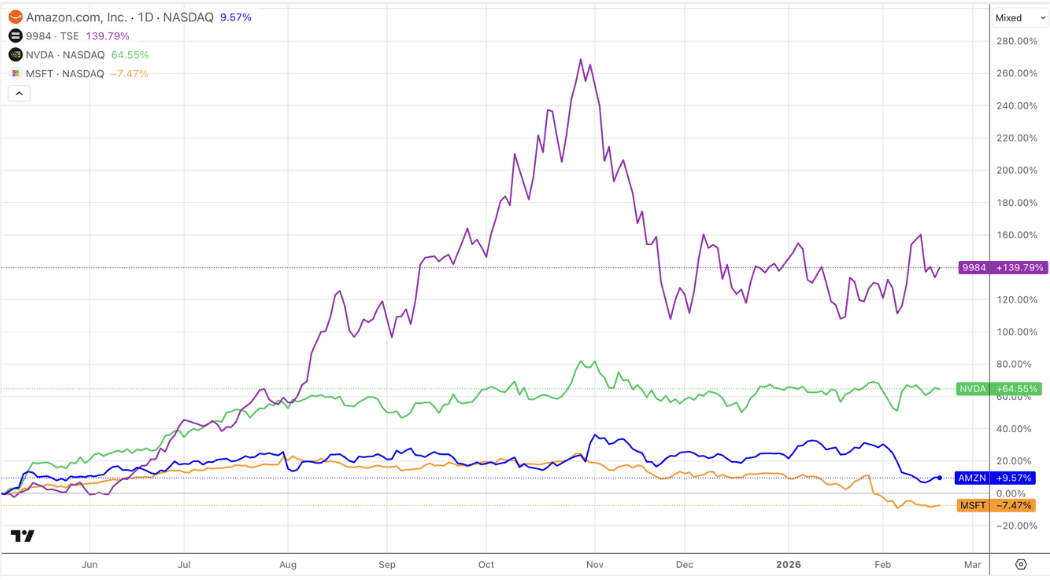
The financial scale of the transaction is particularly significant amid the public market correction. Since the beginning of the year, Microsoft’s shares have fallen by 17%, reducing its market capitalization by almost $613 billion. Amazon has lost about 13.85% of its value, and investors are wary of plans to increase capital expenditures by more than 50% to fund AI infrastructure. Even in the leadership segment, there is a cooling. Apple and Alphabet are showing moderate drawdowns, while Nvidia is holding its ground due to steady demand for accelerators. Recently, worries that AI returns may not justify massive investments, along with concerns about the technology’s potential disruptive effects across industries, led to losses in Nasdaq, S&P 500 and Dow Jones futures. Thus, OpenAI’s record-seeking private fundraising is taking place while investors broadly reassess AI risks and payback horizons.
In this context, the company’s desire to raise more than $100 billion appears to be an attempt to consolidate leadership before a possible further tightening of financial conditions. The largest strategic investors are actually betting not only on technology, but also on control over the future AI infrastructure, from computing power to cloud services. This enhances the industry’s vertical integration and raises entry barriers for new players, who will find it increasingly difficult to compete without comparable access to capital.
At the same time, non-financial risks are also increasing. The California federal court’s decision on the Cameo platform’s lawsuit ordered OpenAI to stop using the function’s eponymous name in a product based on Sora 2. Although the dispute concerns branding, it highlights the growing legal burden on rapidly scalable AI companies. For investors, such processes entail additional costs and reputational risks, which, in the context of multibillion-dollar valuations, can affect transaction structures and corporate governance requirements.
Collectively, the situation reflects a phase change in the AI cycle. If the ChatGPT hype was the growth driver in 2022-2023, the market is now entering a stage of capital consolidation and a more rigorous assessment of payback. The OpenAI round is becoming not just another fundraiser, but a marker of whether investors are ready to continue financing the exponential expansion of infrastructure amid the correction of public tech giants. The answer to this question will determine not only the balance of power among private AI companies but also the dynamics of the entire technology sector in the coming years.