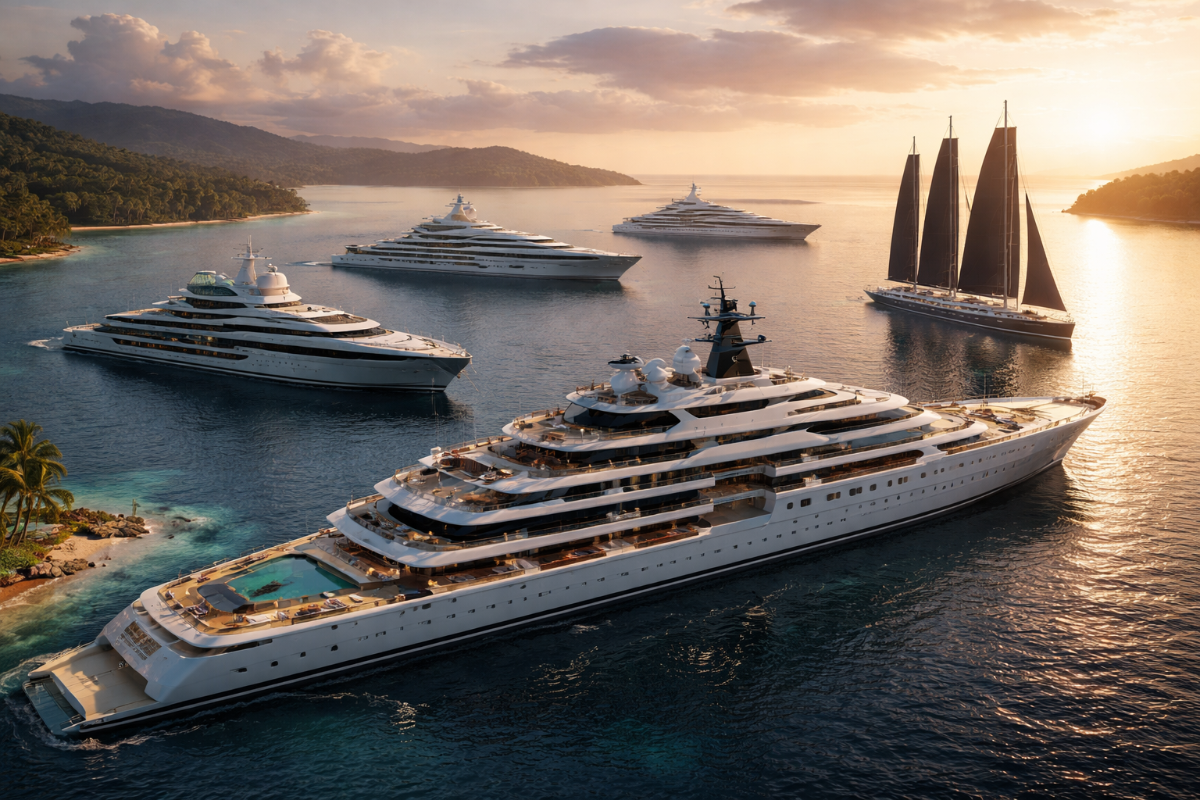
The most anticipated superyachts launching in 2026 signal a defining moment for the global superyacht industry. As shipyards prepare for a landmark year, 2026 is shaping up to become one of the most influential periods in modern yachting history. A powerful convergence of technological maturity, sustainability demands, and evolving ultra-high-net-worth individual (UHNWI) preferences is driving the creation of vessels that are not only larger, but also cleaner, smarter, and more luxurious than ever before.
Moreover, unlike earlier growth cycles that emphasized sheer size and extravagance, the most anticipated superyachts launching in 2026 reflect a fundamental shift in design philosophy. Today’s owners prioritize advanced propulsion systems, reduced environmental impact, expedition-level capability, and deeply personalized onboard experiences. As a result, the new superyachts launching in 2026 are redefining what true luxury at sea means.
In addition, with global wealth concentration increasing and luxury assets increasingly viewed as long-term lifestyle investments rather than mere status symbols, the most anticipated superyachts of 2026 represent a strategic blend of engineering excellence, design artistry, and enduring value creation.
The Industry Forces Driving the Most Anticipated Superyachts Launching in 2026
Several interconnected forces are accelerating innovation across the superyacht sector and shaping the most anticipated superyacht launches of 2026:
-
Technological breakthroughs in hybrid, hydrogen, and fuel-cell propulsion systems
-
Stricter environmental regulations, compelling shipyards to adopt cleaner maritime solutions
-
Growing owner demand for autonomy and exploration, extending beyond traditional coastal cruising
-
Rising demand from emerging wealth markets, particularly in Asia-Pacific and the Middle East
Consequently, luxury superyacht launches in 2026 are not incremental upgrades. Instead, they represent transformational projects that push the boundaries of sustainability, performance, and onboard innovation.
Leading Shipyards Behind the Most Anticipated Superyachts Launching in 2026
The most anticipated superyachts launching in 2026 are being delivered by a select group of elite shipyards renowned for their technical mastery, bespoke craftsmanship, and forward-thinking innovation. These builders are setting new benchmarks for the next generation of ultra-luxury vessels, ensuring that 2026 superyacht launches will define industry standards for years to come.
Feadship (Netherlands)
Feadship continues to lead in bespoke engineering and alternative propulsion, setting benchmarks for hydrogen and hybrid technology.
Lürssen (Germany)
Lürssen dominates the ultra-large yacht segment, focusing on fuel-cell systems, explorer capabilities, and extreme customization.
Amels (Netherlands)
Amels blends semi-custom efficiency with full-custom scale, producing some of the largest yachts ever built in the Netherlands.
Admiral (Italy)
Admiral is pushing boundaries in diesel-electric propulsion and interior spatial design.
Vard and Freire (Northern Europe & Spain)
These yards are redefining scale, research integration, and expedition-ready luxury.
The Most Anticipated Superyachts Launching in 2026
2026 is set to be a landmark year for the global superyacht industry, with record-breaking builds, groundbreaking technology, and ultra-luxury design redefining the benchmark for maritime excellence. Leading shipyards across Europe and Asia are unveiling vessels that integrate hybrid and fuel-cell propulsion, cutting-edge AI navigation systems, and bespoke interiors designed for comfort, privacy, and sustainability. These new superyachts appeal not only to ultra-high-net-worth owners seeking prestige and lifestyle but also to investors considering yachts as long-term luxury assets. With mega-expeditions, explorer-class designs, and innovative sustainability features, 2026 promises to showcase the most exciting and highly anticipated superyacht launches yet.
REV Ocean (Approx. 195m)
Builder: Vard (Norway)
REV Ocean is widely expected to become the largest superyacht in the world upon delivery in late 2026. Unlike traditional gigayachts, this vessel has been designed with a dual mission: ultra-luxury living and serious scientific research.
Designed by Espen Øino with interiors by H2 Yacht Design, REV Ocean includes onboard laboratories, research equipment, and facilities for marine conservation initiatives. At the same time, it delivers five-star accommodation, expansive leisure decks, and long-range expedition capability. This project signals a new category of superyacht one that blends philanthropy, exploration, and luxury into a single platform.
Project Tanzanite (120m)
Builder: Amels / Damen Yachting (Netherlands)
Project Tanzanite is set to become the largest motor yacht ever built in the Netherlands. With a massive internal volume of 6,083 gross tons, it represents a new high point for the Amels Limited Editions portfolio.
The yacht features exterior design by Espen Øino and interiors by Zuretti Design, combining architectural scale with refined elegance. Project Tanzanite reflects a growing preference for large-volume yachts that prioritize comfort, stability, and long-term cruising over extreme speed.
Project Boardwalk (117m)
Builder: Lürssen (Germany)
Commissioned by a prominent American owner, Project Boardwalk is one of the most closely watched Lürssen launches scheduled for 2026. With an estimated volume of 5,350 gross tons, it ranks among the largest yachts the German yard has ever produced.
While official details remain tightly controlled, industry sources suggest the yacht may feature multiple pools and dual helipads. The project reflects Lürssen’s continued dominance in delivering ultra-large, discreetly luxurious yachts for experienced owners.
Project Cosmos (114.2m)
Builder: Lürssen (Germany)
Project Cosmos stands out as one of the most technologically advanced superyachts expected in 2026. It is among the first yachts of its size to incorporate hydrogen-methanol fuel cell propulsion, allowing for significantly reduced emissions and quieter operation.
Designed by Marc Newson, the yacht features a futuristic explorer-style profile, highlighted by a striking glass dome housing the owner’s private study. Project Cosmos represents the direction many top-tier builders are heading where sustainability, design innovation, and performance intersect.
Project Shackleton / “O3” (Approx. 109m)
Builder: Lürssen / Peene-Werft (Germany)
Formerly known as Project Icecap, this highly confidential expedition yacht is built for extreme environments. With an ice-classed hull and axe-style means, Project Shackleton is designed for polar and remote-region exploration.
A massive aft deck allows for carrying tenders, submersibles, and cargo, reinforcing its role as a true explorer yacht rather than a traditional leisure vessel. Its secrecy and technical ambition make it one of the most intriguing launches expected in 2026.
Project Incógnita (107m)
Builder: Freire Shipyard (Spain)
Project Incógnita is one of Spain’s most significant superyacht builds to date. Designed for long-range cruising, the yacht reportedly offers a range of approximately 6,000 nautical miles.
With a volume of 3,999 gross tons spread across six decks, the yacht emphasizes endurance, efficiency, and onboard comfort. Its scale and ambition signal Spain’s growing role in the global superyacht construction market.
Project Jassi (103m)
Builder: Lürssen (Germany)
Designed by RWD, Project Jassi is a 3,420GT superyacht tailored for multi-generational and family-oriented cruising. The layout reportedly balances private owner spaces with generous communal areas.
Key features include a foredeck helipad and a main deck aft swimming pool. The yacht reflects a broader trend toward family-friendly design without sacrificing sophistication or technical performance.
Feadship Project 1014 (101.2m)
Builder: Feadship (Netherlands)
Feadship Project 1014 continues the Dutch yard’s tradition of fully bespoke craftsmanship. Drawing visual inspiration from previous Feadship icons, the yacht features refined, flowing exterior lines and a strong focus on wellness and onboard lifestyle.
With an estimated volume of 3,840 gross tons, Project 1014 prioritizes spatial harmony, quiet operation, and high levels of customization hallmarks of Feadship’s approach to ultra-luxury yacht building.
Admiral Hull 597 (100m)
Builder: The Italian Sea Group (Italy)
Admiral Hull 597 is set to become the largest yacht ever built by the Italian Sea Group at the time of launch. Designed entirely by Winch Design, both inside and out, the yacht blends bold Italian styling with advanced engineering.
A hybrid propulsion system using Azipods improves efficiency and maneuverability, reflecting Italy’s increasing investment in sustainable large-yacht construction.
Project Vela (130m – Sailing Yacht)
Builder: Brodotrogir (Croatia)
Project Vela is a rare entry into the ultra-large sailing yacht category. With an estimated volume of 4,290 gross tons, it is designed to accommodate 12 guests and up to 50 crew members.
Highly confidential, the project marks Croatia’s emergence into the elite segment of large sailing superyacht construction, traditionally dominated by Northern European yards.
Design Trends Defining 2026 Superyacht Launches
1. Exterior Architecture
Designs are shifting toward explorer silhouettes, axe bows, and extended aft decks. These features improve seaworthiness while maximizing usable outdoor space.
2. Interior Concepts
Interior design increasingly mirrors luxury residences rather than traditional yachts. Expect:
- Natural stone and sustainable woods
- Multi-height atriums
- Residential-style layouts
3. Seamless Indoor–Outdoor Living
Retractable glass walls, fold-down terraces, and beach clubs are now standard expectations.
Engineering Breakthroughs and Sustainability
Sustainability is no longer optional. 2026 superyacht launches highlight:
- Hydrogen fuel cells
- Methanol-powered systems
- Hybrid diesel-electric propulsion
- Advanced waste heat recovery
Consequently, these yachts significantly reduce emissions, noise, and fuel consumption while enhancing onboard comfort.
Ultra-Luxury Amenities Onboard
The most anticipated superyachts launching in 2026 offer amenities that rival private resorts:
- Helicopter hangars and certified helipads
- Wellness centers with cryotherapy and spas
- AI-assisted navigation and safety systems
- Submersibles and expedition gear
- Private cinemas and observation lounges
As a result, yachts are becoming self-contained luxury ecosystems.
Pricing and Ownership Considerations
Purchase prices for the most anticipated superyachts launching in 2026 typically range from USD 200 million to over USD 700 million, depending on size, shipyard pedigree, and onboard technology. Explorer-class vessels and fuel-cell superyachts command premium valuations due to extensive research, advanced propulsion systems, and regulatory compliance requirements. Annual operating costs generally average 8–12% of the yacht’s total value, reflecting the scale, crew demands, and technical complexity of these vessels.
The table below outlines estimated purchase prices and annual ownership costs for key 2026 superyacht launches.
Estimated Pricing & Ownership Costs of Anticipated 2026 Superyachts
| Superyacht Name | Approx. Length | Estimated Purchase Price (USD) | Estimated Annual Operating Cost |
|---|---|---|---|
| REV Ocean | ~195m | $600M – $700M+ | $50M – $70M |
| Project Tanzanite | 120m | $350M – $450M | $30M – $40M |
| Project Boardwalk | 117m | $320M – $420M | $28M – $38M |
| Project Cosmos | 114.2m | $380M – $480M | $32M – $45M |
| Project Shackleton (O3) | ~109m | $300M – $400M | $25M – $35M |
| Project Incógnita | 107m | $260M – $350M | $22M – $30M |
| Project Jassi | 103m | $240M – $320M | $20M – $28M |
| Feadship Project 1014 | 101.2m | $280M – $380M | $24M – $32M |
| Admiral Hull 597 | 100m | $220M – $300M | $18M – $25M |
| Project Vela (Sailing) | 130m | $300M – $450M | $20M – $30M |
Ownership Costs and Propulsion Choices
When thinking about owning a superyacht, fuel use, engine type, and rules compliance greatly affect costs. Traditional diesel yachts are reliable, but fuel prices and emission rules are rising.
On the other hand, hybrid and fuel-cell yachts use less fuel and produce fewer emissions, making them more efficient and eco-friendly. However, they cost more to buy initially and need specialized maintenance.
Because of this, many owners now see yachts as long-term lifestyle assets rather than short-term possessions. They balance efficiency, environmental impact, enjoyment, and the option to charter their yachts.
Superyachts as Luxury Assets
Unlike most luxury items, top superyachts often keep their value. Yachts with:
-
Modern engines
-
Timeless designs
-
Long-range and expedition capabilities
are more likely to hold value over time. Limited production and custom-made features also make these yachts exclusive.
This means owning a superyacht is often about careful investment and long-term enjoyment rather than just showing off wealth.
What 2026 Superyacht Launches Show About the Future?
The yachts coming in 2026 show how the industry is changing:
-
Moving from just big, flashy yachts to smarter and purposeful designs
-
Focusing on efficiency instead of excess
-
Prioritizing experience over display
Future yachts will focus on sustainability, advanced technology, and personalization, while keeping luxury and comfort at the highest level.
Conclusion
The most anticipated superyachts launching in 2026 are some of the most advanced yachts ever made. From hydrogen-powered ships to explorer-class yachts, these vessels push the limits of design, engineering, and eco-friendly technology.
They also show a future where luxury, technology, and environmental responsibility go hand in hand. For yacht owners, builders, and enthusiasts, 2026 marks a new era in superyacht design and ownership.
FAQs About the Most Anticipated Superyachts Launching in 2026
What makes 2026 superyachts different from older yachts?
They focus on being eco-friendly, using advanced engines, and offering highly personalized experiences.
Are hybrid and fuel-cell yachts expensive to maintain?
They need special maintenance, but they save fuel and reduce emissions, which can lower long-term costs.
Will 2026 superyachts keep their value?
Yes, yachts with modern engines, classic designs, and limited production usually maintain their value.
Are 2026 superyachts made for long trips?
Many of them are built for long-range cruising and exploration, not just coastal trips.
How do environmental rules affect new yachts?
Stricter regulations encourage cleaner engines, better energy use, and eco-friendly materials.
Are luxury yachts still seen as lifestyle assets?
Yes, but more owners now view them as long-term investments with lasting value.
Can these yachts be rented out?
Some owners choose selective chartering, especially if the yacht is efficient and follows commercial rules.