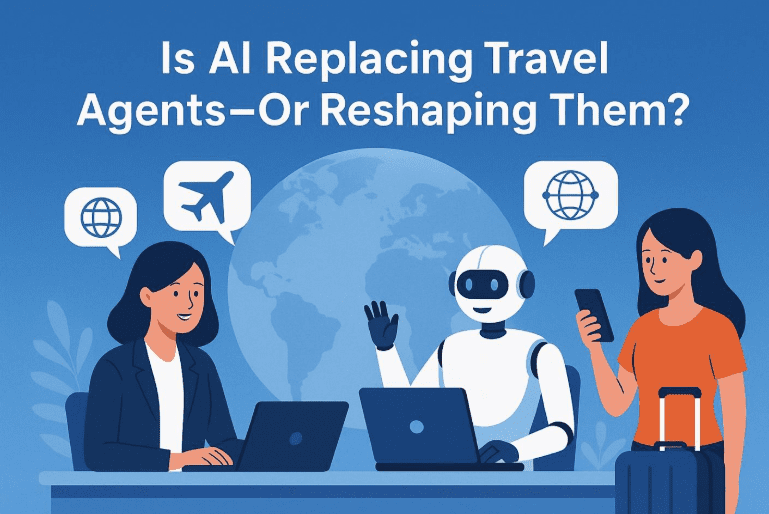
Artificial Intelligence has become one of the most disruptive forces in the travel industry. Chat-based trip planners, automated rebooking tools, and algorithm-driven recommendations are no longer experimental—they’re becoming the backbone of modern travel planning. Some wonder if AI is positioned to replace travel advisors entirely.
The truth is far more interesting:
AI isn’t replacing great travel agents—it’s reshaping the profession and elevating expectations across the entire industry.
Today’s best advisors are not competing with AI. They’re partnering with it to deliver faster, smarter, and more personal travel experiences than ever before.
What’s Actually Changing?
Travel is undergoing a technology shift not seen since the introduction of online booking. The new wave of AI is not simply predictive; it’s agentic—it can act.
1. AI for Travelers
Travelers now have access to conversational trip planners capable of:
- Turning vague ideas (“somewhere warm in June”) into draft itineraries
- Sorting thousands of hotel options in seconds
- Comparing flight classes, baggage rules, and fare types instantly
- Adjusting schedules and offering alternatives when disruptions occur
Tools originally launched in limited markets are now expanding globally, giving travelers near-instant inspiration and planning support.
2. AI for Online Booking Platforms
Major OTAs (Online Travel Agencies) have released their own AI copilots that:
- Become a personal “travel buddy” during planning
- Recommend routes and hotels
- Handle cancellations or delays
- Rebook travelers automatically
This is automation at scale—something traditional websites were never designed to handle efficiently.
3. AI for the Supply Side
Behind the scenes, travel technology providers are rebuilding core engines:
- Pricing systems now use AI to optimize revenue in real time
- Inventory systems can adjust availability dynamically
- Customer service platforms can detect issues and generate solutions before humans flag them
This quiet transformation is improving the entire travel ecosystem, not just the consumer-facing end.
Are Travelers Actually Using AI?
Absolutely. Adoption is accelerating every quarter.
Younger travelers lead the way, but even older demographics are turning to AI for idea generation, safety information, and itinerary structure.
At airports, travelers happily use:
- Mobile boarding passes
- Biometric gates
- Self-service kiosks
Comfort with automation is growing—and this creates a natural entry point for AI-driven travel planning.
So Is AI Replacing Travel Agents?
No. It’s reshaping the role.
Think of AI as the industry’s autopilot. A brilliant tool—but not the pilot.
AI can generate ideas, summarize options, or manage logistics. But it doesn’t replace the human judgment, empathy, and lived experience that travelers value—especially for complex or high-stakes trips.
What AI Does Best
Transforms vague ideas into structured options
Perfect for early inspiration:
“10 days in June. Wildlife. Beach. Light adventure. No redeyes.”
Handles micro-planning at scale
AI excels at:
- Mapping drive times
- Flagging visa or health requirements
- Comparing hotel categories
- Tracking price and availability changes
Responds instantly during disruptions
A flight delay or cancellation triggers immediate rebooking options, eliminating stress and saving time.
What Human Travel Advisors Do Better
Contextual Judgment
Only humans can understand nuance—preferences, personalities, travel style, flexibility, energy levels, and emotional details AI can’t detect.
Multi-Layered Coordination
Complex itineraries require orchestration across multiple suppliers.
For example, a Tanzania honeymoon safari that includes:
- The Great Migration
- A crater-rim lodge at Ngorongoro
- Hot air ballooning
- Private charters
- A tide-aware beach finale in Zanzibar
One small misalignment can derail the entire journey.
AI can outline it.
A human expert makes the magic happen.
Advocacy & Accountability
When something goes wrong, you want a human champion—someone who understands your expectations and can negotiate on your behalf.
The Tanzania Safari Litmus Test
AI can generate a solid first draft of a safari itinerary. But a specialist transforms it into a once-in-a-lifetime experience:
- Matching your exact travel dates with the micro-movements of the Great Migration (not generic seasonal advice).
- Selecting camps with the right photography vehicles, guiding style, and positioning.
- Balancing drive times, comfort levels, and wildlife density.
- Managing bush-flight luggage rules, park fees, and permits.
- Adding those magical touches—sunset drinks, private dinners, secluded tent locations.
AI speeds up the process.
An expert makes it unforgettable.
How Top Travel Advisors Are Evolving
The most successful advisors aren’t resisting AI—they’re leveraging it:
1. AI-Assisted Client Qualification
Quickly sorting leads, identifying travel styles, and drafting tiered proposals.
2. Automated Disruption Handling
AI concierges monitor bookings and send solutions before clients even know there’s an issue.
3. Deep Personalization
Advisors fuse CRM data with AI insights to tailor a trip around personal preferences:
- Sleep habits
- Food sensitivities
- Mobility considerations
- Birthday or honeymoon touches
4. Editor-in-Chief Mindset
Advisors now curate, refine, and elevate AI drafts—saving hours while delivering higher quality.
5. Productizing Expertise
Creating signature journeys (like Great Migration safaris) and letting AI assist with marketing, ads, and hyper-personalized landing pages.
Risks to Watch
Hallucinations
AI can sound confident and be completely wrong. Verification remains essential.
Over-Automation
Travel is emotional. Remove too much human connection, and the experience loses its soul.
Data Governance
Client data must be handled responsibly and transparently.
What the Next 24 Months Look Like
Expect:
- AI that books, modifies, and monitors reservations autonomously
- Deeper GDS and NDC integrations
- Smarter pricing engines
- Invisible AI embedded throughout the journey
Travelers won’t ask for AI. They’ll simply expect frictionless experiences.
Final Verdict
AI is not replacing travel advisors.
It’s replacing order-takers.
The advisors who thrive will be those who combine:
- Machine speed
- Human nuance
- Creativity
- Local relationships
- Authentic storytelling
And nowhere is this more obvious than in complex, emotion-filled journeys like a tailor-made Tanzania safari—where timing, intimacy, and personalization matter more than ever.
For travelers seeking that level of craftsmanship, companies like Tanzania Safaris exemplify the future of travel design: using modern tools to eliminate friction while elevating the human touch that turns a trip into a life-changing experience.