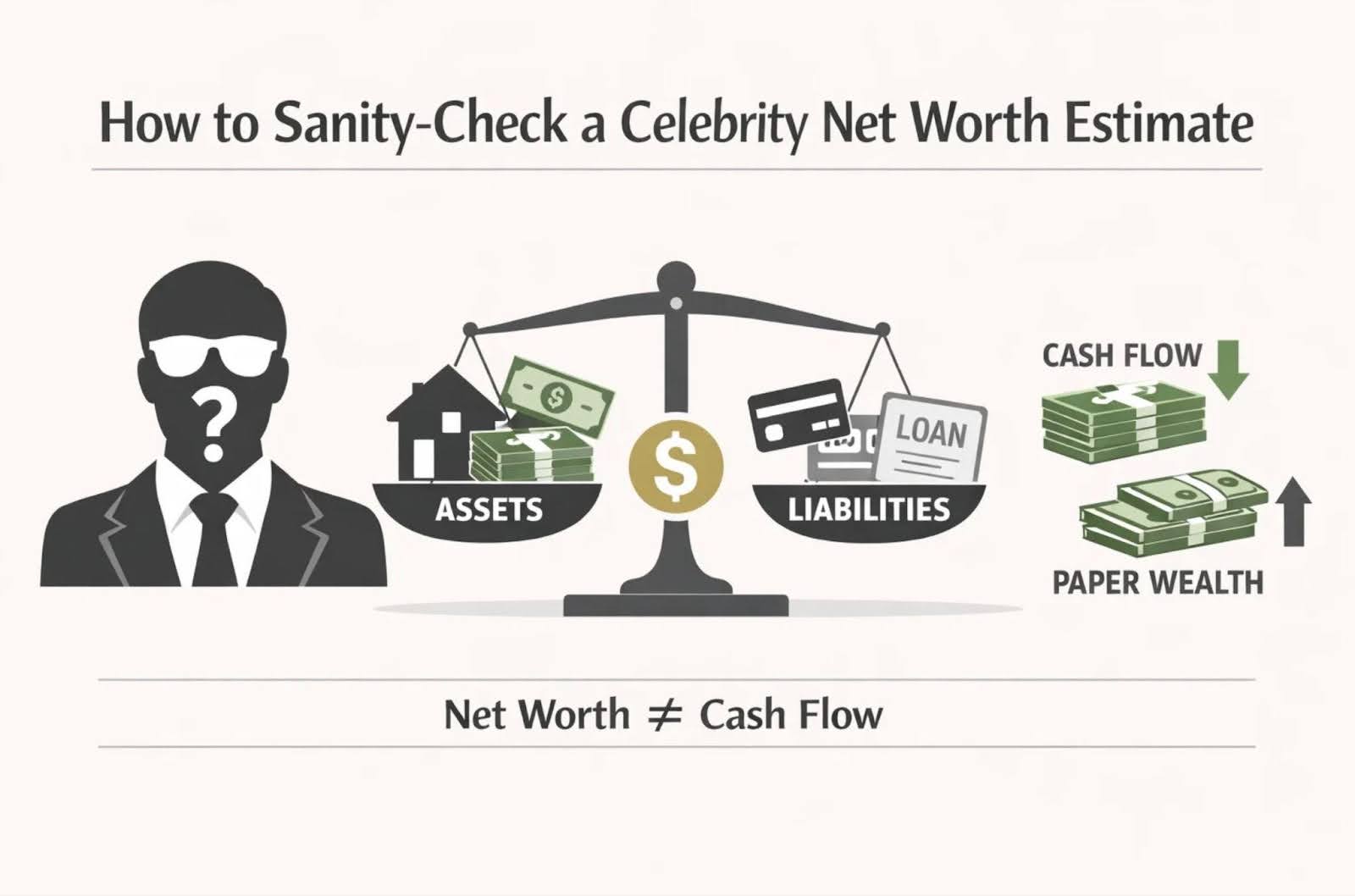
Net worth is a snapshot: what you own minus what you owe on a given day. It’s not your salary, not your annual income, and definitely not your “value to the world.” If you remember just one sentence, make it this: cash flow pays your life; net worth measures your balance sheet.
Assets are things with value you can sell or borrow against (cash, investments, property, business ownership). Liabilities are what you owe (loans, credit cards, taxes due). When a headline claims someone is worth $50 million, it’s saying that if you sold their assets at reasonable prices and paid their debts, you’d land around that number—give or take.
Liquidity vs “paper wealth”
Liquidity means how easily something turns into cash without a big discount. A listed stock is liquid (you can sell quickly). A private business stake is less liquid (you might wait months or years, and price is negotiable). “Paper wealth” is value that exists on paper—real, but not instantly spendable.
This is where readers get tricked. A person can look rich (high net worth on paper) and still be cash-poor if most value is locked in a company, property, or long-term holdings. That’s why net worth estimates often feel inconsistent with lifestyle.
Where Public Net Worth Estimates Come From
Most public net worth numbers are modeled estimates, not audited statements. The best ones are built from:
- Public records (property purchases, court filings, tax liens)
- Disclosed deals (acquisitions, funding rounds, IPO documents)
- Reported earnings (contracts, salaries, royalties)
- Known ownership stakes (company shares, founder equity)
- Reasonable assumptions (valuation multiples, market comps)
The weak estimates come from circular reporting—site A cites site B, which cites site A. Your job is to spot what’s sourced versus what’s copied.
The difference between “verified” and “modeled” numbers
“Verified” is rare in celebrity and founder coverage unless there’s a court document, a filing, or a detailed investigative report. “Modeled” is normal: you combine partial facts with standard valuation logic. Modeled doesn’t mean fake—it means probabilistic.
A practical way to read any estimate is to ask: What are they counting, and what are they guessing? If you can’t answer that, the number is entertainment, not information.
The Big Drivers: Income Streams That Build Wealth Over Time
Net worth grows when someone converts income into assets and keeps liabilities under control. The common drivers are:
- High income (salary, fees, bonuses)
- Ownership (equity in a company, partnerships, revenue shares)
- Compounding (investments over time)
- Deal events (selling a company, cashing out shares, big settlements)
- Asset selection (real estate, businesses, IP that appreciates)
Here’s the mistake novices make: they see a big revenue number and assume it equals wealth. Revenue is what comes in. Wealth depends on profit, taxes, spending, and whether money was turned into durable assets.
One-time events that move the number fast (sale, IPO, lawsuit)
One-off events can spike net worth—selling a business, going public, or winning a settlement. But the “headline net worth” can also fall fast after a market drop, a divorce settlement, a failed venture, or leverage (debt) going bad.
Mini-case #1 (novice vs experienced):
A novice reads “$10M deal” and thinks “$10M richer.” An experienced reader asks: Is it cash or equity? Upfront or over years? Pre-tax or after? A deal headline is a starting point, not the answer.
Volatility Matters: When Money Is Hard to Model
Some money streams are high-variance: they swing up and down dramatically, making them hard to model. Variance is simply the “wiggle” in outcomes over time. High variance means a great month can be followed by a terrible one, with no warning.

A creator might have steady brand work, plus one unpredictable category: affiliates, performance bonuses, and revenue shares tied to user activity. That’s why a single headline about someone’s “big month” can distort their perceived wealth—especially when the income source is unstable, short-lived, or contract-dependent.
When you see content mentioning an online casino in Australia as part of an affiliate portfolio, don’t treat that as a stable salary. It can be real income, but it’s often seasonal, algorithm-driven, and dependent on partnerships that can change overnight.
A frequent modeling error is confusing gross receipts with take-home. If someone is paid per signup or per revenue share, you need to think in ranges, not points: best-case, base-case, worst-case. That’s standard scenario analysis—just plain-language forecasting.
You’ll also see people assume that “a brand partnership equals wealth.” Not necessarily. A deal can be “up to” a number, paid only if targets are hit. If the content references an Australian online casino, you should treat it like any performance-based deal: possible upside, but uncertain.
A smart reader also asks about the durability of the niche. If a creator’s traffic is platform-dependent, a policy change can cut earnings. In other words: volatility isn’t just income bouncing—it’s income at risk.
You may notice pages talking about online casinos australia in the context of sponsorships or content monetization. The keyword itself doesn’t tell you profitability; it hints that part of revenue may come from competitive, compliance-sensitive partnerships—again, something you model cautiously.
Some lists will claim someone promoted the best australian online casino and earned a fortune. Treat that phrase like a marketing label, not a financial fact. Your job is to locate the underlying mechanics: contract terms, payout structure, and longevity.
Finally, remember the human side: in any high-variance environment, a disciplined approach matters. Even when people discuss online casino australia as entertainment, responsible behavior means setting hard limits, separating “fun money” from essentials, and never chasing losses to “prove” anything.
Mini-case #2 (novice vs experienced):
A novice sees a creator with one viral period and assumes lifetime wealth. An experienced reader says: “This could be a peak.” They look for multi-year signals: consistent business ownership, property, diversified income, and low leverage.
Reality Check: Spend Rate, Risk Budget, and “Fun Money”
If you want a fast sanity-check, look at spend rate: the likely monthly burn (housing, travel, staff, taxes) versus what the person would need in cash flow to support it. This doesn’t require gossip—just basic math and realism.
Here’s a simple model you can use:
The 3-Lens Sanity Framework
- Assets lens: What could they reasonably own (property, equity, portfolio)?
- Earnings lens: What could they reasonably earn (recurring vs one-off)?
- Constraints lens: What could shrink the number (debt, taxes, settlements, volatility)?
Now add a “risk budget.” A risk budget is the maximum amount you’re willing to expose to uncertain outcomes without harming essentials. For everyday people, this might be investing risk or business risk. For public figures, it can include expensive experiments, speculative ventures, or entertainment spending.
If someone openly mentions playing at australian online casinos, that doesn’t prove anything about their net worth. But it can illustrate risk budgeting: a disciplined person treats it as discretionary, capped, and separate from core finances.
Likewise, when content includes online casino in Australia as a lifestyle example, the point isn’t the venue—it’s the behavior. Novice behavior is “I’m up, so I’ll press harder.” Experienced behavior is “I’m up, so I lock it in, because outcomes swing.”
You’ll sometimes see people assume that involvement with an Australian online casino means “easy money.” For net worth modeling, the right takeaway is uncertainty: sponsorships can end, regulations can change, and income can drop. So you discount it, you don’t inflate it.
If a profile mentions online casinos australia as a monetization lane, treat it like any volatile revenue stream: you want evidence of consistency. One big quarter doesn’t equal a stable annual run rate.
Marketing claims like best australian online casino are useful only as a clue that a deal might have existed. They are not proof of how much money was earned, and they’re not proof of personal wealth. Always translate slogans into questions about contracts, duration, and payment triggers.
And if someone references online casino australia in a “big night” story, it’s a good moment to reinforce responsible limits: set a cap, stick to it, and avoid chasing losses. Your wealth is built by repeatable choices, not emotional swings.
Mini-case #3 (novice vs experienced):
A novice uses discretionary risk as a shortcut to “catch up” financially. An experienced person uses a fixed risk budget, keeps essentials protected, and treats any high-variance outcome as noise—not a plan.
A Practical Checklist to Validate Any Net Worth Headline
Here’s a compact checklist you can run in five minutes. It’s not academic; it’s a way to avoid getting fooled by shiny numbers.
Plain-text table:
| Check | What to look for | Quick interpretation |
| Asset clarity | Named assets: property, equity, portfolio | Specific beats vague |
| Ownership proof | Stakes, shares, filings, partner mentions | Ownership builds wealth |
| Cash vs paper | Liquid assets vs private valuations | Paper wealth can’t pay bills fast |
| Debt & leverage | Loans, liens, guarantees | Debt can erase “net worth” |
| Taxes & timing | Pre-tax vs after-tax, vesting schedules | Timing changes reality |
| One-off vs recurring | A sale vs stable income streams | Recurring supports lifestyle |
| Volatility discount | High-variance income treated as a range | Use conservative assumptions |
| Double counting | Revenue counted as wealth, or assets counted twice | Common error online |
| Source quality | Filings/docs vs “reports say” | Documents > echoes |
How to update an estimate when new info drops (divorce, sale, new venture)
Net worth is dynamic. When something changes, update the model rather than clinging to an old headline:
- Divorce/settlement: reduces net worth or changes asset ownership.
- Sale/IPO: converts paper wealth to cash (or at least to liquid shares), but taxes matter.
- New venture: can increase expected future earnings, but usually adds risk and uncertainty early.
A good rule: when information is weak, widen the range instead of pretending you know the exact number. “$5–$15M” can be more honest than “$9.7M.”
Key Takeaways and What to Do Today
Net worth headlines are often a mix of fact and modeling. Your advantage is not secret knowledge—it’s a repeatable method.
Key takeaways:
- Net worth is assets minus liabilities, not income.
- Liquidity matters: paper wealth can be real but not spendable.
- Public estimates are usually modeled; trust documents more than echoes.
- Volatile income should be discounted and treated as a range.
- The best sanity-check uses three lenses: assets, earnings, constraints.
Practical actions you can start today:
- Use the 3-Lens Sanity Framework on the next net worth headline you see.
- Run the checklist table and mark each item as “clear,” “unclear,” or “missing.”
- Convert any single number into a range (base-case, best-case, worst-case).
- Practice separating cash flow from net worth in your own finances (it improves decision-making fast).
- Set a personal risk budget for discretionary categories so volatility never touches essentials.
And a final responsible-risk note for casino contexts: if you choose that kind of entertainment, keep it strictly inside a preset limit, treat losses as the cost of entertainment, and step away if it stops feeling controlled or fun.
If you’re curious and have a minute, this extra link is an easy next click.