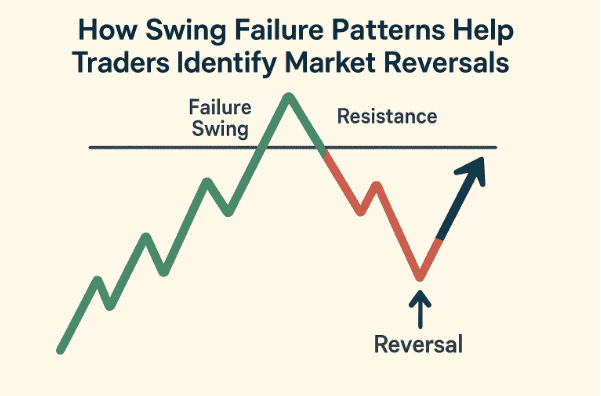
Markets in 2025 are volatile, with BTC swinging 5-10% daily amid US-China tariffs and 2.7% inflation. Swing failure patterns (SFP) are key reversal signals, helping traders spot tops and bottoms in crypto or stocks. What is SFP in trading? It’s when price fails to hold a new high or low, trapping breakout traders and sparking reversals. With 80% of retail traders losing money on false moves, SFPs offer an edge. Copy trading can automate this, mirroring pros’ SFP plays. This article explains how SFPs work and how to use them for smarter trades.
The Anatomy of Swing Failure Patterns
SFP forms when price breaks a swing high or low but quickly reverses, failing to sustain momentum. In a bullish SFP, price exceeds a prior high, triggers stops, then drops below it, trapping longs. Bearish SFP is the opposite: a new low breaks, stops trigger, then price rallies above.
For BTC at $110,591, a bullish SFP might see a spike to $112,000, then rejection to $110,500. Volume spikes on the break, fades on reversal, confirming the trap.
SFPs shine in ranging or trending markets. They signal exhaustion, with RSI divergence (above 70 on highs, below 30 on lows) adding confluence.
How SFPs Signal Market Reversals
SFPs trap breakout traders, shifting sentiment. A bullish SFP at $112,000 BTC high with low volume on rally hints at weak bulls. Shorts pile in, driving price down as stops cascade.
In stocks, SFPs at earnings gaps reverse trends. A tech stock gapping to $150 on hype, then closing below $148 prior high, signals bearish SFP, targeting $140.
Confirmation is key. Wait for candle close beyond the swing point. Fakeouts occur without volume or in strong trends—use 1-hour or 4-hour charts for clarity.
| SFP Type | Formation | Reversal Signal | Example |
| Bullish SFP | Break above high, fail to hold | Short entry, target prior low | BTC $112K high to $110.5K |
| Bearish SFP | Break below low, fail to hold | Long entry, target prior high | ETH $4K low to $4.1K |
| Volume Role | Spike on break, fade on reverse | Confirms trap | 200% spike then 50% drop |
Trading SFPs with Price Action and Copy Trading
Trade bullish SFPs by shorting on close below the failed high, like BTC at $111,500 after $112K rejection. Stops above the high ($112,100), target prior low ($110,000). Risk 1%, reward 2:1.
Bearish SFPs: long on close above failed low, stops below, target prior high. Use RSI divergence for confluence—above 70 on SFP highs boosts odds.
Copy trading enhances this. Mirror pros with 80% win rates on SFPs, automating shorts at $111,500. Choose low-drawdown traders (under 10%) for safety. Diversify 2-3 to balance false signals.
Conclusion
Swing failure patterns are reversal powerhouses in 2025’s volatile markets, trapping breakouts to flip trends. Bullish SFPs short failed highs like BTC at $112K, bearish long failed lows like ETH at $4K. Confirm with volume and RSI, risk 1% for 2:1 rewards. Copy trading aligns you with pros’ SFP timing, boosting your edge. In choppy ranges or trend ends, SFPs cut through noise—trade them disciplined, and turn traps into profits.