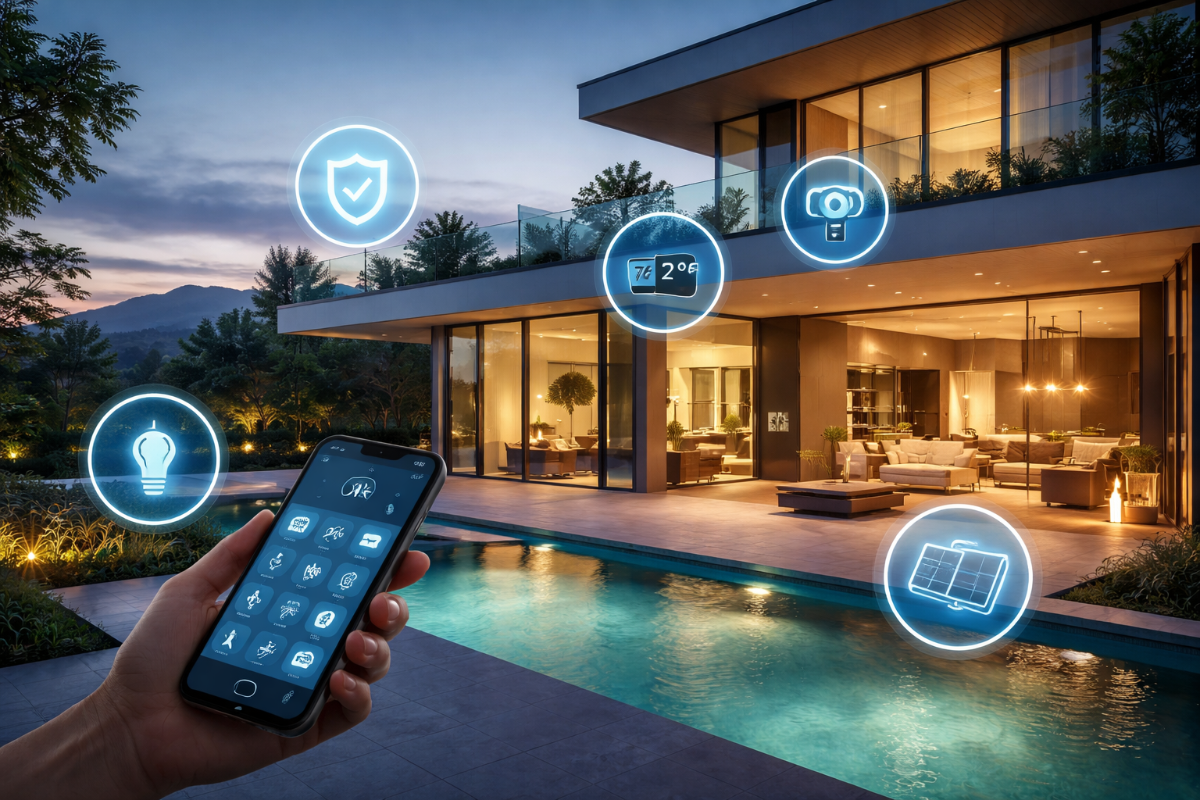
Smart Security Systems
Safety is one of the biggest advantages of Smart Future Homes. Modern security technology goes far beyond traditional alarms.
Facial Recognition Access
Many smart homes now use facial recognition or biometric entry systems. Instead of keys, residents can unlock doors using their faces or fingerprints. This eliminates the risk of lost keys.
Real-Time Monitoring
Smart cameras and sensors continuously monitor activity around the property. If the system detects unusual movement, it sends instant alerts to the homeowner’s phone.
AI Threat Detection
Artificial intelligence can distinguish between normal activity and potential threats. For instance, it can tell the difference between a family member arriving home and an unknown visitor.
Therefore, security systems in Smart Future Homes provide both prevention and quick response.
Smart Climate Control
Comfort is another important feature of intelligent living spaces. Climate control systems are becoming smarter and more efficient.
Smart thermostats analyze factors such as:
-
Outdoor weather
-
Indoor humidity
-
Occupancy patterns
As a result, they automatically adjust heating or cooling levels to maintain comfort while reducing energy consumption.
Moreover, Smart Future Homes can divide climate control into zones. Each room can maintain a different temperature based on the preferences of its occupants.
Energy Management in Smart Future Homes
Energy efficiency is a major focus in modern property design. Smart technology helps reduce electricity waste and supports sustainability goals.
Energy management systems monitor real-time power usage. They identify which appliances consume the most electricity and recommend ways to reduce consumption.
For example:
-
Smart lighting turns off automatically when rooms are empty.
-
Solar panels connect with energy storage systems.
-
Appliances operate during off-peak energy hours.
Consequently, homeowners save money while also reducing environmental impact.
Comparison: Traditional Homes vs Smart Future Homes
| Feature |
Traditional Homes |
Smart Future Homes |
| Lighting Control |
Manual switches |
Automated and sensor-based |
| Security |
Basic locks and alarms |
AI cameras and biometric access |
| Energy Use |
Limited monitoring |
Real-time energy tracking |
| Climate Control |
Fixed thermostat settings |
AI-adjusted temperatures |
| Device Connectivity |
Standalone appliances |
Fully connected ecosystem |
Role of IoT Devices and Connected Ecosystems
The Internet of Things (IoT) is the foundation of Smart Future Homes. IoT refers to everyday devices connected to the internet that can communicate with each other.
Examples include:
These devices form a connected ecosystem where information flows between systems.
For instance, when a smart lock detects that a homeowner has arrived, it can signal other devices to:
-
Turn on hallway lights
-
Adjust room temperature
-
Start playing music
Therefore, IoT integration creates a seamless and automated home environment.
Impact on Real Estate Value and Buyer Expectations
The real estate industry is already seeing major changes due to Smart Future Homes.
Increased Property Value
Properties with integrated smart systems often sell faster and at higher prices. Buyers view smart features as long-term investments.
Changing Buyer Preferences
Modern buyers expect homes to include:
Consequently, developers are now designing properties with built-in smart infrastructure rather than adding it later.
Comparison: Standard Property vs Smart Future Property
| Factor |
Standard Property |
Smart Future Property |
| Market Appeal |
Moderate |
High demand |
| Energy Efficiency |
Basic |
Advanced energy optimization |
| Security Features |
Traditional systems |
AI-powered protection |
| Property Value Growth |
Slower |
Faster appreciation |
| Buyer Expectations |
Simple comfort |
Intelligent automation |
Privacy and Cybersecurity Challenges
Despite many advantages, Smart Future Homes also raise concerns about privacy and security.
Connected devices constantly collect data about daily activities. While this data improves automation, it may also create risks if not properly protected.
Data Privacy Concerns
Smart home systems collect information such as:
-
Voice commands
-
Movement patterns
-
Device usage behavior
If companies misuse this data, users may lose control over their personal information.
Cybersecurity Risks
Hackers may attempt to access connected systems. If security measures are weak, attackers could potentially control devices or access sensitive data.
However, technology companies are developing stronger protections. These include:
Therefore, cybersecurity will remain an essential part of future smart home development.
Future Trends in Intelligent Living Spaces
Technology is evolving rapidly, and Smart Future Homes will continue to improve in many ways.
Predictive AI Homes
Future homes may predict needs before residents even request them. AI could analyze habits and automatically prepare living environments.
Health Monitoring Systems
Smart sensors may track health conditions such as sleep quality, heart rate, and air quality.
Consequently, homes could support better wellness and preventive healthcare.
Fully Autonomous Homes
In the long term, homes may manage themselves completely. Systems will coordinate cleaning robots, food management, security monitoring, and energy usage without human involvement.
Integration with Smart Cities
Future properties will also connect with city infrastructure. Homes may communicate with transportation systems, power grids, and public services.
Therefore, intelligent living spaces will become part of a much larger connected ecosystem.
Frequently Asked Questions
What are Smart Future Homes?
Smart Future Homes are residential properties equipped with advanced technologies such as artificial intelligence, IoT devices, and automated systems that manage household functions efficiently.
Are smart homes expensive?
Initially, smart home systems may cost more than traditional setups. However, they often reduce energy bills and maintenance costs over time.
Do smart homes improve property value?
Yes. Homes with advanced automation, energy management, and security systems usually attract more buyers and higher market value.
Are smart homes safe from hackers?
Most modern systems include strong encryption and authentication methods. However, homeowners should still use secure passwords and regular software updates.
Can smart homes save energy?
Yes. Automated lighting, smart thermostats, and energy monitoring systems help reduce electricity consumption significantly.