Along the northern shoreline of Dubai, a new coastal district is reshaping long-term thinking in global real estate investment. Officially known as Dubai Islands, the development still appears in searches as Deira Island, a reminder of its early planning history and of how deeply the project has already entered the public imagination. But today the identity is clear: Dubai Islands is not simply another extension of the city, but one of the most significant new waterfront markets available to ultra-high-net-worth investors in the current cycle. Built across five interconnected islands and supported by large-scale infrastructure, the district represents a rare moment when a global city opens a new geographic frontier with the full weight of long-term economic strategy behind it.
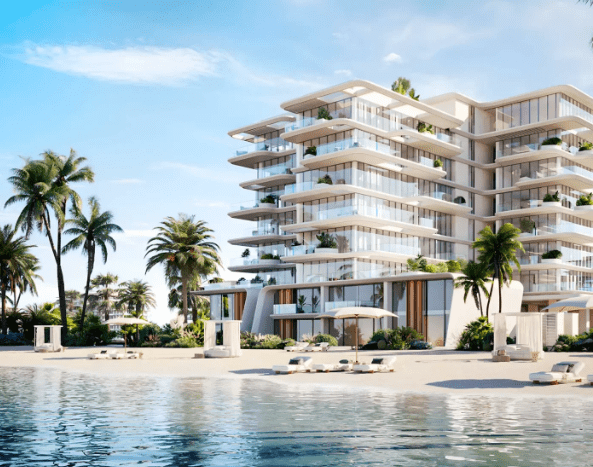
Early development across the district reflects this positioning. Hospitality and residential projects such as Elle Residences Dubai Islands, Ellington Cove, Bay Villas by Nakheel, Azizi Wasel and many more luxury projects illustrate the range of assets emerging at the waterfront, from branded living concepts to coastal villas and long-stay hospitality. These projects are not yet the defining image of the district, but they signal the arrival of a diversified investment landscape—one designed to appeal to private wealth portfolios that prioritize stability, scarcity, and long-term appreciation over short-term speculation. Their presence underscores that Dubai Islands is not an isolated real estate venture; it is a strategic expansion of the city’s investment ecosystem.
An Emerging Waterfront Market with Global Significance
Waterfront real estate has long been a stable asset class for UHNW investors, offering predictable performance, long-term demand, and strong emotional value. But mature global waterfront markets—Miami, Monaco, Singapore—have limited expansion capacity, creating structural scarcity. Dubai Islands changes this equation by introducing a new supply of premium coastal land that is not a speculative extension but a master-planned district aligned with the city’s long-term urban and economic roadmap.
The islands create a new spatial configuration for the city, distributing density outward rather than upward. This horizontal expansion introduces a different lifestyle logic, one that appeals to investors seeking high-value assets within environments that emphasize privacy, openness, and controlled development. For private buyers accustomed to evaluating markets in generational timescales, Dubai Islands offers an unusually early entry point into a fully structured district supported by government-level infrastructure commitments.
A Strategic Asset in Dubai’s Economic Vision
The strength of Dubai Islands lies not only in its waterfront geography but in its integration into Dubai’s broader economic strategy. The project mirrors the economic diversification objectives outlined in the Dubai 2040 Urban Master Plan, which prioritizes sustainability, tourism, mobility, and high-value development.
Because of this alignment, Dubai Islands operates not as a stand-alone district but as a structural component in a coherent national strategy. This gives UHNW investors a level of stability rarely seen in early-stage coastal developments. Regulatory clarity, infrastructure sequencing, and public-private coordination all reduce long-term development risk. For family offices and wealth managers accustomed to navigating fragmented or inconsistent markets, this predictability carries significant value.
Infrastructure as a Long-Term Investment Stabilizer
Large-scale infrastructure is often the defining factor separating resilient investment districts from speculative ones. Dubai Islands benefit from a robust network of bridges, arterial roads, and planned mobility corridors that integrate the islands into the wider city. This infrastructure reduces isolation risk, increases liquidity for future resale, and supports sustained demand across hospitality, residential, and commercial asset classes.
Equally important is the district’s environmental engineering. The islands are elevated, shoreline protections are designed with long-term climate scenarios in mind, and the urban grid is structured to ensure air movement and temperature moderation. For investors evaluating coastal risk, these engineering decisions represent a form of embedded resilience. They also support asset longevity, a crucial factor for UHNW portfolios where real estate often functions as a multi-generational store of value.
A New Model of Waterfront Living and Investment
As global wealth flows increasingly toward destinations offering both lifestyle and strategic upside, Dubai Islands stands out for its ability to merge these dimensions. The district’s design emphasizes open waterfronts, large public spaces, and low- to mid-rise structures that preserve views and environmental quality. This creates a coastal lifestyle distinct from Dubai’s vertical core while maintaining proximity to its business and cultural districts.
For investors, this hybrid positioning—urban but spacious, connected but calm—creates demand profiles that differ from those of established districts. Properties in such environments tend to attract both long-stay international residents and high-spending travelers seeking privacy, access, and reliability. These demand streams reinforce each other, supporting rental yields while stabilizing long-term capital appreciation.
The Rise of Branded Coastal Living
Dubai’s luxury real estate sector is increasingly shaped by branded residences, a trend strongly reflected in the early development of Dubai Islands. Projects such as Elle Residences Dubai Islands and other branded offerings across the district appeal to a specific segment of UHNW buyers who value consistency of service, design pedigree, and operational stability.
Branded residences have proven to outperform non-branded equivalents in liquidity and resale premiums across global markets. On Dubai Islands, this performance advantage is further enhanced by the district’s newness, landscape value, and long-term planning. For investors seeking low-volatility assets with strong international appeal, this creates a compelling entry point.
A Global Magnet for Wealth Migration
In recent years, Dubai has positioned itself as one of the world’s most attractive destinations for mobile wealth. Its tax regime, safety record, global connectivity, and regulatory stability align closely with the priorities of UHNW individuals seeking both residence and global mobility. Dubai Islands contributes substantially to this positioning by offering an entirely new coastal district that complements existing luxury zones rather than competing with them.
For wealth holders evaluating relocation or secondary residence options, Dubai Islands provides something distinct: a chance to enter a waterfront community from its inception, when strategic positioning offers the greatest potential for long-term value. This early availability, combined with the city’s global status, places Dubai Islands at an intersection where lifestyle desire and investment logic reinforce each other.
A Long-Term Horizon for UHNW Portfolios
Private wealth strategy increasingly emphasizes long-duration assets—properties capable of outperforming inflation, diversifying global portfolios, and offering utility across multiple generations. Dubai Islands aligns with this approach. Its early-stage development, regulated planning, and waterfront scarcity position it as an asset class with long-term relevance.
For UHNW families, the district offers multiple pathways: capital appreciation through growth of a new global coastal market, lifestyle benefits through waterfront living, and optionality through diversified real estate typologies. In a world where geopolitical and economic volatility reshape long-term planning, Dubai Islands functions as a stable anchor in a globally connected region.
A New Chapter in Waterfront Investment
Dubai Islands marks a shift in how global investors view early-phase master-planned districts. Instead of high-risk frontier development, the project represents a structured, strategic expansion supported by policy continuity, infrastructure depth, and strong market fundamentals. For UHNW investors and family offices, this combination is rare: an early entry that does not require speculative risk tolerance.
As global waterfront markets continue to tighten and coastal resilience becomes a defining factor in real estate strategy, Dubai Islands offers a model of long-term value creation. It is a district positioned not for rapid turnover, but for generational significance—a quality increasingly sought in the highest tiers of private wealth.