The debate around AI Stocks vs AI ETFs has become one of the most important conversations for long-term investors in recent years. Artificial intelligence is no longer a futuristic concept it is now deeply embedded in healthcare, finance, defense, manufacturing, cybersecurity, and consumer technology. As AI adoption accelerates, investors are increasingly looking for ways to gain exposure to this transformational trend while managing risk effectively.
However, choosing between investing directly in individual AI companies or opting for diversified AI exchange-traded funds is not always straightforward. Each approach offers distinct advantages and trade-offs. Consequently, understanding the differences between AI stocks vs AI ETFs is critical for building a resilient, long-term investment strategy aligned with your financial goals and risk tolerance.
This guide breaks down both options in a clear, practical way, helping investors decide which path may be safer and more suitable for long-term wealth creation.
AI Stocks vs AI ETFs – Understanding AI Investment Strategies
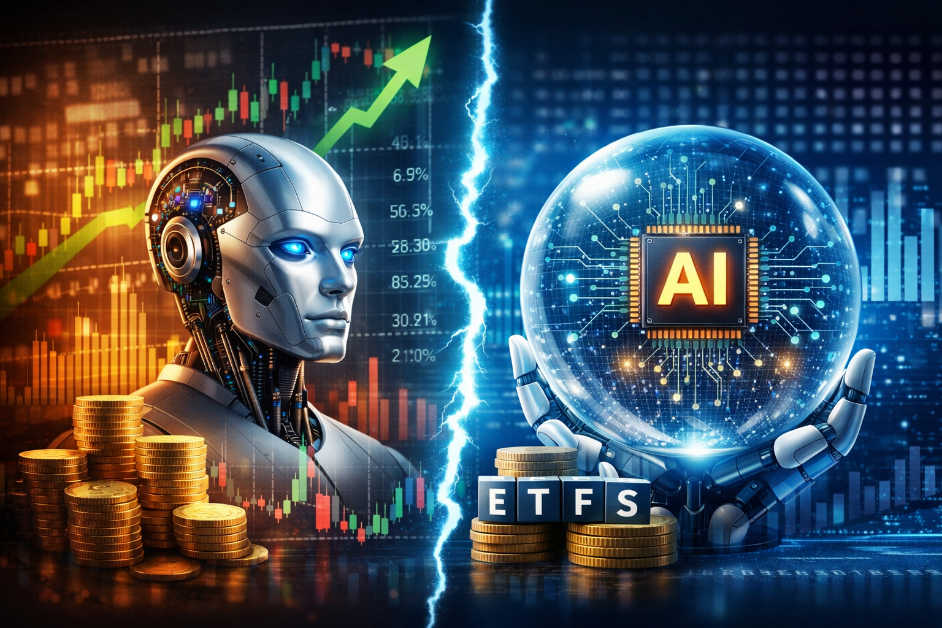
At a high level, the comparison of AI Stocks vs AI ETFs comes down to concentration versus diversification. Investing in AI stocks means buying shares of individual companies that develop or heavily rely on artificial intelligence technologies. AI exchange-traded funds, by contrast, offer exposure to a basket of AI-related companies through a single investment vehicle.
Moreover, these two AI investment strategies differ significantly in terms of risk profile, volatility, potential returns, and management style. As a result, the choice between AI stocks vs AI ETFs often depends on how much uncertainty an investor is willing to tolerate over long time horizons.
Before diving deeper, it is essential to understand how each approach to investing in artificial intelligence works in practice.
Investing in AI Stocks vs AI ETFs – Risk and Reward Explained
Investing in AI Stocks and Company-Specific Growth Potential
Investing in AI stocks allows investors to target specific companies leading innovation in artificial intelligence. These may include firms specializing in machine learning software, AI chips, autonomous systems, cloud computing, or enterprise AI platforms. Moreover, early-stage or fast-growing AI companies can deliver outsized returns if their technology gains widespread adoption.
However, when comparing AI Stocks vs AI ETFs, it becomes clear that individual AI stocks carry higher company-specific risk. High valuations often reflect optimistic growth assumptions. Consequently, earnings disappointments, product delays, or regulatory challenges can trigger sharp price corrections.
H3: Volatility and Concentration Risk When Investing in AI Stocks
One of the biggest drawbacks of investing in AI stocks is volatility. Share prices of AI-focused companies can fluctuate dramatically based on earnings reports, technological breakthroughs, or shifts in market sentiment. Moreover, concentration risk becomes a major issue when portfolios rely on only a handful of AI stocks.
As a result, investors choosing AI stocks over AI ETFs must be prepared to endure periods of significant drawdowns, even if the long-term artificial intelligence thesis remains intact.
Valuation and Market Cycle Sensitivity of AI Stocks
AI stocks are particularly sensitive to market cycles. During bullish phases, valuations often expand rapidly as investors chase high-growth AI opportunities, increasing overall AI valuation risk. However, during economic slowdowns or rising interest rate environments, high-growth AI stocks tend to decline more sharply than the broader market.
Therefore, timing, patience, and risk management play a far greater role when investing directly in AI stocks compared to diversified AI ETFs.
AI Exchange-Traded Funds: Diversification and Stability
Built-In Diversification Benefits
AI ETFs offer a more diversified approach to gaining exposure to artificial intelligence. Instead of relying on the success of a single company, investors gain access to dozens of AI-related firms across multiple industries and geographies.
Moreover, diversification helps reduce company-specific risk. If one AI company underperforms, its impact on the overall ETF is limited. Consequently, AI ETFs tend to experience less extreme volatility compared to individual AI stocks.
Expense Ratios and Passive Management
While AI ETFs provide convenience and diversification, they also come with expense ratios. These fees, although generally low, can slightly reduce long-term returns when compounded over many years. However, for many investors, the trade-off is worthwhile given the reduced risk and lower maintenance required.
As a result, AI exchange-traded funds are often better suited for investors who prefer a hands-off approach to AI investment strategies.
Long-Term Stability and Predictability
AI ETFs typically track indices or themes related to artificial intelligence, robotics, or automation. Consequently, they benefit from the overall growth of the AI sector rather than relying on a single company’s success.
This makes AI ETFs particularly attractive for long-term investors seeking steady exposure to AI without constantly monitoring individual stocks.
AI Stocks vs AI ETFs — Key Differences
| Factor | AI Stocks | AI ETFs |
|---|---|---|
| Diversification | Low (company-specific) | High (multiple companies) |
| Volatility | High | Moderate |
| Return Potential | Very high for winners | More stable, market-aligned |
| Risk Level | Higher | Lower |
| Management | Active decision-making | Passive or semi-passive |
| Expense Ratios | None (broker fees only) | Low annual fees |
| Suitability | Experienced, risk-tolerant investors | Conservative to moderate investors |
Market Cycles and Macroeconomic Impact
Interest Rates and Liquidity
Macroeconomic conditions play a crucial role in the performance of both AI stocks vs AI ETFs. Rising interest rates tend to compress valuations of growth-oriented companies, including AI firms. Consequently, AI stocks often react more sharply to monetary policy changes.
AI ETFs, while still affected, typically show more resilience due to their diversified nature. As a result, they may offer better downside protection during tightening cycles.
Economic Growth and Corporate Spending
AI adoption is closely linked to corporate investment cycles. During periods of strong economic growth, businesses invest heavily in AI-driven efficiency and automation. However, during recessions, spending may slow temporarily.
Therefore, both AI stocks and AI ETFs can experience cyclical fluctuations. Nevertheless, long-term secular trends continue to support AI growth across industries.
AI Investment Strategies for Long-Term Investors
Blending AI Stocks and AI ETFs
Rather than choosing strictly between AI stocks vs AI ETFs, many long-term investors adopt a blended approach. This strategy involves allocating a core portion of the portfolio to AI ETFs for stability, while selectively investing in high-conviction AI stocks for growth.
Moreover, this hybrid strategy balances diversification with upside potential. As a result, investors can benefit from innovation without exposing their entire portfolio to excessive risk.
Risk Tolerance and Time Horizon
Risk tolerance plays a decisive role in choosing AI investment strategies. Younger investors with longer time horizons may tolerate higher volatility in exchange for potential outsized returns from AI stocks. Conversely, investors closer to retirement often prefer the smoother return profile of AI ETFs.
Consequently, aligning investment choices with personal financial goals is essential.
Sample Portfolio Allocation Scenarios
| Investor Profile | AI Stocks Allocation | AI ETFs Allocation |
|---|---|---|
| Conservative | 10% | 90% |
| Balanced | 40% | 60% |
| Aggressive | 70% | 30% |
Valuation Risk and Long-Term Expectations
AI is widely regarded as a multi-decade growth story. However, that does not mean all AI-related investments will succeed. Valuation risk remains a key concern, particularly for companies priced for perfection. AI ETFs mitigate this risk by spreading exposure across multiple valuation profiles. As a result, they reduce the impact of overvaluation in any single stock.
Moreover, long-term investors should focus on fundamentals rather than short-term hype. Consistent revenue growth, strong balance sheets, and sustainable competitive advantages matter more than headline-driven enthusiasm. For those interested in evaluating AI stocks individually, understanding general stock valuation techniques can help choose stocks wisely.
Practical Guidance: Which Is Safer Long Term?
When comparing AI Stocks vs AI ETFs, safety for long-term investors generally favors AI ETFs. Diversification, lower volatility, and reduced company-specific risk make them a more stable choice for most investors.
However, AI stocks can play a valuable role for those willing to accept higher risk in pursuit of higher returns. Consequently, the “safer” option ultimately depends on individual circumstances, including risk tolerance, investment horizon, and portfolio size.
Conclusion: Making the Right Choice Between AI Stocks vs AI ETFs
The question of AI Stocks vs AI ETFs does not have a one-size-fits-all answer. AI stocks offer exciting upside and direct exposure to innovation but come with higher volatility and risk. AI ETFs, on the other hand, provide diversified, long-term exposure to artificial intelligence with greater stability.
As a result, many investors find that combining both approaches creates a more resilient and flexible portfolio. By understanding market cycles, valuation risks, and personal financial goals, investors can make informed decisions that align with long-term success in the rapidly evolving AI landscape.
Frequently Asked Questions (FAQs)
Are AI ETFs better than individual AI stocks?
Investing in an AI ETF gives you access to multiple AI companies at once, reducing risk compared to buying individual stocks while still benefiting from the sector’s growth.
Is it worth investing in an AI ETF?
Yes, AI ETFs provide broad exposure to AI stocks, offering growth potential without the need to pick individual winners. The AI ETF market is expected to grow significantly by 2030.
Which ETF is best for AI?
Some top AI ETFs include Global X Artificial Intelligence UCITS ETF, WisdomTree Artificial Intelligence UCITS ETF, and iShares AI Innovation Active UCITS ETF, each offering different growth and risk profiles.
What are the top AI stocks to buy now?
Investors often focus on companies leading in AI development, including big tech names driving innovation in machine learning, autonomous systems, and AI cloud platforms.
What if I invest $1000 a month for 5 years?
Regular investments over time can benefit from dollar-cost averaging, compounding growth, and exposure to a growing AI market, potentially yielding substantial returns in the long term.
Does Warren Buffett own any AI stocks or ETFs?
Warren Buffett generally prefers diversified and well-established investments. While he has expressed interest in tech, direct AI-focused holdings are limited in his portfolio.
Who are the big 4 of AI?
The leading companies shaping the AI sector are typically major tech firms driving innovation, investment, and AI adoption globally, often referenced in AI market analyses and ETF compositions.