By Raul Serebrenik
In recent weeks, I was struck by a statistic shared at an event with leading asset managers and economists: nearly 52% of family businesses in the United States lack a successor or family member willing to continue their parents’ business.
In a world where demographic phenomena remain underexplored and their impact on business life too often overlooked, this statistic revealed a profound void. It led me to reflect on what I call “The Loss of the Sense of Transcendence.”
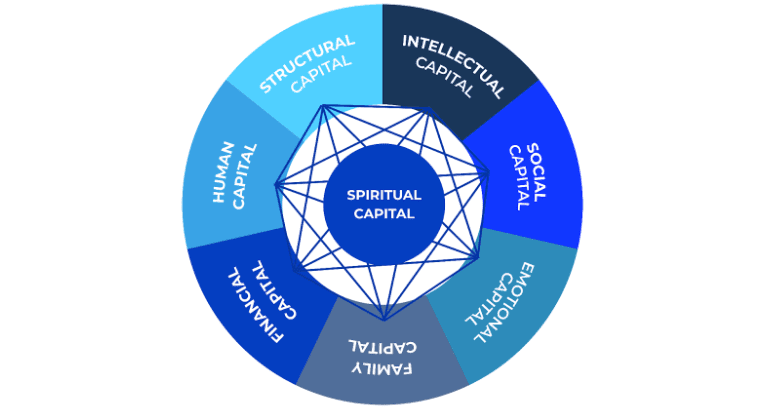
For centuries, children were regarded as the natural extension of lineage, family name, clan, and values, what the Serebrenik Model (referenced in the image below) identifies as Human Capital. Today, however, in a culture increasingly shaped by individualism and present-focused living, the urgency to leave a legacy beyond oneself has diminished. Many no longer feel compelled to carry forward their parents’ or ancestors’ heritage, creating a quiet erosion of intergenerational transcendence.
What Changed?
The Culture of Fear and Uncertainty
Multiple forces have eroded traditional family values: failing education systems, wars, economic crises, cultural clashes, climate change, and declining trust in institutions and leaders. Together, they foster a climate of uncertainty, leaving many hesitant to bring children into a world perceived as unstable or even hostile.
The Priority of Personal Success
The dominant narrative now emphasizes professional achievement, consumption, travel, and self-fulfillment. In this context, children are often seen as obstacles to independence and individual ambition.
Fragility of Relationships
Rising difficulty in building stable, lasting bonds further reduces willingness to form families. Without emotional stability, many feel unprepared to create a foundation for future generations.
Reducing Life to the Material
When the costs of raising children are measured only in financial terms education, housing, time rather than in spiritual and emotional wealth, troubling attitudes take root: “It’s not worth it,” or “It’s too expensive.” This mindset diminishes the drive to share, co-create, and build a family legacy.
Disconnection from the Sacred
In spiritual traditions, children are seen as blessings expressions of purpose and love. As societies lose touch with transcendence, the deeper meaning of bringing life into the world fades. Humanity has not lost its capacity to love, but many now seek meaning and fulfillment elsewhere. Reclaiming the value of family and life as sacred gifts could reignite the desire to embrace parenthood once more.
The Impact on Family Businesses Through the Serebrenik Model
This loss of transcendence deeply shapes life decisions: postponing or rejecting parenthood, disconnecting from family heritage, or struggling to define a purpose beyond personal achievement.
Over 15 years of research, I developed the Serebrenik Model of the 8 Capitals by studying families that cultivated a strong sense of transcendence. Analyzing thousands of family businesses with more than 200 years of history, I identified key practices that sustained their legacy distilled into eight forms of capital.
The 8 Capitals explain how enduring families preserve identity, cohesion, and purpose across generations. They also reveal how erosion of transcendence weakens not only spiritual capital, but every form of capital that sustains a long-term legacy.
Analysis Through the 8 Capitals
- Human Capital – Talent, skills, education, and health. Without transcendence, investment in the next generation loses urgency.
- Intellectual Capital – Knowledge, methodologies, and accumulated wisdom. Reduced to short-term utility without intent to pass it on.
- Social Capital – Trust networks with communities, suppliers, and institutions. Relationships become fragile, transactional, and short-lived.
- Family Capital – Unity, identity, traditions, and belonging. Without transcendence, families fragment, and traditions fade.
- Spiritual Capital – Principles, values, ethics, and higher purpose. The most directly eroded, leaving decisions more materialistic and individualistic.
- Emotional Capital – Resilience and capacity to sustain healthy bonds. Without transcendence, relationships weaken, and emotions become reactive.
- Financial Capital – Resources to sustain the family project. Without higher purpose, wealth risks becoming an end rather than a means, losing its power to inspire.
- Structural Capital – Governance systems and protocols. Stripped of meaning, these are dismissed as bureaucratic burdens instead of the backbone of continuity.
Conclusion
The loss of transcendence weakens each of the 8 Capitals. Since they are interdependent, the erosion of one undermines the others, creating cycles of fragmentation.
Recovering transcendence is not only a spiritual challenge it is a strategic imperative for families and businesses seeking continuity. Family enterprises represent the last frontier of this effort.
A stronger society is one that re-centers purpose, inheritance, and transcendence allowing families to rediscover the true meaning of prosperity and legacy across generations.