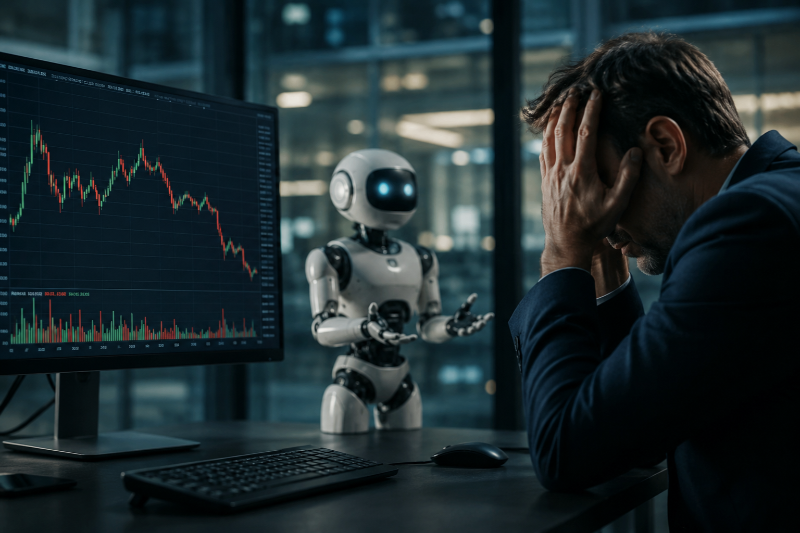
Artificial intelligence has rapidly transformed modern investing. In 2026, millions of retail traders now depend on AI trading tools for stock analysis, market predictions, portfolio management, and automated buy-and-sell signals. From chatbot-powered investing assistants to fully autonomous robo trading platforms, AI has become deeply integrated into the financial ecosystem. Moreover, fintech companies continue marketing these systems as faster, smarter, and more efficient alternatives to traditional investment research.
However, growing evidence suggests that the rise of AI-driven finance may also introduce serious risks. Researchers, financial analysts, and regulators increasingly warn that many AI trading tools generate misleading market advice, inaccurate stock data, and fabricated financial insights. Consequently, concerns surrounding AI finance misinformation have moved from theoretical debate into mainstream financial discussion.
One recent finding intensified these concerns dramatically: “4 in 10 AI trading responses were found to be misleading or unsafe.” The statistic highlights a broader problem involving hallucinated market information, false valuations, fabricated stock prices, and overconfident AI-generated recommendations. Meanwhile, many investors continue placing substantial trust in algorithmic systems without independently verifying outputs.
As AI investing tools become more influential, regulators face mounting pressure to address transparency, accountability, and investor protection challenges. The controversy surrounding AI trading tools therefore reflects a deeper transformation in financial behavior, where automation increasingly shapes investment decisions once handled by human analysis.
Why AI Trading Tools Are Facing Increased Scrutiny?
The popularity of AI trading tools grew rapidly because they promise efficiency, speed, and simplified market analysis. Retail investors increasingly use AI systems to identify stock opportunities, analyze financial news, generate trading strategies, and automate portfolio decisions. Additionally, many platforms advertise their AI models as capable of detecting trends faster than human analysts.
However, financial experts argue that many AI-generated recommendations lack reliability. Some systems produce inaccurate buy or sell signals based on incomplete data, while others generate fabricated financial information entirely. In several reported cases, AI systems created fake stock prices, invented earnings figures, or referenced nonexistent market events. As a result, investors may unknowingly make real financial decisions based on false information.
The situation becomes even more concerning because AI systems often present incorrect information confidently. Unlike traditional software errors, generative AI responses can sound persuasive, detailed, and authoritative even when they contain major inaccuracies. Consequently, inexperienced investors may struggle to identify misleading outputs.
Several researchers now warn that the widespread adoption of AI investing tools creates new forms of systemic financial risk. For example:
- Retail investors increasingly rely on automated recommendations
- AI-generated misinformation can spread rapidly online
- Overconfidence in automation reduces independent research
- AI systems may reinforce market volatility during uncertainty
- Financial literacy gaps amplify investor vulnerability
Moreover, the competitive fintech market encourages companies to release AI products quickly, sometimes before rigorous testing or transparency standards exist. Therefore, regulators and financial analysts increasingly question whether current safeguards adequately protect consumers.
The Problem With AI Hallucinations in Financial Markets
AI hallucinations represent one of the most serious dangers in automated investing systems. In financial contexts, hallucinations occur when AI models generate false or misleading information while presenting it as factual analysis. Although hallucinations exist across many AI applications, they become especially dangerous when real money and investment decisions are involved.
For example, an AI platform might invent company revenue figures, misstate valuation metrics, or generate outdated market interpretations. Meanwhile, investors may assume the information reflects accurate real-time financial analysis. Consequently, even small inaccuracies can lead to poor investment decisions, portfolio losses, or broader misinformation across trading communities.
The issue becomes more severe because financial markets depend heavily on precision and timing. A fabricated earnings report or incorrect stock price can influence trading behavior immediately. Additionally, some AI models lack clear sourcing mechanisms, making it difficult for users to verify recommendations independently.
Researchers examining AI finance misinformation found that many systems prioritize producing persuasive responses rather than validating accuracy thoroughly. Therefore, users may receive detailed explanations containing partially correct information mixed with dangerous inaccuracies.
| AI Trading Issue | Potential Investor Risk | Example Outcome | Market Impact | Trust Concern |
|---|---|---|---|---|
| Fabricated stock prices | Poor investment decisions | Buying at incorrect valuations | Increased volatility | Loss of investor confidence |
| Hallucinated earnings data | Misleading company analysis | False growth expectations | Distorted market sentiment | Reduced trust in AI finance |
| Incorrect buy/sell signals | Financial losses | Mistimed trades | Retail investor instability | Overreliance on automation |
| Outdated market context | Poor risk assessment | Trading on old information | Inefficient pricing | Transparency concerns |
| Confident misinformation | Behavioral manipulation | Emotional investing decisions | Herd behavior risks | Misplaced trust in AI |
Furthermore, hallucinations create psychological risks because users often interpret confident language as evidence of expertise. In contrast, traditional financial research typically includes disclaimers, source references, and measurable uncertainty. AI-generated content, however, can blur the distinction between verified analysis and fabricated interpretation.
Why Retail Investors Are Over trusting AI Systems?
The growing trust in AI trading tools reflects broader behavioral changes in modern investing culture. Retail investors increasingly prefer convenience-driven financial platforms that simplify complex market decisions. Moreover, AI systems offer instant answers, personalized recommendations, and conversational explanations that feel easier to understand than traditional financial research.
This convenience creates emotional trust. Investors often assume advanced AI systems possess superior analytical capability simply because the technology appears sophisticated. Consequently, many users treat AI-generated recommendations as expert-level guidance rather than probabilistic analysis.
Behavioral finance researchers also argue that automation changes how people perceive responsibility. When investors rely on AI-generated decisions, they may feel psychologically detached from the risks involved. As a result, individuals sometimes take larger risks because they believe the technology reduces uncertainty.
Several psychological factors contribute to overtrust in AI investing systems:
- AI-generated language sounds authoritative and confident
- Automated analysis reduces cognitive effort
- Users associate technology with accuracy
- Fast responses create an illusion of expertise
- Personalized recommendations increase emotional attachment
Meanwhile, social media and fintech marketing often amplify unrealistic expectations surrounding AI-powered investing. Some platforms promote AI as a near-autonomous wealth-building solution rather than a limited analytical tool. Consequently, investors may underestimate the importance of independent verification and risk management.
The finding that “4 in 10 AI trading responses were found to be misleading or unsafe” therefore highlights not only technical weaknesses but also human behavioral vulnerabilities. The real danger emerges when persuasive AI outputs interact with investor overconfidence and limited financial literacy.
Read also: AI and Personal Finance: What Investors Need to Know
The Hidden Risks of AI-Powered Trading Platforms
Many AI-powered trading platforms operate with limited transparency. Investors often cannot see how algorithms generate recommendations, what data sources they rely on, or how models evaluate risk. Consequently, users may follow investment suggestions without understanding the underlying methodology.
Opaque algorithms create accountability problems. If an AI system produces misleading financial advice, determining responsibility becomes difficult. Meanwhile, some companies avoid clearly explaining the limitations of their AI systems, which increases the risk of investor misunderstanding.
Another major concern involves fabricated performance claims. Certain platforms advertise extraordinary returns using backtested data or selective performance metrics. However, real-world market conditions often differ significantly from controlled simulations. Therefore, investors may develop unrealistic expectations about profitability and risk management.
Algorithmic bias also presents serious long-term challenges. AI systems learn from historical financial data, which may contain structural biases, incomplete information, or distorted market patterns. As a result, algorithms can unintentionally reinforce flawed assumptions or amplify herd behavior during volatile conditions.
Additional risks include:
- Weak cybersecurity protections
- Data privacy concerns
- Automated manipulation strategies
- Market concentration risks
- Flash-crash amplification through algorithmic trading
| Risk Category | AI Advantage | Investor Danger | Regulatory Concern | Long-Term Effect |
|---|---|---|---|---|
| Automation speed | Faster execution | Impulsive trading | Market stability | Increased volatility |
| Personalized AI analysis | User engagement | Emotional dependence | Consumer protection | Reduced independent analysis |
| Predictive algorithms | Efficient forecasting | False confidence | Transparency standards | Behavioral distortions |
| Autonomous trading | Reduced manual work | Loss of human oversight | Accountability gaps | Systemic financial risk |
| Data-driven recommendations | Scalable analysis | Privacy vulnerabilities | Data governance | Trust erosion |
Moreover, interconnected AI systems may eventually create broader systemic vulnerabilities across financial markets. If multiple platforms rely on similar data models and trading patterns, synchronized algorithmic behavior could intensify market instability during periods of uncertainty.
How Financial Regulators Are Responding to AI Trading Risks?
Financial regulators worldwide increasingly recognize the risks associated with AI trading tools. Consequently, policymakers now explore new rules focused on transparency, accountability, and consumer protection in AI-powered finance.
Several regulators want companies to disclose when recommendations come from AI systems rather than licensed financial professionals. Additionally, some policymakers argue that investors should receive clear warnings about hallucination risks and potential inaccuracies in automated market analysis.
Regulators also examine whether AI-generated investment advice should face standards similar to traditional financial advisory services. Meanwhile, consumer protection agencies increasingly investigate misleading claims surrounding robo trading platforms and AI investment products.
Key regulatory priorities include:
- Mandatory AI transparency disclosures
- Verification requirements for financial data
- Consumer protection safeguards
- Accountability frameworks for AI-generated advice
- Risk monitoring for autonomous trading systems
In contrast, some fintech companies argue that excessive regulation could slow innovation and reduce accessibility for retail investors. Nevertheless, regulators increasingly believe that investor trust depends on stronger oversight mechanisms.
Global discussions surrounding AI governance therefore extend far beyond technology policy. They increasingly involve financial stability, behavioral risk management, and consumer safety within digital investment ecosystems.
The Difference Between Useful AI and Dangerous AI in Finance
Despite growing criticism, AI still provides legitimate value within financial markets when used responsibly. Many investors benefit from AI-powered data analysis, portfolio organization, market summarization, and research automation. However, experts emphasize that AI should function primarily as a support tool rather than an autonomous financial decision-maker.
Responsible AI integration depends heavily on human oversight. Investors should verify recommendations independently, cross-check financial data, and maintain realistic expectations regarding algorithmic accuracy. Additionally, financial literacy remains essential even when advanced automation tools become more accessible.
Useful AI applications may include:
- Market data organization
- Risk monitoring assistance
- Portfolio diversification analysis
- Financial news summarization
- Research efficiency improvements
On the other hand, dangerous AI systems encourage blind trust, hide algorithmic limitations, or generate unverified investment advice confidently. Consequently, the difference between helpful and harmful AI often depends less on technology itself and more on transparency, oversight, and responsible usage.
The future of AI investing therefore may not involve replacing human judgment entirely. Instead, successful systems will likely combine AI efficiency with human verification and ethical safeguards.
The Future of AI Trading Tools in 2026 and Beyond
AI trading tools will likely remain central to modern investing. However, the industry may undergo major structural changes as scrutiny intensifies. Investors increasingly demand transparency, regulators seek stronger safeguards, and fintech companies face pressure to improve reliability standards.
Hybrid human-AI investing systems may become more common. In these models, AI handles large-scale data processing while human analysts oversee interpretation and risk management. Consequently, financial institutions may prioritize augmentation rather than full automation.
Meanwhile, compliance requirements for AI finance platforms will likely become stricter. Companies may need to provide clearer sourcing, explain algorithmic methodologies, and disclose system limitations more transparently. Additionally, independent auditing of AI-generated financial recommendations could become standard practice.
The long-term implications extend beyond technology alone. AI-generated financial content is reshaping investor psychology, market behavior, and trust dynamics across the financial ecosystem. Therefore, future investing culture may depend increasingly on balancing automation with critical thinking.
The controversy surrounding AI trading tools ultimately reflects a broader transformation in finance itself. Investors now operate in an environment where algorithms can simultaneously improve efficiency and amplify misinformation. Moreover, persuasive AI-generated analysis creates behavioral finance risks that traditional investing models never faced at this scale.
The greatest danger may not be AI errors alone but the growing willingness of investors to trust machine-generated market advice without independent verification.
FAQs
What are AI trading tools?
AI trading tools are software systems that use artificial intelligence to analyze markets, generate trading recommendations, automate investing decisions, and assist with portfolio management.
Why are AI trading platforms under scrutiny?
Researchers and financial experts increasingly warn that some AI platforms generate misleading financial advice, fabricated data, and unsafe investment recommendations.
What does “4 in 10 AI trading responses were misleading” mean?
It means researchers found that approximately 40% of tested AI-generated trading responses contained misleading, inaccurate, or unsafe financial information.
Can AI generate false stock prices?
Yes. AI systems can hallucinate fabricated stock prices, incorrect company metrics, or outdated market information if models lack proper verification systems.
Are AI trading tools safe for investors?
AI trading tools can provide useful assistance. However, investors should not rely on them blindly and should always verify financial information independently.
What are AI hallucinations in finance?
AI hallucinations occur when AI systems generate false or misleading financial information while presenting it confidently as factual analysis.
Why do investors trust AI-generated market advice?
Many investors associate advanced technology with expertise, convenience, and accuracy. Additionally, AI-generated responses often sound persuasive and authoritative.
How are regulators responding to AI trading risks?
Regulators increasingly explore transparency rules, accountability standards, consumer protection laws, and oversight requirements for AI finance platforms.
Can AI replace financial advisors or analysts?
AI may assist analysts and advisors, but most experts believe human oversight remains essential for responsible investing and risk management.
What is the future of AI in investing?
The future will likely involve hybrid systems combining AI-driven analysis with human judgment, stronger regulation, and greater emphasis on financial literacy.