Why Wealth and Generosity Are at a Crossroads Right Now
Philanthropy for the wealthy has never been more important — or more complicated — than it is in 2026.
Here’s the quick answer if you want it fast:
What is philanthropy for wealthy individuals?
- It means using significant personal wealth to fund charitable causes, either directly or through structured vehicles like donor-advised funds (DAFs), private foundations, or LLCs
- It can happen during your lifetime or through your estate
- It includes everything from a one-time major gift to a fully staffed family foundation with a multi-generational mission
- The goals range from tax efficiency and legacy building to genuine social impact
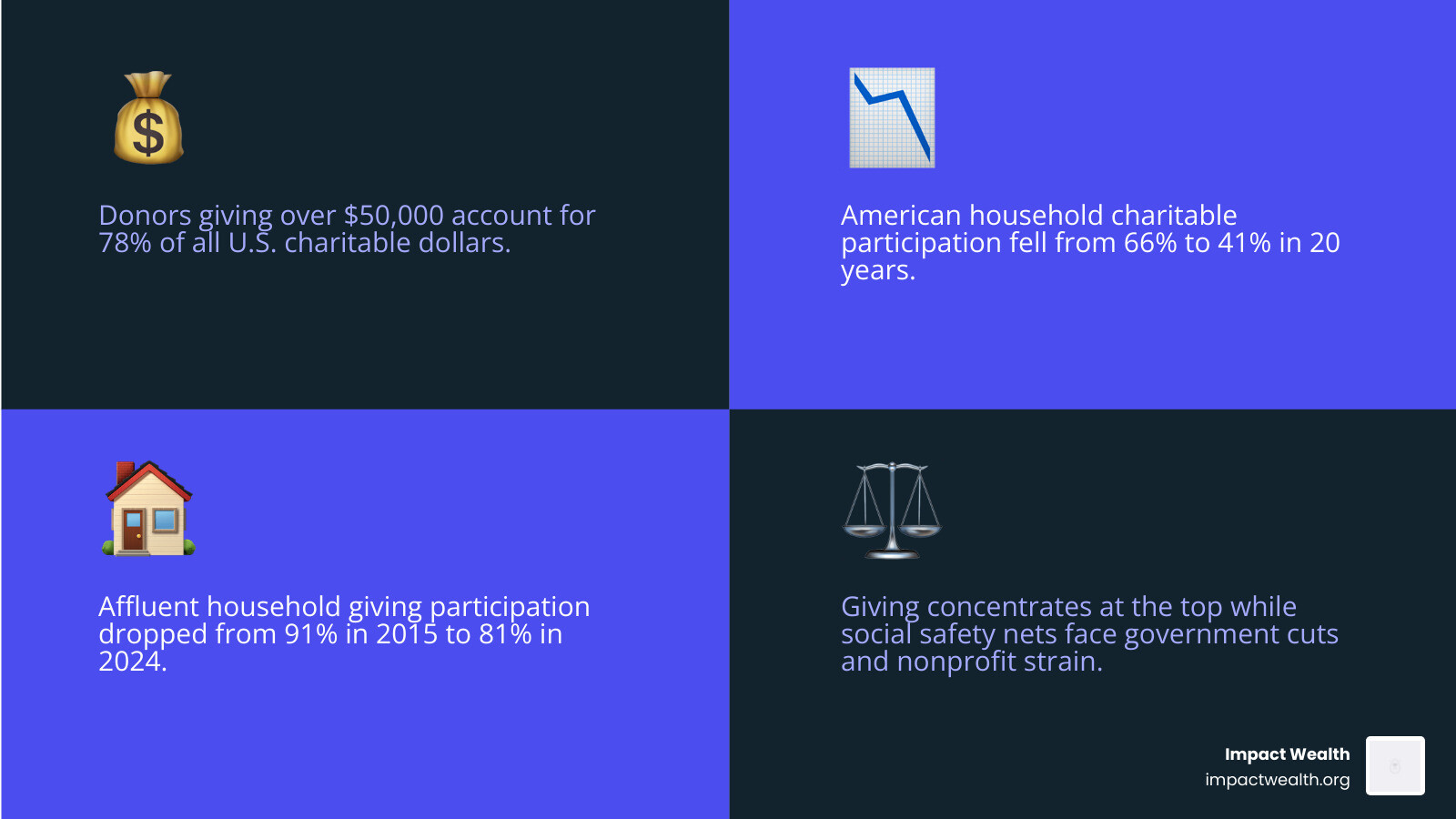
The numbers tell a striking story. Donors giving over $50,000 now account for nearly 78% of all dollars donated in the U.S. Yet at the same time, the share of Americans giving to charity has dropped from roughly two-thirds twenty years ago to just 41% today. Affluent household participation has slid from 91% in 2015 to 81% in 2024.
In other words: giving is concentrating at the top, while the base is shrinking.
Meanwhile, government cuts to social services are widening the gap that nonprofits are expected to fill. Food banks, shelters, arts organizations, and community health programs are all being squeezed from both sides — less public funding and fewer donors.
At the same time, a new generation of ultra-high-net-worth families is rethinking how they give, why they give, and who should have a say in where the money goes. The old model — write a check, put your name on a building — is being replaced by something more strategic, more relational, and in many cases, more impactful.
This guide is built for families and family office principals who want to move beyond ad hoc giving and build a philanthropic approach that is as intentional as the wealth strategy that funded it.
Why Philanthropy for Wealthy Matters More Than Ever
Record wealth and weaker social safety nets are colliding at the same moment. That is why philanthropy for wealthy families matters more now than it did even a decade ago.
A few numbers frame the issue:
- Donors giving more than $50,000 account for nearly 78% of donated dollars
- 81% of affluent households still give, but that is down materially from 91% in 2015
- Overall household participation has fallen to 41%
This concentration means large donors matter enormously. It also means communities become more vulnerable when wealthy donors pause, delay, or narrow their giving.
Why is philanthropy declining among the wealthy despite record wealth levels?
This sounds contradictory, but it is not. Wealth can rise faster than giving for several reasons:
- Asset appreciation is not the same as spendable cash. A family may be richer on paper because of business equity, real estate, or concentrated stock, while still feeling cautious about liquidity.
- Tax timing can delay gifts. Some donors bunch deductions into high-income years and give irregularly rather than steadily.
- Incentives do not always reward immediate payout. Capital can move into vehicles that produce a deduction now while grants happen later.
- Donor fatigue is real. Years of crisis-era appeals can make even generous families more selective.
- Psychological distance matters. Research has long suggested that wealthy households in enclaves can become less connected to everyday hardship than those in mixed communities.
- Some donors increasingly prefer investments over grants, which can shift dollars away from traditional charitable budgets.
So yes, wealth is up. But the emotional, tax, and structural drivers of generosity have become more complicated.
How charitable participation has changed for households and wealthy donors
The broad trend is clear: fewer people are giving, and giving is becoming more top-heavy.
Among affluent households, participation fell from 91% in 2015 to 81% in 2024. That is still high, but the decline matters because these households also account for a disproportionate share of total dollars.
Across the public, the drop is even more dramatic. Twenty years ago, nearly two-thirds of Americans donated to charity. Today, only 41% do.
That shift creates two big changes:
- Major donors now carry more of the sector.
- Nonprofits have fewer small and midsize donors to stabilize revenue.
Broad-based giving used to function like a diversified portfolio. Now many nonprofits depend on a smaller number of large relationships. That may look efficient until one donor changes priorities.
What reduced giving means for nonprofits and society
When government support shrinks and philanthropy also tightens, nonprofits are forced into triage.
The most immediate pressure often shows up in:
- Food banks and shelters
- Community health and mental health programs
- Arts and culture groups
- Education access and scholarship programs
- Local service organizations filling emergency gaps
The downstream effects are easy to underestimate. Reduced nonprofit capacity can mean longer waiting lists, fewer staff, weaker prevention programs, and less community resilience during shocks.

For wealthy families, this is where strategy matters. A thoughtful grant can do more than fund a program. It can stabilize an institution, preserve local capacity, and buy time for a community under pressure.
The State of Giving Pledge and Billionaire Philanthropy
Billionaire philanthropy gets outsized attention because billionaire wealth is outsized. The best-known symbol of that world is The Giving Pledge.
What is the Giving Pledge and how effective has it been?
Launched in 2010, the Giving Pledge is a public commitment by very wealthy individuals and couples to give the majority of their wealth to philanthropy during life or at death.
As of October 2025, it had more than 250 signatories from 30 countries. Its biggest success may be cultural rather than legal:
- It normalized public commitments to major giving
- It created peer pressure among the ultra-wealthy
- It encouraged more discussion of “giving while living”
- It made philanthropy part of elite identity, not just estate planning
But effectiveness is mixed if we define success as dollars actually deployed. The pledge is nonbinding. Some signers have given at extraordinary scale, while others have moved much more slowly. Research cited in your brief shows that only 8 of 22 deceased signatories gave away enough to clearly meet the half-wealth goal by death.
So the pledge has been powerful as a norm-setting device. It has been less powerful as an enforcement mechanism, because it has none.
Why some billionaires are backing away from the Giving Pledge
There are several reasons some signers or observers have become more cautious:
- The pledge is voluntary and unenforceable
- Wealth has grown so fast for some signatories that giving “half” becomes a moving target
- Complex assets are harder to liquidate than public appearances suggest
- Families may prefer long-term control through foundations or LLCs
- Public skepticism of billionaire influence has grown
That skepticism is not trivial. Critics argue that private fortunes should not determine public priorities without democratic accountability. Others worry about slow payout, reputational laundering, or philanthropic vehicles that warehouse assets.
Those criticisms do not mean big philanthropy is bad. They do mean wealthy donors should expect more scrutiny in 2026 than they did in 2010.
Lessons from the most generous philanthropists
Some of the clearest lessons come from donors who moved quickly and at scale.
MacKenzie Scott has donated more than $26 billion to over 2,700 nonprofits since 2019. Warren Buffett has given more than $60 billion. Bill Gates has given more than $50 billion, and Mark Zuckerberg is estimated at roughly $45 billion.
What can we learn from this group and from analyses like How America’s Most Generous Philanthropists Are Giving Big?
- Speed matters. Delayed giving can mean missed opportunities.
- Trust matters. Unrestricted or lightly restricted funding can be more useful than highly controlled gifts.
- Scale matters. Large, multi-year grants let nonprofits plan instead of merely survive.
- Simplicity matters. Endless applications and reporting may protect donor comfort more than social impact.
For more on this shift, see our coverage of Impactful Philanthropy.
How Philanthropy for Wealthy Families Is Changing in 2026
The old hierarchy of prestige causes is being challenged. Younger donors increasingly support causes over institutions, and many want direct, visible impact.
A 2025 study found that 64% of next-gen donors prefer cause-based giving, especially around social justice, racial equity, mental health, and climate.
How philanthropy for wealthy donors differs from middle-income giving
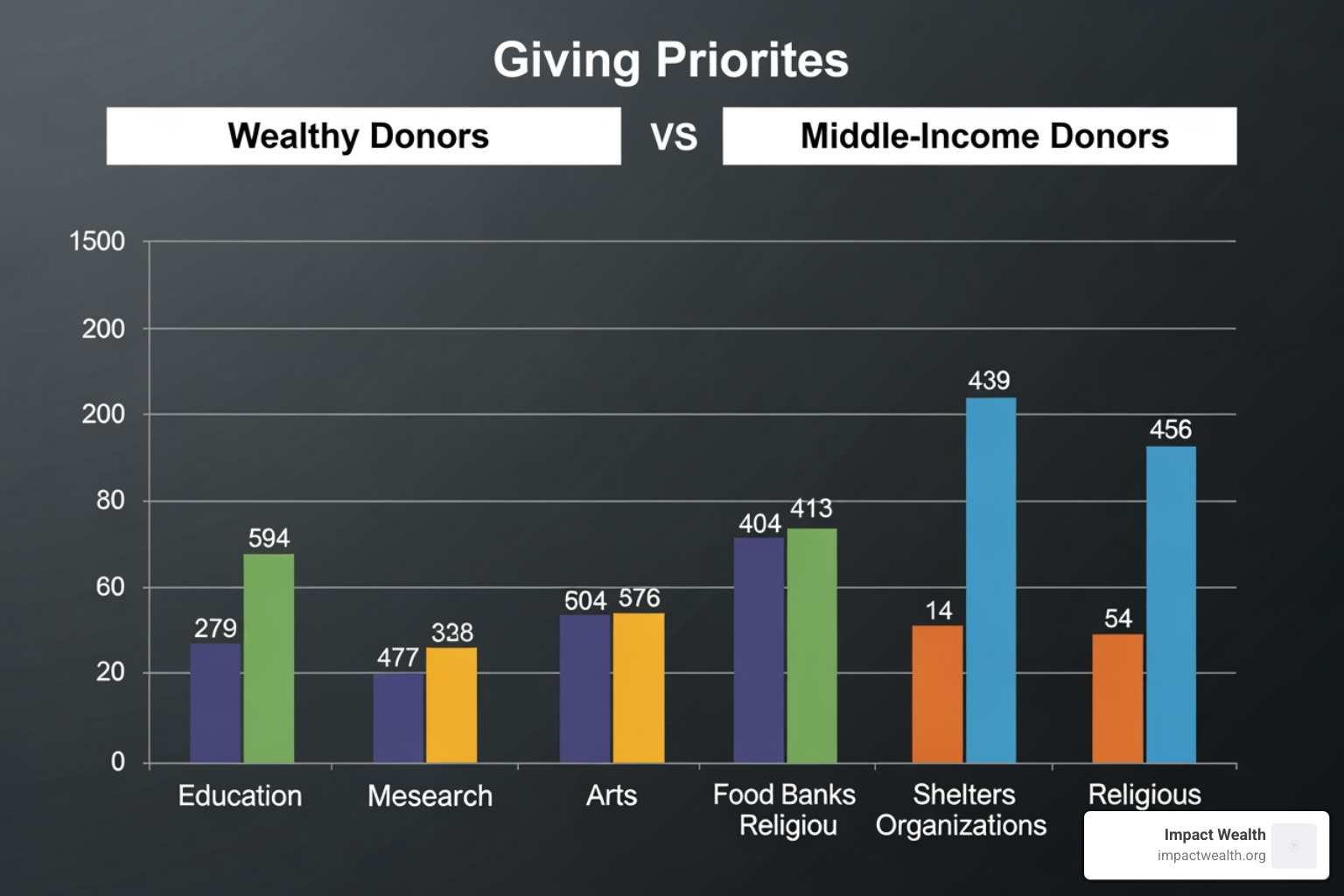
Wealthy donors and middle-income donors often fund different needs.
Higher-net-worth donors are more likely to support:
- Education, especially higher education
- Arts and culture
- Medical research
- Named institutions and legacy organizations
Middle-income donors are often more focused on:
- Food banks
- Shelters
- Religious organizations
- Local aid and immediate needs
Neither pattern is inherently better. They simply reflect different experiences, networks, and time horizons. But it does create a mismatch: elite causes often attract large gifts, while frontline community services depend on thinner funding streams.
That is one reason many modern advisors encourage a balanced portfolio of giving: some legacy institutions, some immediate human need, and some systems-change work.
How younger donors are reshaping philanthropy for wealthy households
Millennials and Gen Z are changing the tone and mechanics of giving.
We are seeing more interest in:
- Trust-based philanthropy
- Participatory grantmaking
- Mutual aid
- Digital-first fundraising and activism
- Community voice in funding decisions
- Faster response to urgent social issues
Younger donors often ask different questions. Not “Which institution should we support?” but “Which problem are we trying to solve?” That is a meaningful shift.
Many also care less about donor recognition and more about values alignment, lived experience, and measurable outcomes. For more on that evolution, visit our Philanthropic Trends coverage.
Why the great wealth transfer could reset philanthropic priorities
The coming transfer of wealth to heirs, especially younger family members and women, could reshape philanthropy dramatically.
This matters because philanthropic priorities are not inherited automatically. A family may have built its identity around museums, universities, or hospitals, while the next generation may be more focused on climate resilience, mental health, housing, or justice reform.
Without governance, this can create mission drift. With governance, it can create renewal.
The best family philanthropy plans treat next-gen involvement as training, not theater. Give younger members real participation, real budgets, and real accountability.
Strategic Vehicles for Wealthy Giving
There is no single best structure for every family. The right tool depends on control, privacy, complexity, tax planning, and desired speed.
Choosing between donor-advised funds, private foundations, and LLCs
Here is the simple version:
| Vehicle | Best for | Main advantages | Main drawbacks |
|---|---|---|---|
| Donor-advised fund | Simplicity | Immediate deduction, low admin, privacy options | Less control, no direct operations |
| Private foundation | Control and family governance | Custom mission, staffing, legacy structure | More compliance, cost, reporting |
| LLC | Flexibility | Can mix grants, investments, advocacy, privacy | No charitable deduction for contributions to the LLC itself |
DAFs are popular because they are easy. A donor contributes cash or appreciated assets, receives an immediate deduction, and recommends grants later.
Private foundations work well for families wanting a durable institution, board governance, and a visible legacy. They can also become a training ground for younger family members.
LLCs offer flexibility for donors who want to combine charitable giving with impact investing or policy work. But flexibility comes with tradeoffs, especially around tax treatment and public perception.
For a practical overview, see Charitable Giving for the Ultra High Net Worth.
Tax incentives, deductions, and why benefits skew to the wealthy
Tax incentives do encourage giving, but the benefits are not evenly distributed.
They tend to favor wealthy donors because:
- Itemized deductions are more useful at higher income levels
- Appreciated stock can be donated without triggering capital gains tax
- Estate tax planning creates additional charitable incentives at death
- Wealthy donors have more ability to time gifts around liquidity events
In plain English: a billionaire donating appreciated stock may receive far more tax leverage than a salaried donor writing a check.
That is one reason reform discussions often include:
- Broadening tax benefits beyond itemizers
- Setting stronger payout expectations for certain charitable vehicles
- Encouraging matching credits for ordinary households
- Creating clearer reporting on when charitable dollars actually reach working nonprofits
Tax efficiency is not wrong. But if incentives only reward the already wealthy, the system can deepen concentration rather than broaden generosity.
Compliance requirements wealthy families should not overlook
This is where the glamorous part of philanthropy meets the spreadsheet.
Wealthy families using formal structures need to pay attention to:
- Board governance
- Conflict-of-interest policies
- Grantee due diligence
- Self-dealing rules
- Expenditure responsibility for certain grants
- Cross-border giving rules
- Cash flow management and grant budgeting
If you fund internationally, compliance becomes even more important. Entity checks, charitable status, sanctions screening, and documentation are not optional.
We cover many of these issues in Philanthropic Wealth Strategies.
Building a Strategic Family Philanthropy Plan
A strategic plan prevents philanthropy from becoming random generosity with expensive overhead.
How to create a mission statement and giving guidelines
A useful family mission statement should answer:
- What do we care about?
- Who do we want to help?
- Where do we want to focus geographically?
- What kinds of change are we trying to produce?
- How much risk are we willing to take?
From there, build giving guidelines:
- Priority themes
- Geographic focus
- Typical grant size
- Preferred grant length
- What you do not fund
- Decision-making roles
- Review cycle, often every three to five years
The biggest mistake is making the mission so broad it means nothing. “Improving humanity” sounds noble but does not help when deciding between a scholarship fund, climate nonprofit, or housing initiative.
Measuring impact and ensuring long-term results
Good philanthropy is not just about writing checks. It is about learning.
Track a small set of meaningful indicators:
- Outputs: what was delivered
- Outcomes: what changed
- Financial health: can the nonprofit sustain the work
- Leverage: did your gift attract other support
- Learning: what did not work and why
Multi-year grants are especially powerful because they let organizations plan. Unrestricted funding is also often underrated; it allows strong nonprofits to allocate resources where they are most needed.
For more ideas, see our Impactful Giving archive.
The role of impact investing in modern philanthropy
Many wealthy families no longer separate “the investment portfolio” from “the charitable portfolio” as sharply as before.
That is where impact investing enters the picture. Instead of only making grants, families can deploy capital into ventures, funds, or projects designed to generate both financial return and social benefit.
This sits on a spectrum:
- Responsible investing
- Sustainable investing
- ESG-informed investing
- Impact investing
- Catalytic capital with higher risk tolerance
The key idea is alignment. If your grants support climate resilience while your portfolio finances the opposite, the left hand and right hand are having a very awkward family dinner.
Explore more in our Impact Investing and Ai For Impact Investing coverage.
Criticisms, Reforms, and Smarter Ways to Give
Philanthropy deserves praise when it works and scrutiny when it does not.
The main criticisms of billionaire philanthropy
The leading criticisms are fairly consistent:
- Democratic deficit: donors can shape public priorities without public accountability
- Asset warehousing: funds can sit inside structures while communities need help now
- Elite agenda-setting: donor preference may outweigh community voice
- Naming power and prestige distortion
- Limited transparency in some vehicles
These critiques are strongest when philanthropy substitutes for public systems instead of supporting them. They are weaker when donors listen, move money faster, and share power with communities.
Reforms that could encourage more giving and better outcomes
Some commonly discussed reforms include:
- Minimum payout rules for more charitable vehicles
- Better public reporting on grants and timelines
- Broader tax incentives for non-wealthy households
- Sunset clauses for certain philanthropic structures
- Community advisory boards or participatory models
The point is not to punish giving. It is to make sure charitable capital reaches working organizations faster and with stronger accountability.
Smarter giving principles for wealthy families starting now
If we were advising a family starting in 2026, our first-year moves would be:
- Give while living, not only through the estate
- Start with a clear mission before choosing a vehicle
- Fund some overhead; strong organizations need infrastructure
- Make at least part of the portfolio multi-year
- Keep restrictions light unless there is a compelling reason
- Listen locally before scaling globally
- Involve younger family members early
- Review results annually and adjust
A little humility also helps. Philanthropy is not a moon landing every time. Sometimes the most effective gift is simply steady support for people already doing excellent work.
Frequently Asked Questions about Philanthropy for Wealthy
How much should wealthy families give each year?
There is no universal rule, but a useful framework is to set an annual giving budget as a percentage of income, liquidity events, or net worth growth.
Some families benchmark against their historical pattern. Others tie giving to realized gains. The important point is consistency. A multi-year budget usually produces better decisions than year-end improvisation.
Is it better to give now or leave philanthropy in an estate plan?
Usually both, but with a bias toward giving now.
Giving during life lets you:
- See impact directly
- Learn and refine your strategy
- Involve the next generation
- Respond to urgent need in real time
Estate gifts still matter, especially for legacy commitments and tax coordination, but delayed generosity can become missed opportunity.
Should a family office manage philanthropy internally or outsource it?
That depends on complexity.
Internal management works well when the family office has:
- Staff capacity
- Strong governance
- Experience with diligence and reporting
Outsourcing works well when specialized expertise is needed, especially for evaluation, compliance, or international grantmaking. Many families use a hybrid model: internal leadership with outside support for technical execution.
Conclusion
In 2026, philanthropy for wealthy families sits at the intersection of responsibility, opportunity, and scrutiny. Wealth is more concentrated. Giving is more concentrated too. Nonprofits are under more strain, and the next generation wants a bigger say in what impact should look like.
That makes this a good moment to be intentional.
The strongest philanthropic strategies usually share a few traits: clear purpose, the right vehicle, disciplined governance, faster deployment, and a willingness to learn. They also recognize that generosity is not separate from legacy. It is one of the clearest ways a family can express what it stands for.
At Impact Wealth, we believe thoughtful giving can strengthen family identity, support communities under pressure, and create long-term impact well beyond a single donation cycle.
If you are building a more intentional family office approach, explore our family office resources for the next step.