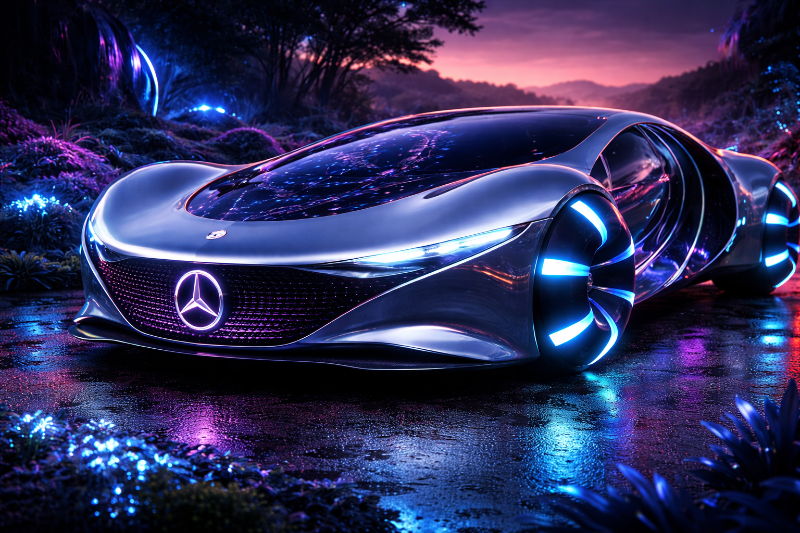
The Mercedes AVTR represents one of the boldest experiments in futuristic automotive design ever unveiled by a major luxury automaker. Inspired by James Cameron’s cinematic universe of Avatar, the Mercedes AVTR blends bio-inspired automotive design with cutting-edge electric mobility. Rather than functioning as a mere showpiece, this futuristic mobility concept demonstrates how art, sustainability, artificial intelligence, and next-generation electric vision can converge into a single rolling sculpture.
Moreover, the Mercedes AVTR pushes beyond traditional concept-car boundaries. It introduces an entirely new design language shaped by biomimicry where organic forms replace sharp mechanical lines. From its flowing body surfaces to its scale-like rear flaps, every detail reflects inspiration drawn from Pandora’s ecosystem. Consequently, the vehicle is less about horsepower and more about emotional interaction between human, machine, and environment.
However, what makes the Mercedes AVTR particularly compelling for automotive enthusiasts and EV investors is its experimental technology. It integrates electric propulsion, sustainable materials, immersive user interfaces, and 360-degree wheel mobility into a unified design statement. Therefore, the Mercedes AVTR is not just a concept car it is a laboratory for the future of luxury mobility.
Cinematic Inspiration Meets Engineering Vision
The Mercedes AVTR (Advanced Vehicle Transformation) debuted as a collaboration between Mercedes-Benz and the creators of Avatar. The design was intended to embody the symbiotic relationship between humans and nature portrayed in the film.
Unlike typical promotional tie-ins, however, this experimental luxury prototype introduced technologies that aligned with the automotive industry’s long-term sustainability goals:
-
Fully electric propulsion
-
Organic design language
-
Biodegradable and recycled materials
-
Human-machine interaction without conventional controls
Consequently, the Mercedes AVTR stands at the intersection of entertainment and engineering, redefining how cinematic storytelling can influence automotive innovation.
Biomimicry Design Philosophy
One of the defining characteristics of the Mercedes AVTR is its bio-inspired automotive design.
Exterior Innovation
-
33 “bionic flaps” at the rear resembling reptilian scales
-
Organic, flowing body panels
-
Illuminated surfaces that respond to driver input
-
Transparent wheel housings
These design elements are not merely aesthetic. The bionic flaps can communicate with the environment and other vehicles, suggesting future vehicle-to-vehicle interaction systems.
Moreover, the low, sweeping stance eliminates traditional front grilles and mirrors, reinforcing the idea of a clean, electric future.
Electric Powertrain & 360-Degree Mobility
The Mercedes AVTR features a fully electric powertrain with four independently controlled motors—one at each wheel. This setup enables:
-
Instant torque delivery
-
Precise torque vectoring
-
All-wheel-drive capability
-
360-degree wheel rotation (“crab movement”)
Consequently, the vehicle can move diagonally, sideways, or pivot within tight spaces—dramatically improving maneuverability in urban environments.
The battery technology utilizes graphene-based organic cell chemistry, eliminating rare earth materials. Therefore, the sustainability impact extends beyond tailpipe emissions into raw material sourcing.
Technology & Innovation Breakdown
| Feature | Purpose | Performance Advantage | Sustainability Impact | Production Feasibility |
|---|---|---|---|---|
| Four-Wheel Independent Motors | Enhanced control | Precise torque vectoring | Efficient energy use | High |
| 360-Degree Wheel Rotation | Urban maneuverability | Sideways movement | Reduced spatial footprint | Medium |
| Organic Graphene Battery | Clean energy storage | High efficiency | No rare earth metals | Experimental |
| Bionic Flaps | Environmental interaction | Aerodynamic adaptation | Visual communication | Low |
| Gesture-Based Interface | Seamless UX | No traditional steering | Minimal hardware waste | Medium |
Interior: Human-Machine Symbiosis
Inside the Mercedes AVTR, traditional controls disappear.
Instead of a steering wheel, a central control unit responds to hand placement. The interior features:
-
Sustainable vegan leather (DINAMICA microfiber)
-
Recycled materials
-
Ambient lighting responsive to biometric signals
-
Immersive augmented reality displays
Moreover, the vehicle can recognize its driver via biometric connection. The cabin adapts lighting, seating position, and infotainment to individual preferences. Consequently, the driving experience becomes interactive rather than mechanical.
This autonomous interaction system reflects Mercedes’ exploration into AI-integrated vehicles.
Environmental Consciousness
The Mercedes AVTR’s sustainability approach extends beyond electrification:
-
Use of recycled plastics
-
Compostable materials
-
Avoidance of conventional lithium-ion chemistry
-
Reduced resource-intensive manufacturing
However, while its eco-claims are ambitious, full-scale production feasibility remains uncertain. Graphene battery technology is still in experimental phases, and large-scale manufacturing would require significant supply-chain transformation.
Nevertheless, the concept demonstrates how luxury brands can experiment responsibly with environmental innovation.
Concept-to-Production Feasibility
Will the Mercedes AVTR enter production?
Directly, likely not. However, many of its technologies may influence future models.
For example:
-
Four-motor torque vectoring systems
-
Advanced gesture interfaces
-
Sustainable interior materials
-
Enhanced battery chemistries
Consequently, the AVTR serves as a testing platform for next-generation electric vision concepts that may gradually appear in Mercedes’ production EV lineup.
Concept Car Influence Factors
| Factor | Impact |
|---|---|
| Design Uniqueness | Extremely high – no comparable production model |
| Technological Advancement | Demonstrates advanced EV and UX innovation |
| Brand Positioning | Reinforces Mercedes as a luxury innovation leader |
| Media Impact | Global attention through Avatar collaboration |
| Long-Term Legacy Potential | Strong influence on sustainable design trends |
The Mercedes AVTR’s media visibility significantly boosted its global recognition. Moreover, it strengthened Mercedes’ identity as a pioneer in experimental luxury prototypes.
Investment and Collector Narrative
Concept cars rarely become direct investment vehicles unless sold at auction. However, their indirect value lies in influence.
For collectors and EV investors, the Mercedes AVTR represents:
-
A turning point in design philosophy
-
A sustainability-driven luxury statement
-
A milestone in human-machine interaction
Therefore, while not tradable like a production vehicle, its legacy may increase the collectibility of early electric Mercedes models influenced by its innovations.
Future Outlook Beyond 2026
The relevance of the Mercedes AVTR will likely expand as EV technology evolves.
AI-Integrated Vehicles
Biometric recognition and adaptive cabin environments may become standard features in luxury EVs.
Sustainable Luxury Materials
Recycled and vegan materials will increasingly replace traditional leather and plastics.
Advanced Battery Chemistry
Graphene and solid-state batteries may eventually achieve commercial viability.
Autonomous Interaction Systems
Gesture-based controls and immersive augmented reality interfaces could redefine vehicle interiors.
Consequently, the Mercedes AVTR may be remembered as an early blueprint for eco-conscious, AI-driven mobility.
FAQ Section
Will the Mercedes AVTR enter production?
There are no confirmed plans for direct production; however, elements may influence future Mercedes EVs.
What is its connection to Avatar?
The vehicle was developed in collaboration with the creators of Avatar, inspired by Pandora’s ecological philosophy.
Is the technology feasible today?
Some features like four-motor EV setups are feasible, but graphene batteries remain experimental.
Are the sustainability claims realistic?
The materials and battery concepts are promising, though large-scale adoption requires further development.
How does it influence future Mercedes models?
It showcases sustainable materials, AI integration, and electric propulsion systems that may shape upcoming luxury EV platforms.