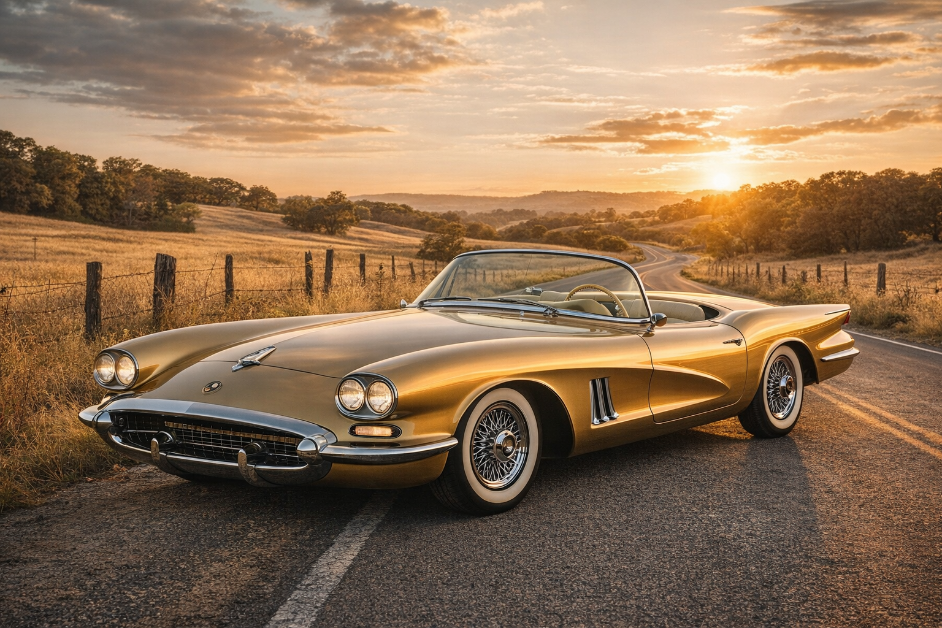
The Oldsmobile F88 stands as one of the most intriguing and overlooked concept cars in American automotive history. While icons like the early Corvette dominated headlines in the 1950s, the Oldsmobile F88 quietly occupied a unique place in General Motors’ experimental lineup. As a rare GM experimental vehicle, it combined Corvette-based engineering with distinctive Oldsmobile styling, creating a prototype performance roadster that could have redefined its brand’s trajectory.
Moreover, the Oldsmobile F88 represents the golden age of American concept design a period when dream cars captivated audiences at auto shows and shaped public imagination. Introduced during the glamorous GM Motorama era, the F88 embodied the optimism, chrome-laden flair, and performance ambition of mid-century America. However, unlike many show cars that evolved into production models, the Oldsmobile F88 remained largely hidden from public awareness for decades.
Consequently, the F88’s rediscovery and later auction success transformed it from an obscure heritage show car into a blue-chip collector asset. Today, automotive historians and investors regard the Oldsmobile F88 not just as a design exercise but as a mid-century American concept icon with significant long-term appreciation potential.
Origins: GM Motorama and Concept Ambition
The 1950s marked a transformative era for General Motors. Through the glamorous GM Motorama exhibitions, the company showcased futuristic concepts that highlighted innovation, design leadership, and brand differentiation.
The Oldsmobile F88 debuted as part of this experimental push. Although Chevrolet’s Corvette was already gaining traction, Oldsmobile sought its own halo sports car to elevate its performance image. Therefore, engineers leveraged existing GM components to develop a Corvette-based engineering platform dressed in bespoke Oldsmobile styling.
However, internal brand strategy and market positioning likely prevented the F88 from entering production. Oldsmobile was positioned as an upscale yet practical brand, and a limited-production sports car may have conflicted with that identity.
Corvette-Based Engineering
Under its sculpted fiberglass body, the Oldsmobile F88 shared much with early Corvettes:
-
Corvette chassis architecture
-
Fiberglass body construction
-
Small-block V8 configuration
-
Rear-wheel-drive layout
Yet, the F88 incorporated Oldsmobile’s signature Rocket V8, distinguishing it from Chevrolet’s offerings. This blending of corporate components with brand-specific powertrains reflects GM’s mid-century engineering strategy.
Moreover, its lightweight construction and robust engine design gave the F88 strong performance credentials. For a concept vehicle, it was far more than a static showpiece—it was a functional performance machine.
Technical Overview
| Specification | Details |
|---|---|
| Engine Type | 324 cu in Rocket V8 |
| Platform/Chassis Origin | Corvette-based GM platform |
| Horsepower Estimate | Approx. 250–275 hp |
| Design Highlights | Fiberglass body, chrome accents, wraparound windshield |
| Production Count | 4 prototypes (estimated) |
| Concept Debut Year | 1954 |
Although exact production numbers remain debated, historians generally agree that only four F88 prototypes were constructed. Consequently, its rarity exceeds even many limited-production sports cars of the era.
Design Philosophy: Mid-Century American Expression
Visually, the Oldsmobile F88 captured the exuberance of 1950s America:
-
Sweeping chrome trim
-
Sculpted fenders
-
Prominent grille
-
Jet-age tail styling
-
Two-seat roadster configuration
Unlike the Corvette’s relatively minimalist design, the F88 emphasized Oldsmobile’s identity through bold chrome detailing and dramatic lines. Therefore, it served as both a performance statement and a branding exercise.
The car’s fiberglass construction allowed designers to experiment freely with curves and proportions. Moreover, the wraparound windshield and low-slung stance gave it a futuristic presence on Motorama stages.
Why It Remained Obscure?
Despite its potential, the Oldsmobile F88 never entered mainstream production. Several factors contributed:
-
Internal GM brand overlap concerns
-
Market risk for niche sports cars
-
Production cost considerations
-
Shifting corporate priorities
However, obscurity ironically enhanced its mystique. For decades, the F88 existed largely in archival photos and collector whispers. Consequently, when surviving examples resurfaced, the collector world reacted with intense interest.
Rediscovery and Auction Milestones
One of the most pivotal moments in the Oldsmobile F88’s legacy occurred when a surviving example crossed the auction block in the early 21st century. The sale price—reaching several million dollars—redefined perceptions of American concept car value.
Moreover, this auction milestone elevated the F88 into elite collector territory. Investors began recognizing the financial strength of rare GM experimental vehicles, particularly those tied to Motorama heritage.
Auction results demonstrated that:
-
Concept-car provenance commands premium pricing.
-
Brand legacy enhances cross-generational appeal.
-
Rarity creates competitive bidding environments.
Consequently, the Oldsmobile F88 became a benchmark for mid-century American concept icon valuation.
Collector Value Drivers
| Factor | Impact |
|---|---|
| Rarity Status | Extremely rare (few surviving prototypes) |
| Provenance Documentation | Critical for valuation authenticity |
| Restoration Originality | Preference for historically accurate preservation |
| Auction Performance Impact | Record-breaking sales influence future valuations |
| Long-Term Appreciation Outlook | Strong due to scarcity and concept heritage |
The Oldsmobile F88’s rarity is unmatched among American concept roadsters. However, documentation plays an equally important role. Without factory records and clear ownership chains, value can be significantly affected.
Moreover, originality matters. Over-restoration may diminish historical integrity, while well-preserved examples command stronger premiums.
Restoration Challenges
Restoring a prototype performance roadster like the F88 presents unique difficulties:
-
Limited availability of original components
-
Fiberglass body repair complexities
-
Matching period-correct finishes
-
Reconstructing historically accurate details
Because only a handful were built, replacement parts often require custom fabrication. Consequently, restoration costs can be substantial, frequently reaching seven figures for museum-grade work.
However, advanced preservation technology—including 3D scanning and archival documentation—now aids restorers in maintaining historical fidelity.
Investment Narrative: Rarity Meets Heritage
The long-term investment appeal of the Oldsmobile F88 stems from several intersecting factors:
-
Ultra-limited production
-
Direct link to GM Motorama
-
Corvette-based engineering credibility
-
Strong brand legacy
-
High-profile auction precedents
Therefore, it occupies a unique niche between American muscle car heritage and European coachbuilt exclusivity. As collector tastes evolve toward rare prototypes and historically significant vehicles, the F88’s positioning strengthens.
Moreover, concept cars from the 1950s represent a cultural moment of optimism and industrial confidence—an emotional narrative that enhances desirability.
Future Outlook Beyond 2026
The collector market is evolving rapidly. Several trends will influence the Oldsmobile F88’s trajectory:
Concept Car Investment Growth
Investors increasingly view rare show cars as blue-chip assets, especially those tied to major automakers.
Digital Authentication
Blockchain-based documentation and digital chassis registries will reduce fraud risk and enhance transparency.
Preservation Technology
Non-invasive restoration methods and materials science advancements will preserve originality more effectively.
Changing Demographics
Younger collectors entering the market may gravitate toward vehicles that blend design drama with historical narrative qualities the F88 embodies.
Consequently, the Oldsmobile F88 is poised to maintain strong appreciation potential as a rare GM experimental vehicle with enduring historical significance.
FAQ Section
How many Oldsmobile F88 cars were built?
Approximately four prototypes are believed to have been constructed.
Why did it remain obscure for decades?
Limited production, internal GM strategy decisions, and lack of commercial release kept it out of mainstream awareness.
How does it compare to early Corvettes?
It shares Corvette-based engineering but features Oldsmobile’s Rocket V8 and distinctive styling.
What are the restoration challenges?
Scarcity of original parts and fiberglass body repair complexities make restoration highly specialized.
What is its current market value?
Values vary by provenance and condition, but notable examples have achieved multimillion-dollar auction results.