Impact-focused storytelling has a funny constraint: it has to feel human, not “produced.” Family offices and philanthropic teams don’t need another flashy reel—they need something that can explain a thesis, show a project, or summarize outcomes without looking like a gimmick.
That’s why “video to anime” is interesting when you treat it like a controlled production workflow instead of a viral effect. If you want a low-friction entry point, a tool like a video to anime converter can be used as a repeatable sandbox: you run small iterations, you keep what stays stable, and you build a style you can reuse across updates.
The hidden difficulty of video-to-anime: consistent style across frames
Single frames are easy to make pretty. Continuity is the hard part.
In motion, your viewer’s brain tracks anchors automatically: facial proportions, clothing edges, background geometry, even tiny highlight patterns on hair and fabric. When those anchors drift, the clip stops feeling intentional—and starts feeling like a demo.
So the goal isn’t “maximum anime.” The goal is “consistent enough that nobody notices the tool.”
The three inputs that determine success rate (rules beat vibes)
Most failures can be predicted before you generate anything. You’re balancing action complexity, camera motion, and lighting stability.
| Variable | Low risk | Medium risk | High risk |
| Action complexity | talking, walking, simple gestures | turning, pointing, moderate dance | fast spins, hands crossing face, complex footwork |
| Camera motion | locked tripod | slow push-in, gentle pan | handheld shake, rapid zooms, whip pans |
| Lighting stability | single soft key | mixed indoor lighting | colored LEDs, strobe, changing exposure |
If you want “repeatable,” aim for two lows + one medium. When all three are high, the model is forced to invent structure every frame—and invention is the enemy of continuity.
A prompt structure you can reuse (copy this template)
Think of your prompt like a short creative brief that doesn’t contradict itself. You’re giving the model anchors first, then style, then motion, then camera.
Subject anchors:
[who/what], [age range if relevant], [hair], [outfit], [distinctive details], same identity across all frames
Style spec:
clean anime linework, consistent cel shading, stable color palette, crisp edges, minimal texture noise, no flicker
Motion spec:
[action], small-to-medium amplitude, readable limbs, smooth timing, loop-friendly cadence (if needed)
Camera spec:
locked-off shot, full body in frame (for dance), stable background, no sudden framing changes
A small trick that helps: describe what must NOT change in plain language (outfit stays the same, background stays the same, face proportions stay the same). It’s not glamorous, but it’s practical.
The five failure modes you’ll see most—and how to fix them by changing only one thing
When a result looks “weird,” the fastest improvement comes from isolating variables. Change one input, re-run, compare.
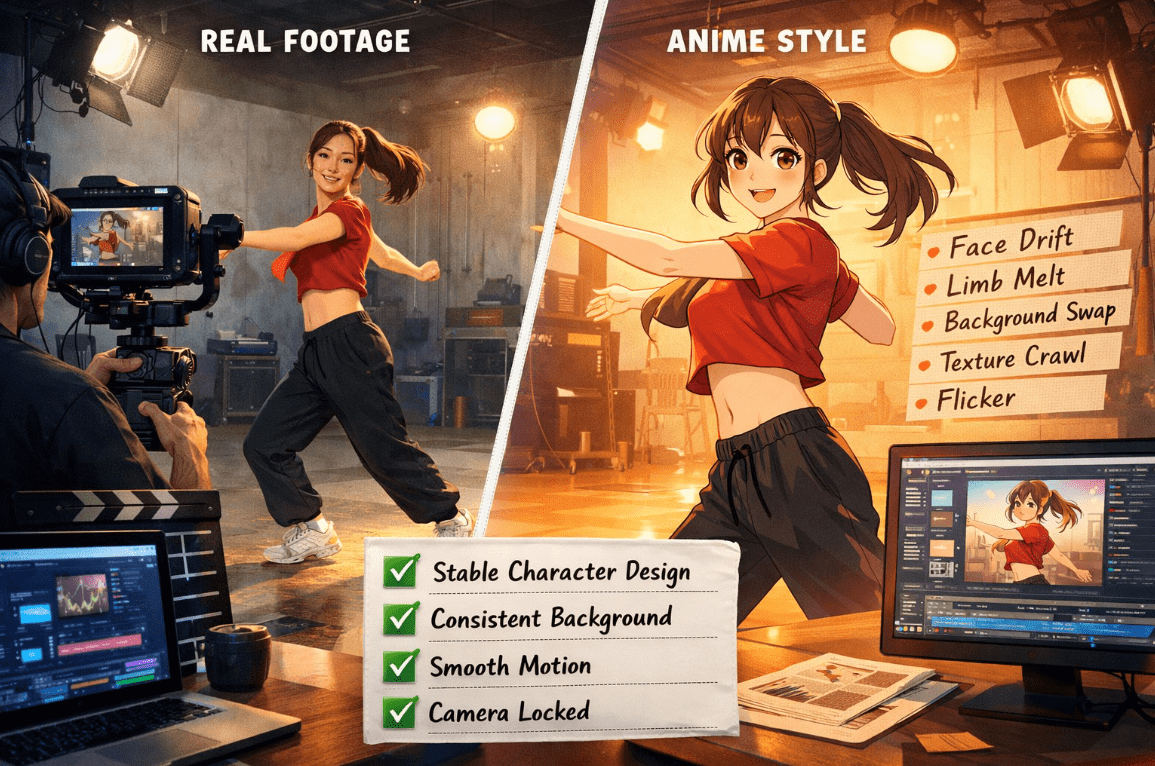
| Failure mode | What it looks like | One-variable fix |
| Face drift | eyes/nose/mouth subtly morph | strengthen subject anchors (hairline, eye shape, defining feature) |
| Limb melt | fingers/arms warp mid-motion | reduce action complexity (smaller gestures, slower tempo) |
| Background swap | walls/furniture jump | lock camera spec + simplify background details |
| Texture crawl | shimmering edges on clothes/hair | simplify style spec (less micro-texture, cleaner shading) |
| Flicker | brightness/color shifts frame-to-frame | stabilize lighting (even exposure, avoid colored LEDs) |
If you’re mentoring a team, this table is the difference between “random prompting” and a workflow you can teach.
The publish-ready test: does it hold up on the timeline?
You don’t need a scoring rubric. You need a quick set of gates.
- Three-second test: play any 3 seconds—does the face stay the same, do hands behave, does the background hold?
- Keyframe check: scrub frame 1, a middle frame, and the last frame. If identity or wardrobe changes, it’s a no.
- Edge sanity: look at hairline edges and finger silhouettes. If they shimmer, fix style/lighting before touching anything else.
This kind of evaluation matters more than a “best frame” screenshot. Your audience experiences the clip as time, not as a still.
Expanding to dance: why rhythm is the real constraint
Dance is the perfect stress test because it combines fast limbs, repeated patterns, and viewer expectations about timing. If the beat feels off—or if the motion jitters—people notice immediately.
Two tactics help:
- Constrain motion amplitude. “Upbeat” doesn’t have to mean chaotic. Ask for clean arm swings, readable footwork, smooth transitions.
- Prioritize camera discipline. Full-body framing with a stable background is your friend. Handheld movement multiplies failure modes.
If you’re creating dance-based content (for campaigns, event recaps, or just social reach), a dedicated generator like an AI dance generator can be useful specifically because it nudges you toward rhythm-first constraints—exactly what style-transfer workflows tend to neglect.
Compliance and trust (short, but non-negotiable)
Family office and philanthropy storytelling lives on credibility. A clean workflow still needs clean permissions.
- Portrait rights: only use footage you own or have explicit permission to transform and publish.
- Music rights: don’t assume trending audio is cleared for commercial use; treat licensing as a separate checklist item.
- Disclosure: if the clip could be interpreted as documentary evidence, label it as stylized/illustrative.
- Sensitive content: avoid anything involving minors, private individuals, or situations that could be misconstrued as endorsement or representation.
Trust compounds slower than views, but it lasts longer.
A two-iteration experiment that makes this workflow “real”
Run this as an A/B test with the same 6–8 second source clip.
Version A (baseline):
- Use the template prompt once. Don’t over-tune.
- Export and evaluate using the three-second test + keyframe check.
Version B (one change only):
- Pick the single biggest failure mode you saw.
- Apply the corresponding one-variable fix (from the table).
- Re-run and compare.
If your team can consistently improve results with one controlled change, you’ve moved from “prompt luck” to a repeatable process. That’s the difference between a fun demo and a dependable content pipeline—especially when the story you’re telling is tied to real capital, real people, and real impact.