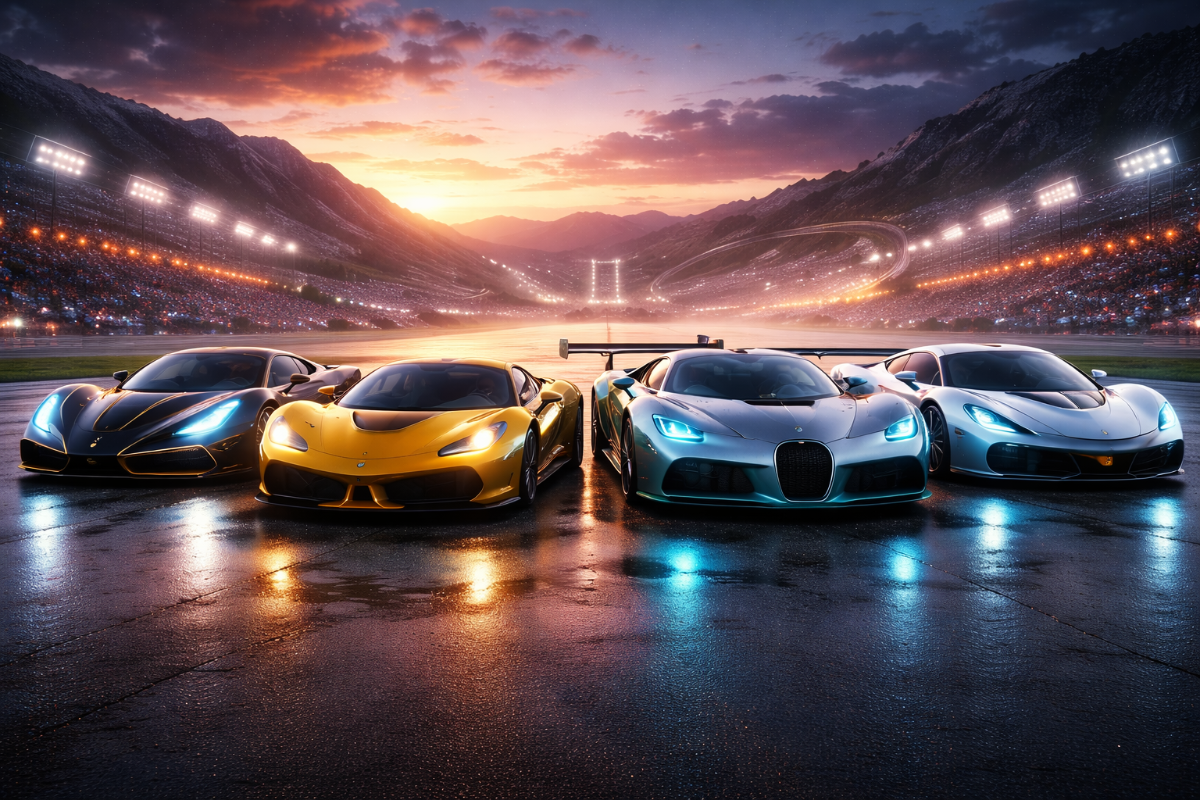
Speed has always been the ultimate benchmark of automotive ambition. From early land-speed record machines to today’s million-dollar hypercars, the pursuit of velocity has driven engineers to rethink what is mechanically, aerodynamically, and materially possible. In this elite world, Top Speed Kings are not just fast cars they are rolling laboratories where physics, software, and craftsmanship collide at the edge of feasibility.
What makes these record-breaking cars so fascinating is that raw power alone is never enough. Achieving extreme speed requires a perfect balance of engine output, aerodynamic efficiency, structural rigidity, and tire technology, all working in harmony under immense stress. As a result, the fastest cars on Earth represent the peak of modern engineering, often debuting innovations that later filter into mainstream high-performance vehicles.
For automotive enthusiasts, collectors, and investors alike, Top Speed Kings symbolize more than bragging rights. They define brand prestige, technological leadership, and long-term value. This article explores the engineering secrets behind the world’s fastest cars, the manufacturers pushing the limits, and what the future holds for ultra-high-speed automotive design.
What Defines the Top Speed Kings?
At its core, top speed is a simple metric: how fast a car can go in ideal conditions. However, becoming one of the Top Speed Kings involves far more than achieving a single impressive number.
First, the car must generate immense and sustained power. This typically means high-displacement engines, advanced turbocharging systems, or cutting-edge hybrid setups. Second, that power must overcome aerodynamic drag, which increases exponentially with speed. Consequently, even small improvements in airflow management can unlock significant gains at the top end.
Finally, stability and control are non-negotiable. At speeds exceeding 250 mph, tiny imperfections in chassis balance or suspension tuning can become catastrophic. As a result, the fastest cars are as much about precision engineering as they are about outright performance.
Engine Power: The Heart of Record-Breaking Cars
Every speed demon starts with an extraordinary engine. Among the Top Speed Kings, horsepower figures often exceed 1,500 hp, achieved through a mix of traditional internal combustion excellence and modern forced induction.
Bugatti’s quad-turbo W16 engine is a prime example. Designed to deliver colossal power smoothly and reliably, it produces relentless acceleration even at extreme speeds. Koenigsegg, however, takes a different approach, favoring lighter engines with advanced turbo systems and innovative valvetrain technology to maximize efficiency.
Moreover, hybrid assistance is becoming increasingly common. Electric motors provide instant torque, filling gaps in power delivery and improving acceleration without sacrificing top-end performance. As a result, future record-breaking cars may rely as much on electrons as on fuel.
Aerodynamics: Fighting the Invisible Enemy
Above 200 mph, air becomes the single greatest obstacle. Drag, lift, and turbulence can make or break a car’s top-speed ambitions. This is why aerodynamics plays such a central role among the Top Speed Kings.
Designers use active aerodynamic systems adjustable wings, flaps, and diffusers that change configuration depending on speed and driving mode. At lower speeds, these systems prioritize downforce and stability. At maximum velocity, they flatten out to reduce drag.
Consequently, the fastest cars often look deceptively calm at speed, slicing through the air with minimal resistance. Computational fluid dynamics (CFD) simulations and wind tunnel testing are pushed to extremes, sometimes consuming more development time than engine tuning itself.
Lightweight Materials: Speed Through Mass Reduction
Power is important, but weight is equally critical. Every kilogram saved improves acceleration, braking, and handling. For the Top Speed Kings, exotic materials are standard rather than optional.
Carbon fiber monocoques provide exceptional stiffness with minimal weight. Titanium is used for exhaust systems and structural components, while aluminum alloys balance strength and manufacturability. Some manufacturers even experiment with graphene-infused composites and 3D-printed metal parts.
As a result, these cars achieve astonishing power-to-weight ratios, enabling them to reach extreme speeds faster and more safely than ever before.
Top Speed Kings – Performance Comparison
| Car Model | Top Speed | 0–60 mph | Horsepower | Approx. Price |
|---|---|---|---|---|
| Bugatti Chiron Super Sport 300+ | 304 mph | 2.3 sec | 1,577 hp | $3.9M+ |
| Koenigsegg Jesko Absolut | 300+ mph (theoretical) | 2.5 sec | 1,600 hp | $3M+ |
| SSC Tuatara | 295+ mph (claimed) | 2.5 sec | 1,750 hp | $2M+ |
| Hennessey Venom F5 | 311 mph (target) | <2.6 sec | 1,817 hp | $2.1M+ |
Tire Technology: The Unsung Hero of Speed
Even the most powerful car is useless without tires capable of surviving extreme rotational forces. At 300 mph, tires experience forces that can literally tear them apart. Therefore, tire development is one of the most critical and secretive aspects of creating Top Speed Kings.
Manufacturers work closely with specialized tire companies to develop custom compounds and reinforced structures. These tires are often speed-rated far beyond standard commercial limits and tested under extreme conditions.
However, durability is always a limiting factor. Consequently, many top-speed runs are carefully controlled, with tires inspected or replaced after minimal use to ensure safety.
Advanced Drivetrains and Transmission Systems
Delivering power smoothly at extreme speeds requires more than just a strong engine. Transmission systems in the Top Speed Kings must handle massive torque loads while shifting seamlessly.
Dual-clutch gearboxes dominate this space, offering lightning-fast shifts with minimal power interruption. Some manufacturers experiment with single-gear setups or novel transmission architectures to reduce weight and complexity.
Moreover, advanced traction control and torque vectoring systems constantly adjust power delivery to maintain stability. As a result, drivers can harness extreme performance without losing control, even as speeds climb into previously unthinkable territory.
Leading Brands Behind the Speed Legends
Bugatti
Bugatti represents the pinnacle of luxury and speed. Its engineering philosophy prioritizes refinement as much as performance, ensuring that even at record-breaking speeds, the experience remains composed and controlled.
Koenigsegg
Koenigsegg is the innovator’s brand. Known for unconventional solutions, it pushes boundaries with lightweight design, advanced aerodynamics, and groundbreaking engine technologies.
Ferrari and McLaren
While not always chasing absolute top-speed records, Ferrari and McLaren contribute heavily to the evolution of high-performance vehicles. Their focus on balance, track performance, and hybrid systems influences the broader category of Top Speed Kings.
Emerging and Disruptive Speed Innovators
Hennessey Performance Engineering
Hennessey blends American brute force with cutting-edge engineering. Its hypercars focus on extreme horsepower, lightweight construction, and aerodynamic efficiency. With aggressive top-speed ambitions, Hennessey has positioned itself as a serious contender among the fastest cars ever conceived.
SSC (Shelby SuperCars)
SSC is driven by a singular mission: claiming the world speed crown. Its designs emphasize aerodynamic purity, minimal drag, and massive turbocharged power. Though controversial at times, SSC remains one of the boldest challengers in the pursuit of absolute velocity.
Rimac Automobili
Rimac represents the electric frontier of speed. By leveraging instant torque, advanced battery systems, and sophisticated software control, Rimac is redefining what high-speed performance looks like in the electric era. Its technology is already influencing legacy manufacturers worldwide.
Czinger Vehicles
Czinger is reshaping hypercar engineering through AI-assisted design and additive manufacturing. By optimizing structures at a microscopic level, the brand achieves unprecedented strength-to-weight ratios. This approach signals a new chapter where digital engineering may dominate future Top Speed Kings.
Pagani
Pagani merges artistry with aerospace engineering. While not always focused on outright top speed, its obsessive attention to materials, aerodynamics, and craftsmanship contributes significantly to ultra-high-performance innovation. Pagani’s work often influences broader hypercar design philosophy.
Why These Brands Matter?
Together, established icons and emerging challengers form a competitive ecosystem where innovation accelerates rapidly. Each brand brings a distinct philosophy luxury refinement, radical experimentation, digital manufacturing, or electric disruption. As a result, the evolution of the Top Speed Kings is no longer driven by one dominant player but by a global race to redefine speed itself. Many of these manufacturers also shape the broader market for luxury performance cars, where speed, design, and everyday usability intersect.
Engineering Innovations Behind Extreme Speed
| Innovation Area | Key Features | Impact on Performance |
|---|---|---|
| Aerodynamics | Active wings, flat underbodies | Reduced drag, improved stability |
| Materials | Carbon fiber, titanium | Higher strength-to-weight ratio |
| Powertrain | Turbocharging, hybrid assist | Massive power with efficiency |
| Electronics | Advanced stability control | Safer high-speed operation |
The Investment Angle: Why Speed Matters Financially
Beyond performance, the fastest cars often become valuable assets. Limited production runs, technological significance, and brand prestige make many Top Speed Kings highly collectible.
Moreover, cars that achieve or approach records tend to appreciate over time, especially when tied to major engineering milestones. As a result, collectors increasingly view ultra-fast cars as alternative investments rather than mere toys.
The Future of the Top Speed Kings
Looking ahead, the race for speed is far from over. Hybrid systems, improved aerodynamics, and new materials will continue to redefine what is possible. However, regulations and environmental considerations may shift focus away from pure top speed toward efficiency and sustainable performance.
Even so, the allure of being among the Top Speed Kings will never fade. These cars represent humanity’s relentless drive to push boundaries, proving that modern engineering still has room to astonish.
Frequently Asked Questions (FAQ)
What is the fastest production car in the world?
The title varies depending on verification standards, but Bugatti, Koenigsegg, and Hennessey are consistently at the top.
Why don’t all supercars chase top speed records?
Top speed requires compromises that may hurt handling, comfort, or usability. Many brands prioritize balance instead.
Are top-speed claims always verified?
Not always. Independent verification is crucial, which is why some claims remain controversial.
Do these cars require special driving conditions?
Yes. Most top-speed runs occur on closed tracks or specially prepared roads under controlled conditions.
Will electric cars become Top Speed Kings?
Electric hypercars show promise, especially in acceleration, but sustained top speed remains a challenge due to battery limitations.