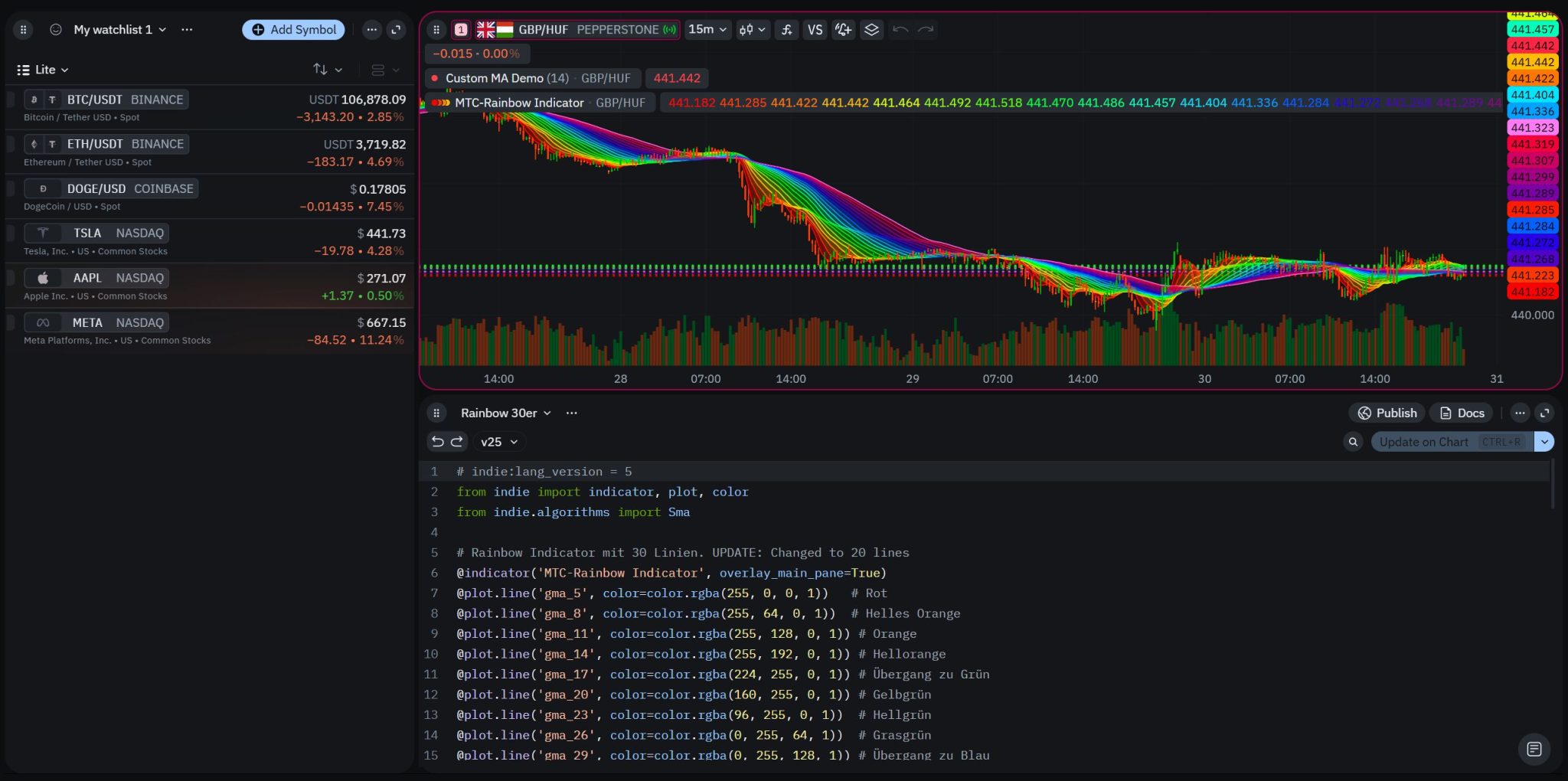
How Python-like syntax and transparent pricing make TakeProfit a compelling alternative for crypto traders and developers
TradingView serves over 100 million traders worldwide with sophisticated charting tools and a massive community library. For developers building custom indicators, however, the platform presents a significant hurdle: Pine Script, a proprietary scripting language requiring substantial time investment to master. While Pine Script is undeniably powerful, it demands that Python developers learn entirely new syntax just to visualize their trading ideas on charts.
This learning curve has sparked growing interest in TradingView alternatives, particularly among Python developers and cryptocurrency traders who spend more time wrestling with unfamiliar syntax than actually developing trading strategies. Enter TakeProfit and its Indie Script language: a crypto-focused trading platform offering Python-like syntax for building custom indicators.
Why Developers Seek TradingView Alternatives
The search for TradingView alternatives stems from three interconnected frustrations: the proprietary language barrier, escalating subscription costs, and platform lock-in concerns.
The Pine Script Learning Investment
Pine Script represents a non-trivial time commitment. Achieving basic proficiency typically requires 20 to 40 hours of focused study – time spent learning syntax rules, debugging proprietary error messages, and mentally translating Python logic into Pine Script conventions. For Python developers who already understand technical analysis concepts and can prototype indicators in pandas or NumPy, this represents pure overhead.
The deeper issue isn’t difficulty – it’s transferability. Pine Script skills remain valuable exclusively within TradingView’s ecosystem. They don’t translate to backtesting frameworks like Backtrader or VectorBT, don’t appear in quantitative finance job descriptions, and offer no advantage when collaborating with data science teams using Jupyter notebooks.
Subscription Economics
TradingView’s tiered pricing creates uncertainty for developers. The platform operates on a structure where features once available in lower plans increasingly migrate to premium tiers. Custom indicator alerts require paid subscriptions, with plans reaching $14.95/month (Essential), $33.95/month (Plus), $67.95/month (Premium), and $239.95/month (Ultimate) when billed monthly. Annual billing offers savings: $12.95/month for Essential, $28.29/month for Plus, $56.49/month for Premium, and $199.95/month for Ultimate – but these costs still exceed many independent developers’ budgets.
The Crypto-Specific Challenge
For cryptocurrency traders specifically, TradingView’s architecture reveals its traditional finance origins. Multi-exchange analysis – comparing Bitcoin prices across Binance, Coinbase, and Kraken simultaneously – requires workarounds. Indicators designed for 9:30 AM to 4:00 PM market hours don’t translate cleanly to 24/7 cryptocurrency trading patterns.

Top TradingView Alternatives Worth Considering
TrendSpider excels in automated technical analysis, using AI to identify chart patterns. It’s particularly valuable for swing traders who need algorithmic assistance spotting setups across multiple timeframes.
Koyfin targets professional analysts with institutional-grade market analysis tools, excelling in fundamental data visualization and comparative analysis across securities.
TakeProfit with Indie Script focuses narrowly on reducing friction for Python developers building custom cryptocurrency indicators. This specialization – Python-like syntax, transparent flat-rate pricing, and multi-exchange crypto data as core features – differentiates it from general-purpose platforms.
Best Alternative to TradingView for Python Developers: Indie
TakeProfit’s value proposition centers on a straightforward premise: developers who already know Python shouldn’t need to invest dozens of hours learning proprietary syntax just to build custom trading indicators.
The Python-Like Syntax Advantage
Indie Script Language isn’t pure Python – it’s a domain-specific language designed for the TakeProfit platform that deliberately mirrors Python’s syntax conventions. Developers can’t import arbitrary Python libraries, but they gain syntax familiarity that dramatically reduces cognitive load during indicator development.
The structure uses Python decorators that any developer will recognize, import statements following standard Python conventions, and type hints providing safety nets when working with financial calculations. Function definitions use the familiar def keyword. Object-oriented patterns match Python’s approach.
Python developers report building their first comprehensive custom (not basic demo) Indie indicator in one to two hours. The equivalent Pine Script learning curve typically spans multiple days as developers absorb not just new APIs but fundamentally different syntax patterns.
Crypto-Native Architecture
TakeProfit’s crypto-native approach manifests in practical ways. Multi-exchange data integration pulls real-time prices from Binance, Coinbase, Kraken, and other major venues simultaneously, enabling cross-exchange arbitrage analysis and volume profiling. The platform assumes 24/7 market operations rather than treating weekend trading as edge cases.
Developer Experience Design
The platform ships with 60+ built-in technical analysis algorithms – SMA, EMA, RSI, MACD, Bollinger Bands, ATR – that serve as both ready-to-use tools and learning examples. The code editor runs entirely in-browser with syntax highlighting and intelligent error checking.
Backward compatibility receives explicit guarantees: indicators written today will function in future platform versions through automatic conversion. Support access includes direct Discord communication with the engineering team rather than ticket-based systems.
Publishing freedom extends even to free tier users: developers can share indicators with the community regardless of subscription status.
TradingView vs TakeProfit: Feature Comparison
| Capability | TradingView | TakeProfit
|
|---|---|---|
| Development Language | Pine Script (proprietary) | Indie Script (Python-like) |
| Primary Market Focus | Multi-asset | Crypto-native with US stock coverage |
| Pricing (Monthly) | $14.95 – $239.95 (tiered) | $0 – $20 (two tiers: free/paid) |
| Annual Cost | $155.40 – $2,399.40 | $0 – $120 |
| Strategy Backtesting | Built-in Strategy Tester | In development |
| Community Size | 100+ million users | Smaller, growing community |
| Multi-Exchange Data | Limited | Native support |
| Custom Indicators | Two indicators are available on the free plan and 5-50 on paid plans | Two indicators are available on the free plan and unlimited on paid plans |
Where TradingView Maintains Advantages
TradingView’s community of over 100 million users has generated thousands of publicly available indicators and strategies, creating an extensive knowledge base. The built-in Strategy Tester provides comprehensive backtesting capabilities that serious algorithmic traders require. Chart functionality depth reflects years of refinement.
The pricing spectrum offers entry points for various budgets. The Essential plan at $14.95 monthly (or $12.95 monthly when billed annually) is comparable to TakeProfit’s paid tier, making it accessible for price-sensitive traders needing basic paid features.
Where TakeProfit Offers Compelling Alternatives
TakeProfit’s advantages emerge most clearly for Python developers building crypto indicators who value rapid prototyping over extensive feature sets. The Python-like syntax reduces time-to-productivity dramatically – from weeks to hours.
Pricing transparency eliminates subscription creep concerns. At $20 monthly ($120 annually), TakeProfit’s all-inclusive pricing means no features migrate to higher tiers. The crypto-native architecture delivers practical advantages for cryptocurrency-focused traders, with multi-exchange data as foundational infrastructure rather than an afterthought.
Honest Limitations
The absence of built-in backtesting represents the most significant current limitation. While Indie Script excels at indicator visualization and real-time analysis, developers cannot yet define strategy entry and exit rules or run historical simulations within the platform.
Community library size reflects TakeProfit’s relative youth. TradingView’s ecosystem contains thousands of publicly shared indicators, while TakeProfit’s smaller user base means fewer examples available.
Market coverage focuses deliberately on cryptocurrency with US stock support as secondary functionality. International exchanges, forex pairs beyond crypto-fiat crosses, and futures contracts receive limited coverage.
When TradingView Remains Better
Developers should consider remaining with TradingView if they need comprehensive strategy backtesting immediately, if their trading focuses primarily on traditional assets rather than cryptocurrency, or if they require access to TradingView’s massive community script library.
Similarly, traders already proficient in Pine Script who have invested dozens of hours mastering the language should carefully weigh switching costs against potential benefits.
When TakeProfit Makes Strategic Sense
TakeProfit fits naturally for Python developers entering algorithmic cryptocurrency trading who want to leverage existing skills rather than invest weeks learning proprietary syntax. Traders frustrated by subscription cost uncertainty find TakeProfit’s flat $20 monthly rate refreshingly predictable – total annual costs won’t exceed $120 (if paid annually) or $240 (if paid monthly).
Cryptocurrency specialists who need multi-exchange analysis and native understanding of crypto market microstructure find TakeProfit’s architecture aligned with their operational reality.

Getting Started
The platform’s free tier provides full indicator development capabilities. Visit TakeProfit.com, create an account (no credit card required), and add the “Indicators Code Editor” widget to your workspace. The browser-based editor provides syntax highlighting and real-time error checking.
Start with a simple indicator – a basic moving average – to experience how Python-like syntax feels. The platform documentation at docs.takeprofit.com includes quick-start tutorials and comprehensive library references covering all 60+ built-in algorithms.
Budget 30 minutes understanding the platform’s interface and one hour building your first indicator. This two-hour investment provides sufficient experience to judge whether syntax familiarity meaningfully accelerates development compared to Pine Script.
Conclusion
TakeProfit’s bet on Python-like syntax, crypto-native architecture, and transparent flat-rate pricing addresses real frustrations that Python developers experience when building cryptocurrency indicators. For this specific intersection – developers who know Python, trade crypto, and prioritize rapid prototyping – the platform delivers measurable advantages in learning curve reduction and development speed.
However, specialization inherently means trade-offs. Current limitations around backtesting, smaller community libraries, and crypto-focused market coverage make TakeProfit unsuitable for traders requiring comprehensive strategy validation or broad asset class access.
The best alternative to TradingView depends entirely on individual circumstances. For Python developers curious whether familiar syntax genuinely matters for indicator development speed, investing two hours exploring TakeProfit’s free tier provides concrete experience worth more than comparative analysis.
Explore TakeProfit at takeprofit.com and evaluate whether Python-like indicator development aligns with your cryptocurrency trading workflow.